

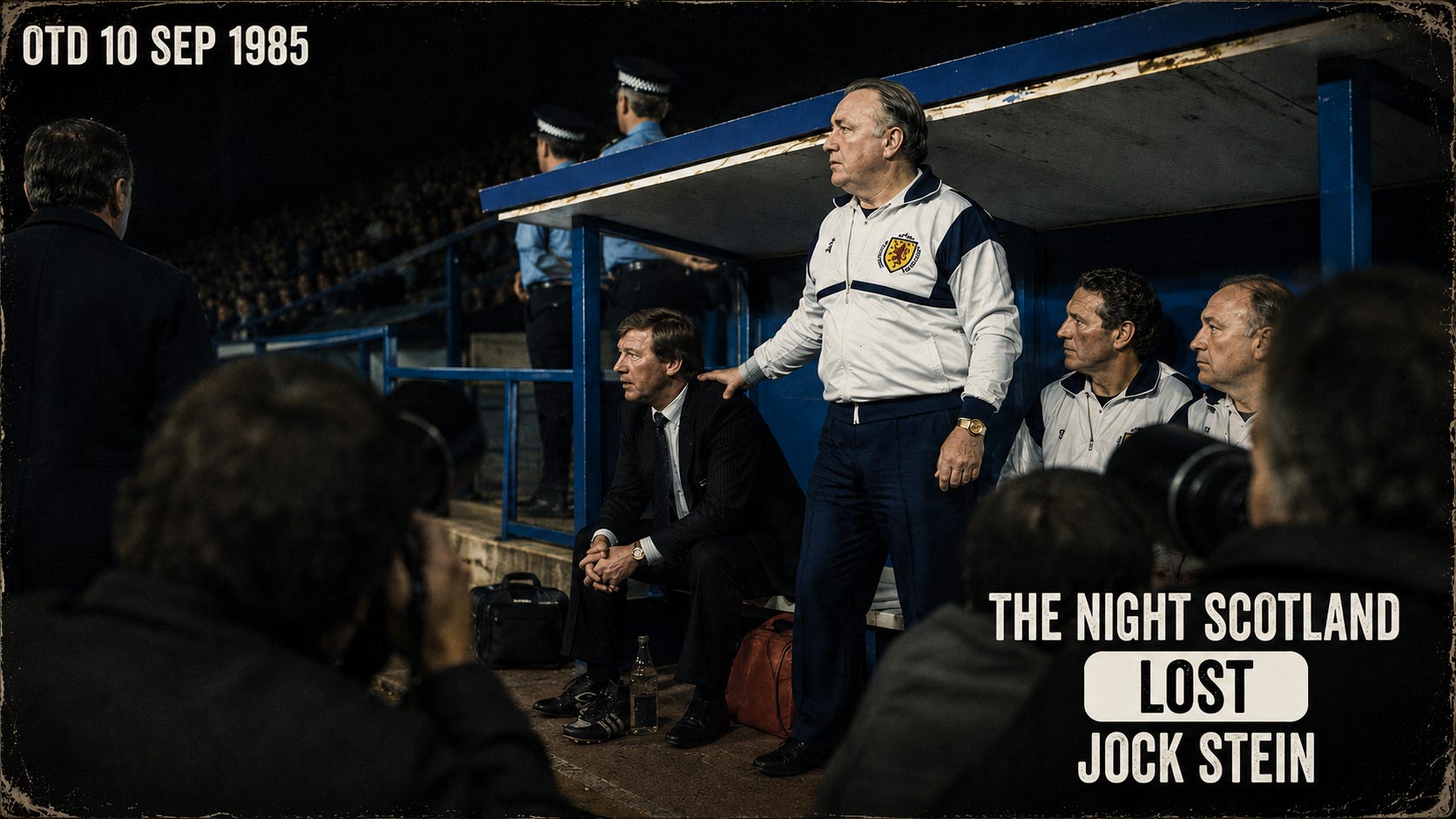
It is September 10, 1985, at Ninian Park in Cardiff, with nine minutes left and Wales leading Scotland 1-0. For Wales, victory keeps alive the dream of a first World Cup since 1958; for Scotland, a draw keeps their road to Mexico open. Scotland’s manager, Jock Stein, has already made what will be the final substitution of his career, sending on Davie Cooper for Gordon Strachan. Now Scotland win a penalty, Cooper steps up and scores, and it is 1-1. Stein’s decision has worked. Minutes later, close to the final whistle, he collapses beside the dugout. The result survives the night. The manager does not.
The two countries came to Cardiff from opposite directions. Scotland had become World Cup regulars, at three consecutive finals in 1974, 1978 and 1982, so qualifying almost felt automatic. Wales knew the opposite feeling. Their only World Cup appearance had come in 1958, and since then qualification kept finding new ways to hurt them, often with Scotland involved. In 1977, the sides met in a decisive qualifier at Anfield, and Scotland were awarded a late penalty for handball, except the television pictures showed the offending hand belonged to Scotland’s own Joe Jordan. Scotland won and went to Argentina. Four years later, Wales missed the 1982 finals on goal difference. So when the 1986 draw paired them again, there was history in the room.
Both sides arrived level on six points, with Scotland holding the better goal difference, so Wales had to win and Scotland needed only the draw. On the Scottish touchline stood one of the most important managers Britain has produced. Jock Stein had been born into a Lanarkshire mining family and worked as a coal miner himself before a modest playing career and then management. At Celtic, from 1965, he changed British football: league titles, cups, nine championships in a row, and, above all, Lisbon in 1967, where his Celtic side came from behind to beat Internazionale and become the first British club to win the European Cup, a team built almost entirely from footballers born around Glasgow. He was stubborn, commanding and obsessed with the game, the sort of man who, months after Lisbon, insisted his players finish a violent Intercontinental Cup series in South America when some wanted to walk away. By 1985 he was managing Scotland, with a rising young Aberdeen manager, Alex Ferguson, as his assistant and something close to a pupil.
Around 39,500 were inside Ninian Park, some 12,000 down from Scotland, who were missing several major players. In the thirteenth minute Mark Hughes put Wales ahead, and the equation could hardly have been clearer: Wales heading toward a play-off, Scotland heading out. Then, at half-time, came a detail that could only belong here. Scotland’s goalkeeper, Jim Leighton, had lost a contact lens and had no spare, so Alan Rough had to replace him. With only two substitutions permitted, Stein had just lost half of his tactical flexibility to a contact lens.
Just after the hour, Stein spent his last substitute, and it raised eyebrows: off came Strachan, one of Scotland’s biggest attacking names, and on came Cooper, a beautiful left-footed footballer but not the obvious percentage choice. Scotland improved anyway. Then, with nine minutes left, a shot struck the Welsh defender David Phillips on the arm, and the Dutch referee pointed to the spot. To Welsh supporters it must have felt like 1977 all over again: Scotland, a handball, a penalty, a World Cup place. Cooper drove it low, Neville Southall got a hand to it but not enough, and Scotland were level. Stein’s substitution had scored the goal his team needed.
Now Wales had to find another, and Ninian Park was frantic. Photographers gathered around the Scottish bench, expecting to capture the moment Scotland secured the result, and Stein grew irritated by the crush. Then, close to the end, the referee blew for an infringement, Stein seemed to think it was full-time, got up, turned toward the Wales manager, and collapsed. At first nobody understood what they had seen. The final whistle followed, the Scottish players and supporters celebrated a 1-1 draw that kept them alive, and beneath the stand Jock Stein was being treated in the medical room. The doctors could not save him. He died at the stadium, aged sixty-two, while thousands above him celebrated a result without knowing that the man who had delivered it was gone.
The qualification story finished quietly. The draw guaranteed Scotland would finish above Wales, and after Spain later beat Iceland, Scotland took second and a play-off place while Wales went out, once again, on goal difference. This Welsh generation, with Southall, Rush and Hughes, was good enough to make you wonder, yet they would not return to a World Cup for another thirty-seven years, until 2022. Scotland still had a play-off against Australia, and it fell to Alex Ferguson to take over from the man he had been learning from and see them through to Mexico. Ferguson would go on to change British football all over again, and later described Stein as an education in himself, a university in one man. Perhaps that is the best way to remember him: not as the manager who died beside a pitch, but as the miner who became a European champion, took Celtic from Glasgow to Lisbon, and, one last time in Cardiff, made a substitution and was proved right.
---
🎧 Listen on Spotify, Apple Podcasts, Amazon Music, Overcast, iHeart, and YouTube.
📩 Got an episode idea? otd@17lawsguy.com
Yesterday: 9 September 2006, the champions of Italy begin life in Serie B.
Tomorrow: 11 September 1927, a skinny 17-year-old debuts for Inter, the day quantum physics comes to the same city.
Man, what a story. Thousands celebrating the result above while Stein was being treated beneath the stand is such a haunting image. Then Ferguson having to take over from the man he’d been learning from afterward. Football history has some incredible intersections like this. Really enjoyed this one.
I remember seeing a Rangers v Celtic game - I think it was 1966 - and was blown away by Stein’s Celtic. It was the first time I had seen a team transition out of defense to attack at speed. It was a whirlwind. I telephoned my father directly after and I remember saying ‘I’ve seen the future of football!”