

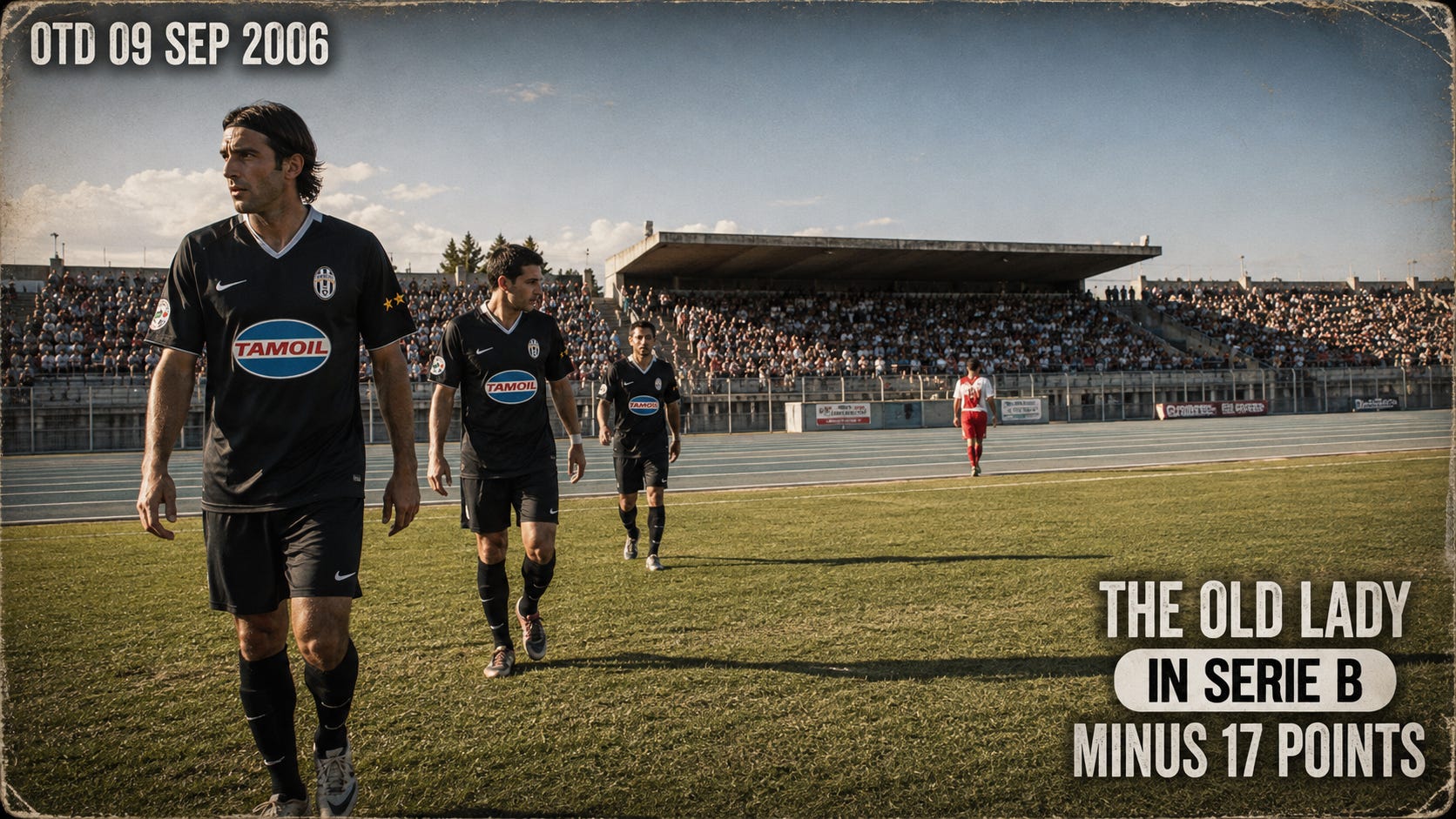
It is September 9, 2006, at the Stadio Romeo Neri in Rimini, and about ten thousand people are watching something that has never happened before. On one side is Rimini, in only their second season in Serie B, with a young Samir Handanović in goal. On the other is Juventus: Gianluigi Buffon, Giorgio Chiellini, Pavel Nedvěd, Alessandro Del Piero, champions of Italy just four months earlier, and now, for the first time in their history, a Serie B club. Stranger still, they begin the afternoon on minus seventeen points. Surely the great Old Lady simply strolls through Rimini and starts digging herself out. Not quite.
Italian football has a long vocabulary for scandal. In 1980 came Totonero, a betting scandal that saw police enter stadiums, players arrested, and Milan and Lazio sent down to Serie B, and a second version followed only six years later. Italy keeps producing magnificent football, and periodically discovers that someone has been interfering with the uncertainty that makes it worth watching. In 2006 the scandal had a new name, Calciopoli, and it was different in kind. The central allegation was not players taking money to lose. It was power. Luciano Moggi, Juventus’s director general and one of the most influential men in the Italian game, was caught on intercepted telephone calls in conversations with officials involved in referee appointments: who got which referee, who was considered friendly, who was difficult. Nothing proved that specific results were bought. The problem was a club executive appearing to influence machinery that was supposed to be neutral. When the recordings became public, the Juventus board resigned, and investigations spread to Milan, Fiorentina, Lazio and others.
Juventus were not just another big club caught up in it. Founded in 1897, tied to the Agnelli family since 1923, they were the most successful club in Italian championship history, European champions in 1985 and 1996, home over the years to Boniperti, Sívori, John Charles, Platini, Baggio and Zidane. They had known defeat and tragedy and scandal, but never Serie B. And the timing was surreal. On July 9, 2006, Italy beat France to win the World Cup, with eight Juventus players on the pitch across the two sides. Five days later, sporting justice sent their club down. The first verdict was Serie B, minus thirty points, and the last two championships stripped. On appeal, Fiorentina and Lazio were restored to Serie A and Juventus’s deduction was cut to minus seventeen, but the relegation stood.
Suddenly one of the most expensive squads in world football had a second-tier balance sheet, and the club’s revenue would fall by tens of millions. The squad broke open. Fabio Capello left for Real Madrid, taking Fabio Cannavaro with him; Gianluca Zambrotta and Lilian Thuram went to Barcelona; Patrick Vieira and then Zlatan Ibrahimović went to Inter. But an extraordinary core stayed. Del Piero, Buffon, Mauro Camoranesi, David Trezeguet and Nedvěd. Buffon, perhaps the best goalkeeper in the world at twenty-eight, could have gone almost anywhere, and chose Serie B. And Juventus turned to another former captain, Didier Deschamps, with a beautifully simple brief: get us out.
Serie B taught them a lesson immediately. Nobody wanted to be a supporting act in Juventus’s redemption story. For every opponent, this was not round one of a season; it was Juventus coming to town, a full house, and the chance of a story to tell forever. Juventus were effectively entering forty-two cup finals. At Rimini the first half finished goalless. Then, midway through the second, Matteo Paro drove in a loose ball for the first Serie B goal in Juventus history. Rimini went down to ten men soon after, and the match looked over, until a defensive error let Adrián Ricchiuti through to equalize past Buffon. Ten-man Rimini had drawn with Juventus, whose reward for their first Serie B point was to sit on minus sixteen. The Gazzetta called it the start of Juventus’s road of suffering.
The suffering did not last long, because this was still Juventus. In October the penalty was cut again, to minus nine, and on the field they began winning, sealing promotion with three matches to spare and finishing top of Serie B with Del Piero as the division’s leading scorer. One season down, one straight back up. There was a delicious Italian footnote: Milan, sanctioned in the same summer but allowed to stay in Serie A, won the 2007 Champions League. The full recovery was not instant, with some uneven seasons before Andrea Agnelli, a new stadium and Antonio Conte produced a run of nine straight titles from 2012.
Calciopoli’s longest shadow, though, is an argument about counting. Juventus wear a gold star above the crest for every ten titles, a tradition the club itself created. Sporting justice removed two championships from their official count, so when they won again in 2012 the club insisted it was their thirtieth on the field while the federation’s arithmetic said twenty-eight, and Juventus printed “30 sul campo”, thirty on the field, on the shirt in protest. A tiny symbol became a question about who gets to count history: the club, the supporters, or the governing body. And no, 2006 did not cleanse Italian football, because further betting and match-manipulation investigations followed. Whatever the mechanism, every one of these scandals attacks the same fragile thing: the belief that the result has not been arranged in advance.
---
🎧 Listen on Spotify, Apple Podcasts, Amazon Music, Overcast, iHeart, and YouTube.
📩 Got an episode idea? otd@17lawsguy.com
Yesterday: 8 September 1888, the day football got a season.
Tomorrow: 10 September 1985, a World Cup qualifier in Cardiff that Scotland won, and could not celebrate.