

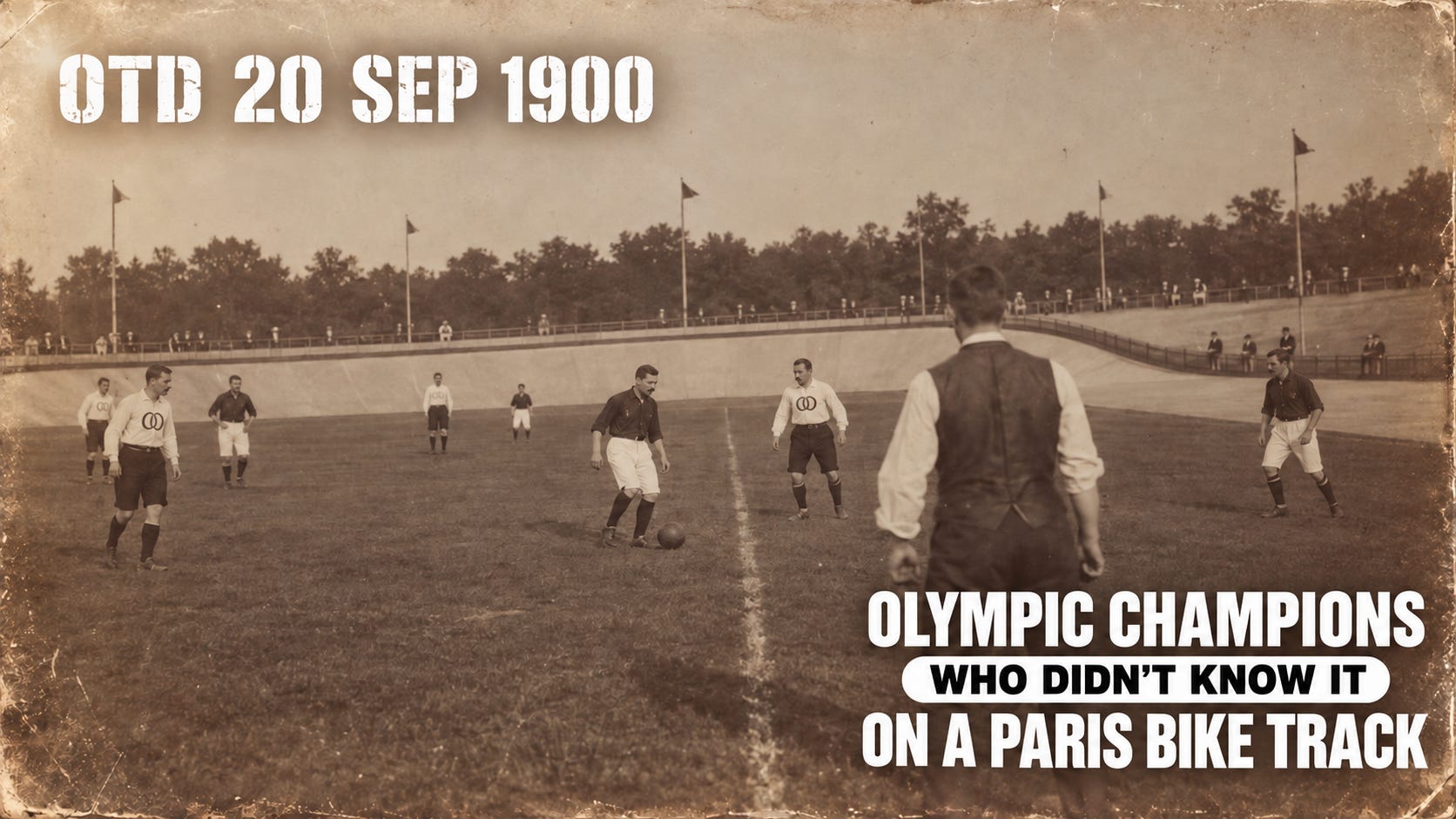
It is September 20, 1900, in Paris, and about five hundred people at the Vélodrome de Vincennes are watching an English amateur club called Upton Park play the French champions, Club Français. John Nicholas scores twice, Richard Turner and Jack Zealley add the others, and Upton Park win 4-0. Today this is recognized as the first football match at an Olympic Games. Upton Park are listed as Olympic champions. Great Britain are credited with the gold medal. Except Upton Park were not a British national team, this was not a conventional tournament, nobody received an Olympic medal, and many of the players may not even have known they were competing in the Olympics at all.
How did we get here?
The first modern Olympics were held in Athens in 1896. Football was discussed during the planning but left off the final programme, which ought to settle the matter: no football in 1896, first Olympic football in Paris in 1900. But later accounts introduced another possibility, claiming an unofficial match had been played in Athens between a Greek team and a Danish selection. Some gave the score as 9-0, others as 15-0; some added a team from Smyrna; a few even described Denmark as the first Olympic football champion. The story acquired players, a venue and thousands of spectators. Yet it has a fundamental problem: no contemporary source from the 1896 Games reliably documents any such match. The detailed official report does not mention it, the surviving programme does not include it, the newspapers of the day do not report it, and researchers have found no secure match report, team list or result produced in 1896. The Olympic historians Bill Mallon and Volker Kluge investigated the claim in detail and concluded that no such match took place.
The likely explanation is historical cross-contamination. Football definitely was played in Athens, but in 1906, at the Intercalated Games, where a Danish selection led an Athens team by nine goals at half-time and the Greeks did not return for the second half. Over time, pieces of that documented 1906 story appear to have migrated backwards into 1896: Athens, a Danish team, nine goals, an unusual Olympic status. The responsible conclusion is that football may have been proposed for Athens in 1896, but there is no solid contemporary evidence that a match was actually played. That makes September 20, 1900, the earliest secure starting point.
But Paris 1900 brings a different problem: what exactly counted as an Olympic event? The Games had been swallowed by the enormous Exposition Universelle, the World’s Fair, and sport was only one part of an international exhibition celebrating technology, industry, culture and imperial power. The competitions stretched across roughly five months. There was no single Olympic stadium, no opening ceremony resembling the modern version, no athletes’ village. Many events were run by separate sporting bodies under the exposition’s umbrella, and some competitors apparently left Paris without ever realizing that later generations would call them Olympians. The official name used at the time was not simply the Olympic Games; these were international contests of physical exercise and sport associated with the exposition. That ambiguity shaped the football.
France’s amateur governing body, the USFSA, entered Club Français, champions of Paris and one of the leading French clubs of the period. Belgium was represented by a selection largely drawn from the Université Libre de Bruxelles. And Britain sent Upton Park Football Club, not West Ham United, a distinction that matters. West Ham were still known as Thames Ironworks until the summer of 1900 and only later played at a ground popularly called Upton Park; the Olympic club was an entirely separate and older organization, founded in east London in the 1860s, committed amateurs who had entered the very first FA Cup and twice won the London Senior Cup, but who were not among England’s leading teams in 1900. They did not win a national qualifying tournament. They were not chosen through anything resembling a modern Olympic process. They were available, amateur and willing to travel, and even then the team was reinforced by players from other clubs: a soldier on leave from Chelmsford, men associated with Ilford, Crouch End Vampires and Bridport. They travelled as Upton Park and, by extension, as the British representatives.
At Vincennes they lined up in the standard 2-3-5 of the day, and Club Français could not turn home advantage into control. Nicholas scored twice, Turner and Zealley once each, and Upton Park won 4-0. That was the entirety of their Olympic campaign: one match, four goals, no final. Three days later Club Français beat the Belgian selection 6-2, and Belgium never faced Upton Park at all. There was no completed round-robin table, no gold-medal match. Britain had beaten France, France had beaten Belgium, and the sequence produced an obvious hierarchy but not a tournament structure we would recognize: Upton Park first, Club Français second, the Belgians third. No Olympic gold, silver or bronze was awarded for football that day; the winners received the kind of prizes attached to the exposition’s sporting competitions. The familiar medal table was imposed later, when historians and the Olympic movement reconstructed Paris 1900 and translated Upton Park’s win into Great Britain gold, Club Français into France silver, and the Belgians into bronze. That is why modern records say Great Britain won the first Olympic football tournament. It is administratively convenient, and historically it requires explaining, because the winner on the field was not Team GB. It was Upton Park FC and several invited amateurs, a side that represented no unified British association, that Scotland, Wales and Ireland had no hand in selecting, and that was never handed a gold medal on the afternoon.
So what?
The first thing is that the match shows how misleading a clean historical table can be. A database gives you Great Britain gold, France silver, Belgium bronze, and it looks precise, implying national teams, a formal tournament and a medal ceremony. None of those assumptions is quite accurate. The table is not false, exactly, but stripped of context it tells a different story from the one the participants actually lived. It is a useful warning about every tidy row of results we inherit: the neatness is often imposed afterward, and the reality underneath was messier, more improvised and more human than the row of medals will ever admit. The cleaner the record looks, the more worth asking how it got that way.
The second thing is that the match captures football before international representation had been standardized. There was no FIFA yet; it would not be founded until 1904. National associations existed, but no settled system governed a world tournament, so a club could represent a country, a university selection could represent another, and players could be gathered from several clubs and placed under a single name. The boundary between club football and international football was still porous, and it stayed that way through the early Olympics. Only in London in 1908 did the tournament begin to look like a contest between official national selections, with England entering a genuine national amateur side, as Great Britain, and the modern idea of one country, one team taking hold. What happened in Paris was closer to an invitational between whoever could be persuaded to turn up: a French champion club, a Belgian university, and a travelling band of English amateurs. The tidy phrase first Olympic football tournament hides just how experimental and unfinished the whole concept of representing a nation still was.
The third thing is that football’s Olympic beginning started a long struggle over who owned the sport’s greatest international competition. The Olympics eventually gave football its first genuinely global stage, and Uruguay’s victories in 1924 and 1928 showed the world the power of South American football. But the Olympic insistence on amateurism increasingly clashed with a sport turning professional, and football eventually outgrew the Games: FIFA created its own world championship, and the first World Cup followed in 1930. Olympic football continued, but it was no longer the summit. That enormous institutional story begins with something very small, an extinct east London amateur club, a Parisian champion, five hundred spectators and four unanswered goals at a velodrome.
Three things to take away
First, the earliest securely documented football match now recognized as Olympic was played on September 20, 1900. Upton Park beat Club Français 4-0 in Paris.
Second, the supposed 1896 match in Athens is unsupported by reliable contemporary evidence. It was probably invented by later confusion with the documented football tournament played in Athens in 1906.
Third, Upton Park’s Olympic championship is retrospective. They competed as a club, played once, and received no Olympic gold at the time; only later were Upton Park, Club Français and the Belgian selection translated into Great Britain, France and Belgium on the medal table.
On this day in 1900, Olympic football began at a velodrome in Paris, although almost nobody involved that afternoon would have described it quite that way.
---
📩 Got an idea to an OTD story? otd@17lawsguy.com
Yesterday: 19 September 1926, Milan open San Siro and Inter score six.
Tomorrow: 21 September 1949, England lose at home to a “foreign” team for the first time, and even that first comes with an Irish complication.
Interesting! This reminds me a bit of the story of the 1924 Winter Olympics. They were actually organized as "International Winter Sports Week", not as Olympics. Two years later, in 1926, the IOC decided to retoactively recognize them as the first official Olympic Winter Games...