

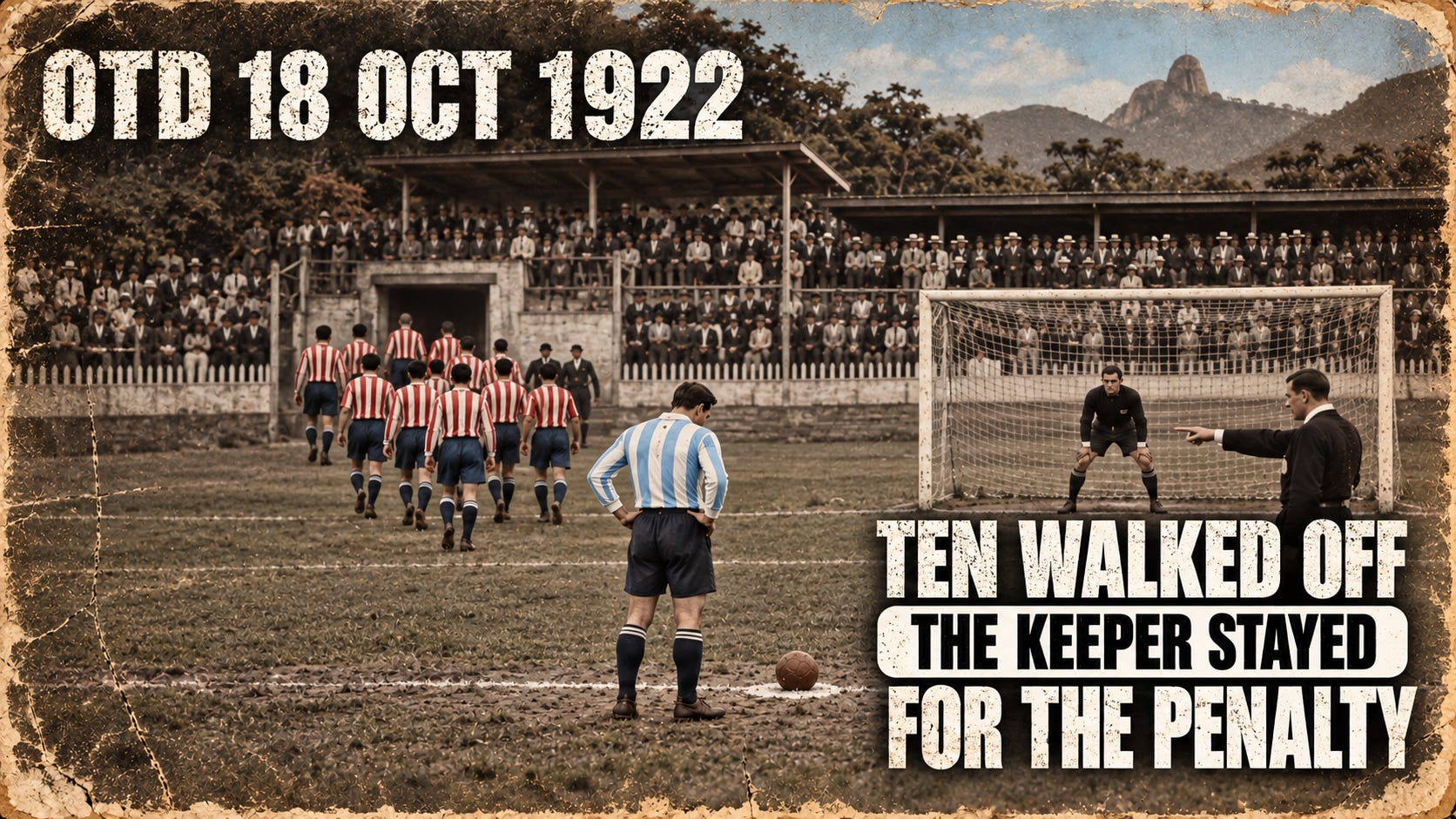
On October 18, 1922, Paraguay stood one draw from becoming champion of South America for the first time. Then Argentina scored. Then a Brazilian referee awarded Argentina a penalty. Ten Paraguayan players walked off the field in protest.
One man stayed.
Modesto Denis, Paraguay’s goalkeeper, remained on his line at Rio de Janeiro’s Laranjeiras ground. Juan Francia placed the ball on the spot. Around them was the shape of a football match without the substance of one: a referee, an Argentine penalty taker, and a goalkeeper abandoned by his teammates.
Francia converted. Argentina led 2-0. The match was abandoned, but the result stood.
That score did not make Argentina champion. It did something more complicated. It stopped Paraguay winning the title outright and created a three-way tie with Brazil and Uruguay. The tournament that we now call the Copa America would be decided by administrative choices, a withdrawal, and one final match between the host nation and the team whose players had just walked away.
This was not merely a tantrum at the end of an old football match. It was an early collision between officiating, national interest, protest, and the question every competition eventually has to answer: what happens when a team decides the referee has made the game illegitimate?
How did we get here?
South America’s international championship was young enough to feel experimental and old enough to have rivalries. The first edition had been played in Argentina in 1916, during celebrations of the centenary of Argentine independence. The same gathering helped produce CONMEBOL, founded by Argentina, Brazil, Chile, and Uruguay. It was the world’s first continental football confederation.
The competition was formally the South American Championship. The Copa America name came much later, but the historical line is direct. Uruguay won three of the first five editions. Brazil won at home in 1919. Argentina finally took its first title in 1921.
Paraguay joined CONMEBOL in 1921 and entered the championship that year. Its debut announced that this would not be a ceremonial addition. Paraguay beat Uruguay 2-1 in its first match in the competition before finishing fourth. The team returned in 1922 knowing it could trouble the old powers, but still looking for a first title.
The sixth championship took place in Rio de Janeiro as Brazil marked 100 years of independence. Every member of CONMEBOL entered: Argentina, Brazil, Chile, Paraguay, and Uruguay. All matches were played at Fluminense’s Laranjeiras ground. A win brought two points, a draw one, and tied teams at the top were required to play off. Goal difference could describe what had happened. It could not crown the champion.
The tournament unfolded slowly, from September into October, and almost immediately refused to follow the host nation’s plan. Brazil opened with three consecutive draws: 1-1 against Chile, 1-1 against Paraguay, and 0-0 against Uruguay. A team that had expected to celebrate the centenary with a trophy was still unbeaten, but it had spent three matches dropping points.
Paraguay was building something more dangerous. After drawing Brazil, it beat Chile 3-0. Then, on October 12, it defeated Uruguay 1-0. That match was refereed by a Brazilian, Pedro Santos, and Uruguay was furious about his work, including disallowed goals. The anger would matter later.
Argentina’s campaign moved in the opposite direction. The defending champion began by beating Chile 4-0, with Juan Francia among the central figures. But Argentina then lost 1-0 to Uruguay and 2-0 to Brazil. The Argentine game was also divided at home. A federation split had placed clubs such as River Plate, Racing, Independiente, and San Lorenzo outside the official association that selected the national side. Argentina still had talent, but not access to every leading player in the country.
Juan Francia was one of those it did have. Nicknamed El Monito, he was a Rosario Central forward whose movement and scoring made him Argentina’s most productive attacker in Rio. He scored four times and finished as the tournament’s leading scorer.
By October 18, the arithmetic had become extraordinary. Uruguay had completed its four matches with five points. Brazil’s victory over Argentina had also taken the host to five. Paraguay had five points with one match still to play.
Paraguay therefore needed only a draw against Argentina to finish on six and win the championship outright. Argentina could not win the title. Brazil and Uruguay needed Argentina to win for the tie to survive.
That made the referee appointment combustible. Enrique Vignal was Brazilian. His nationality did not prove that he would favor any team, and nationality alone cannot tell us whether a decision was correct. But the institutional conflict was obvious. A Paraguayan defeat directly benefited Brazil, the referee’s country, by keeping Brazil in the competition.
Early South American tournaments did not possess today’s expectation of a large, internationally managed pool of neutral elite officials. Referees regularly came from participating nations, and the same individual might handle multiple matches. Yet 1922 showed why perceived neutrality matters almost as much as personal honesty. Pedro Santos had already angered Uruguay. Now another Brazilian would control the match that could eliminate Brazil.
Eight thousand spectators gathered at Laranjeiras. Argentina selected Américo Tesoriere in goal and a side that included Alfredo Celli, Ludovico Bidoglio’s era peers, Juan Francia, and forwards determined to rescue a disappointing campaign. Paraguay’s team included captain Manuel Fleitas Solich, later one of South America’s important coaches, and Denis in goal.
The first half finished 0-0. For Paraguay, that was enough. Another 45 minutes without conceding and the championship belonged to them.
In the 63rd minute, Francia scored. Argentina led 1-0. Paraguay now needed an equalizer to recover the title it had been holding at halftime.
Then came the 79th minute. Vignal awarded Argentina a penalty. The Paraguayan players believed the decision was wrong. Their protest became collective refusal. Ten outfield players left the pitch. Denis did not.
Perhaps the goalkeeper believed his duty was different. Perhaps he hoped to save the kick and preserve the chance of a draw. Perhaps the pause between protest and abandonment simply left him in the loneliest position in football. Whatever his reasoning, the scene distilled the entire dispute into two men.
Francia took the penalty. Denis faced it. Francia scored his second goal of the match and his fourth of the tournament.
There was no meaningful game left to play. The match was abandoned with Argentina 2-0 ahead. Paraguay’s walk-off had expressed absolute rejection of the referee’s authority, but it had not erased the referee’s decisions. CONMEBOL allowed the score to stand.
So what?
The immediate consequence was mathematical. Brazil, Uruguay, and Paraguay all finished with five points. Under the tournament regulations, they were supposed to settle the championship through playoffs.
But Uruguay had reached its own breaking point. Its federation protested the refereeing in the defeat by Paraguay, objected to the Brazilian officials, and withdrew rather than continue. A three-way playoff became one match between Brazil and Paraguay.
For Paraguay, this produced an agonizing choice. Its players had just walked out of a match controlled by a Brazilian because they believed the competition had become unfair. Now the federation could follow Uruguay out, surrendering the chance of a first title, or accept a decisive match against Brazil. In Brazil.
So Paraguay stayed.
The playoff returned the teams to Laranjeiras. This time the referee was Argentine, Servando Perez, a conspicuous answer to the neutrality problem. Twenty thousand people watched. Brazil struck early through Neco in the 11th minute. Formiga made it 2-0 soon after halftime, then scored again near the end. Brazil won 3-0 and claimed its second South American championship.
The path to that title could not be separated from October 18. Had Paraguay drawn Argentina, there would have been no playoff. Had the abandonment voided the result, ordered a replay, or produced a different sanction, the championship might also have taken another path. Instead, Argentina’s 2-0 victory remained in the table, Uruguay removed itself, and Brazil took the opportunity that followed.
Paraguay was left with perhaps the cruellest kind of near miss. It had beaten Uruguay, drawn Brazil, and needed one point from an Argentina side already out of contention. At halftime it had the point. By the 79th minute, its players had decided that leaving the field was preferable to continuing under Vignal. The federation then continued in the tournament anyway, and the team lost the playoff decisively.
There is no reliable surviving record of sweeping individual bans or fines for the Paraguayan players, Denis, or Vignal. That absence should not be mistaken for absence of consequence. Paraguay lost control of its sporting destiny. Uruguay surrendered its place in the title playoff. The championship’s credibility was damaged by repeated accusations that Brazilian referees had influenced a tournament Brazil was trying to win.
Paraguay would wait 31 years for its first South American title, finally winning in 1953. Its second came in 1979. The country that had been one draw from glory in 1922 became an established football nation, produced great players and coaches, and reached World Cups. But the lonely image of Denis remained attached to its first great championship opportunity.
For the competition itself, 1922 was not followed by one neat reform carrying the label “the Paraguay rule.” Football governance rarely develops so cleanly. Neutral refereeing became more important as international competitions grew. Regulations became more explicit about abandonment, refusal to play, forfeits, protests, and the authority that decides a match’s status. Organizers also gained more options than the 1922 championship possessed: independent disciplinary bodies, formal appeal routes, predetermined tiebreakers, and clearer procedures for suspending and resuming games.
The essential distinction is still the same. The referee decides what happens on the field, including whether play is stopped, suspended, or abandoned. The competition decides what the abandonment means. A score can stand. A match can be replayed. A team can forfeit. Players and officials can be punished. The same act of walking away can therefore produce several layers of consequence.
At the 1920 Olympic final, Czechoslovakia walked off after 39 minutes while trailing Belgium 2-0. The Czechoslovaks protested the referee and the dismissal of Karel Steiner. Their protest was rejected, they were disqualified, and Belgium received the gold medal.
In 1989, Chile left the Maracana after goalkeeper Roberto Rojas fell bleeding beside a flare. The apparent safety crisis was a deception: the flare had not struck him, and Rojas had cut himself with a hidden blade. FIFA awarded Brazil a 2-0 win, banned Rojas for life, and excluded Chile from qualifying for the 1994 World Cup.
Then, in January 2026, the Africa Cup of Nations final produced a startling modern echo. Senegal’s players left the field for roughly 14 minutes after Morocco received a late penalty. Captain Sadio Mane helped persuade them to return. Brahim Diaz failed with the kick, Senegal won 1-0 in extra time through Pape Gueye, and the trophy was initially theirs.
The consequences kept changing after the stadium emptied. CAF first imposed bans and heavy fines while leaving the result intact. Its Appeal Board then ruled that Senegal had forfeited by leaving the field, replaced the result with a 3-0 win for Morocco, and transferred the title. Senegal appealed to the Court of Arbitration for Sport. As of the date of this article, CAS’ “reasoned decision” is pending.
That live dispute is why October 18, 1922 still feels modern. A century of denser regulations has not removed the fundamental tension. If a team returns and the referee completes the match, should a later tribunal still declare a forfeit? Does allowing play to resume cure the refusal, or merely postpone its legal consequences? How severe must punishment be to protect the referee’s authority without pretending that every protest is morally identical?
Paraguay’s walk-off offers no perfect answer. The Brazilian appointment created a genuine appearance problem. That does not prove the penalty was wrong. The protest may have been understandable, but leaving the field did not improve Paraguay’s position. It converted suspicion into an irreversible sporting risk.
The deepest consequence was therefore not a new clause in a rulebook. It was a lesson the sport has had to relearn. A team can reject a decision. It can file a protest. It can demand institutional reform. But once its players walk away, they hand enormous power to the very authorities they no longer trust.
Three things to take away
First, Paraguay entered October 18 needing only a draw to become South American champion. Argentina’s 2-0 win did not win Argentina the tournament. It denied Paraguay an outright title and created a three-way tie with Brazil and Uruguay.
Second, the referee issue was structural as well as personal. Enrique Vignal was Brazilian, and Brazil directly benefited from Paraguay losing. That did not prove bias, but after Uruguay’s complaints about another Brazilian referee, it made confidence in the competition almost impossible to preserve.
Third, walking off never ends the argument. It moves the argument from the field into committee rooms, disciplinary judgments, and appeals. Czechoslovakia in 1920, Paraguay in 1922, Chile in 1989, and Senegal in 2026 all left the pitch. Their motives and punishments were different, but each discovered that refusing to continue gives someone else the power to write the result.
On This Day, October 18, 1922, ten Paraguayan players walked away from a penalty they believed should never have been awarded. Modesto Denis stayed. Juan Francia scored. Argentina’s 2-0 victory stood, Paraguay’s first title slipped away, and a disputed match opened the door for Brazil to become champion.
Ideas, corrections, or your own football-history leads: otd@17lawsguy.com
Yesterday: E0351 - The Day Leeds City Died and Leeds United Was Born.