

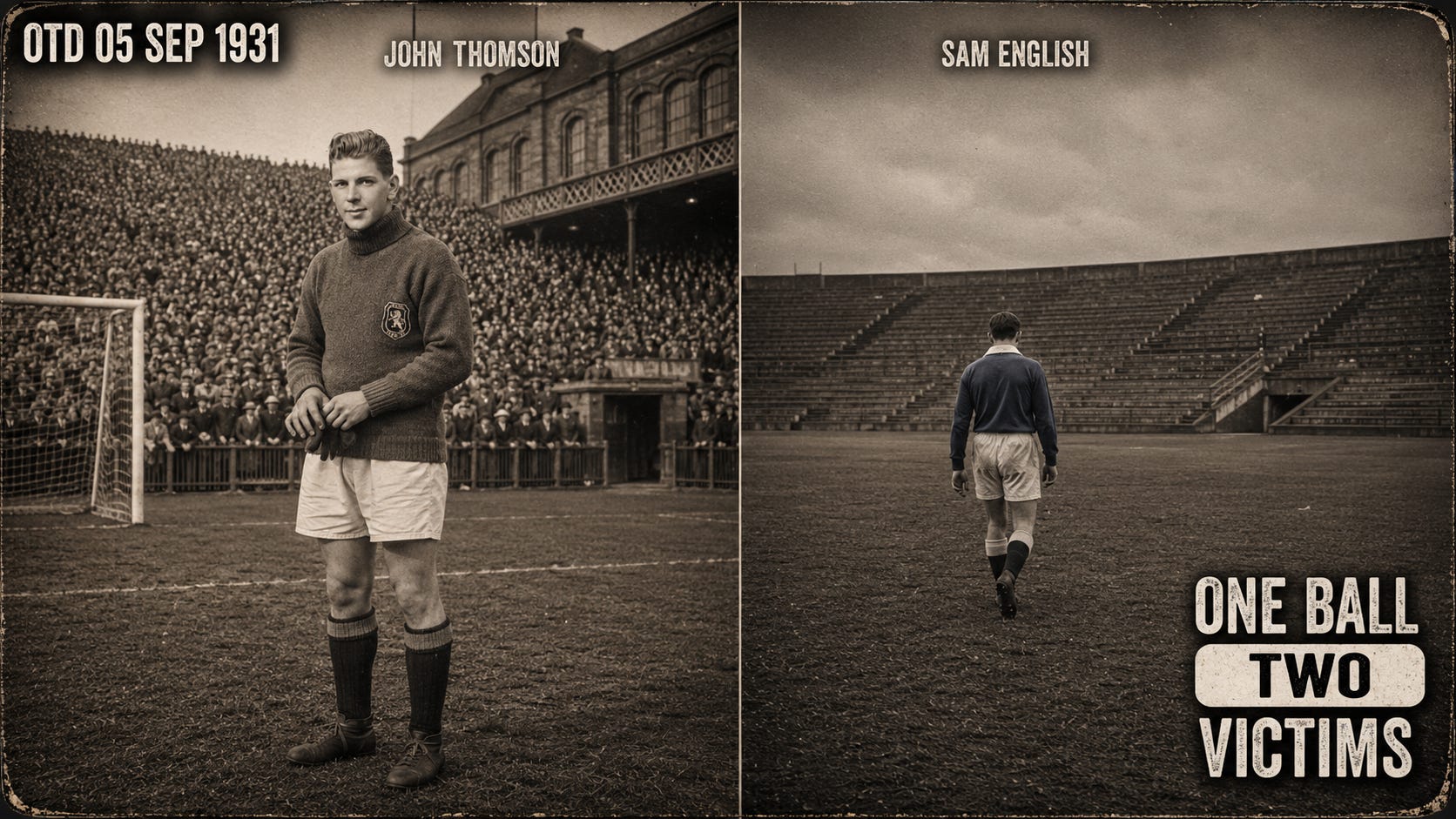
It is September 5, 1931, at Ibrox, five minutes into the second half of a Rangers and Celtic match watched by around seventy-five thousand people. Rangers break forward, and their young centre-forward, Sam English, prepares to shoot. The Celtic goalkeeper, John Thomson, does what he is famous for doing: he dives head first at the forward’s feet. They reach the ball almost together. English’s knee catches Thomson’s head, the ball spins away, and English gets up. John Thomson does not. There is no foul, no malice, no vendetta, just a collision between two young footballers going for the same ball. A few hours later, Scotland’s twenty-two-year-old first-choice goalkeeper is dead. And although only one man died that day, this is, in a quieter sense, the story of two victims.
It matters that Thomson was not a promising boy whose legend grew only because he died. He was already an exceptional goalkeeper. Born in Kirkcaldy in 1909 and raised in the mining community around Bowhill, he went down the pits as a teenager while keeping goal in junior football, and Celtic signed him in 1926, aged seventeen, for a fee of ten pounds. By September 1931 he had made 188 appearances, kept sixty-six clean sheets, won two Scottish Cups and earned four Scotland caps, and he had become his country’s number one. His defining quality was courage, which the goalkeeping of that era demanded without mercy. There was none of the protected space we assume today. High balls meant bodies colliding, loose balls meant boots, and a one-on-one meant throwing yourself into the traffic. Thomson was renowned for exactly that fearlessness at a forward’s feet.
Sam English was almost the same age, twenty-three, a centre-forward newly arrived at Rangers and about to have an extraordinary season, scoring forty-four league goals in 1931-32, a club record at the time. So the two central figures were not an established star and a reckless opponent. They were two young players whose careers were accelerating at the same moment. When they collided, the impact fractured Thomson’s skull and ruptured an artery, and English was immediately among those calling for help. Thomson was carried off, and here another feature of the age appears: there were no substitutes, so a Celtic half-back, Chic Geatons, pulled on the goalkeeper’s jersey and the match played on to a goalless finish. Most of the crowd assumed a bad concussion. That night, at Glasgow’s Victoria Infirmary, John Thomson died without regaining consciousness.
We should be clear about Sam English. He did not kill John Thomson in any moral sense. The inquiry cleared him, Thomson’s family did not blame him, and the players who were there did not blame him. Two men went honestly for a ball, and one angle and one fraction of a second turned it into a catastrophe. But being innocent and being unharmed are not the same thing. English kept playing and kept scoring, yet opposition crowds would not let him forget Ibrox, taunting him about Thomson wherever he went. He eventually left Rangers for Liverpool, partly to escape that environment, and even in England the memory followed him. He retired at twenty-eight, and later described the years after Thomson’s death in five bleak words: seven years of joyless sport.
I will not attach a modern medical label to a man in 1931, because there is no record that would let anyone do so honestly. But what happened to English, being physically involved in an accident in which another person died, seeing the aftermath at close hand, and then being reminded of it publicly week after week, would today be recognized at once as a potentially severe psychological trauma. Modern Scottish football gives players confidential access to mental-health care and trauma specialists, and asks a question the game in 1931 barely knew how to formulate: the player walked away physically, but is he actually all right?
Thomson himself belongs to football’s long, slow reckoning with injury. Only a dozen years earlier, a young Uruguayan goalkeeper named Roberto Chery had died from an injury sustained making a save, a reminder not to romanticize an age that treated courage as an unlimited resource. Thomson’s death produced no overnight law. Substitutes came eventually, sports medicine and neurosurgery advanced, and today competitions can even use an additional permanent substitute for a suspected concussion. The closest modern echo is Petr Čech, who in 2006 suffered a depressed skull fracture when a knee met his head as he came for a ball, the mechanism horribly familiar, and yet entered a completely different medical world of emergency surgery and metal plates, and returned within months in the padded headguard that became his signature. That does not mean modern medicine would certainly have saved Thomson. It shows how much the world around such an injury has changed.
Then came the grief. His body returned to Fife, and his funeral in Cardenden drew tens of thousands, some supporters walking more than fifty miles because they could not afford the train. His teammates carried the coffin, and to this day supporters recreate that pilgrimage. Celtic soon summoned a Canadian goalkeeper, Joe Kennaway, whom they had admired on a North American tour only months before, and by late October football had carried on, because it always does. But John Thomson did not disappear with it. Scottish football had lost its Prince of Goalkeepers at the age of twenty-two.
---
🎧 Listen on Spotify, Apple Podcasts, Amazon Music, Overcast, iHeart, and YouTube.
📩 Got an episode idea? otd@17lawsguy.com
Yesterday: 4 September 1960, the first champions of two footballing worlds.
Tomorrow: 6 September 1995, a goalkeeper turns a harmless cross into the Scorpion Kick at Wembley.
Lovely piece.