

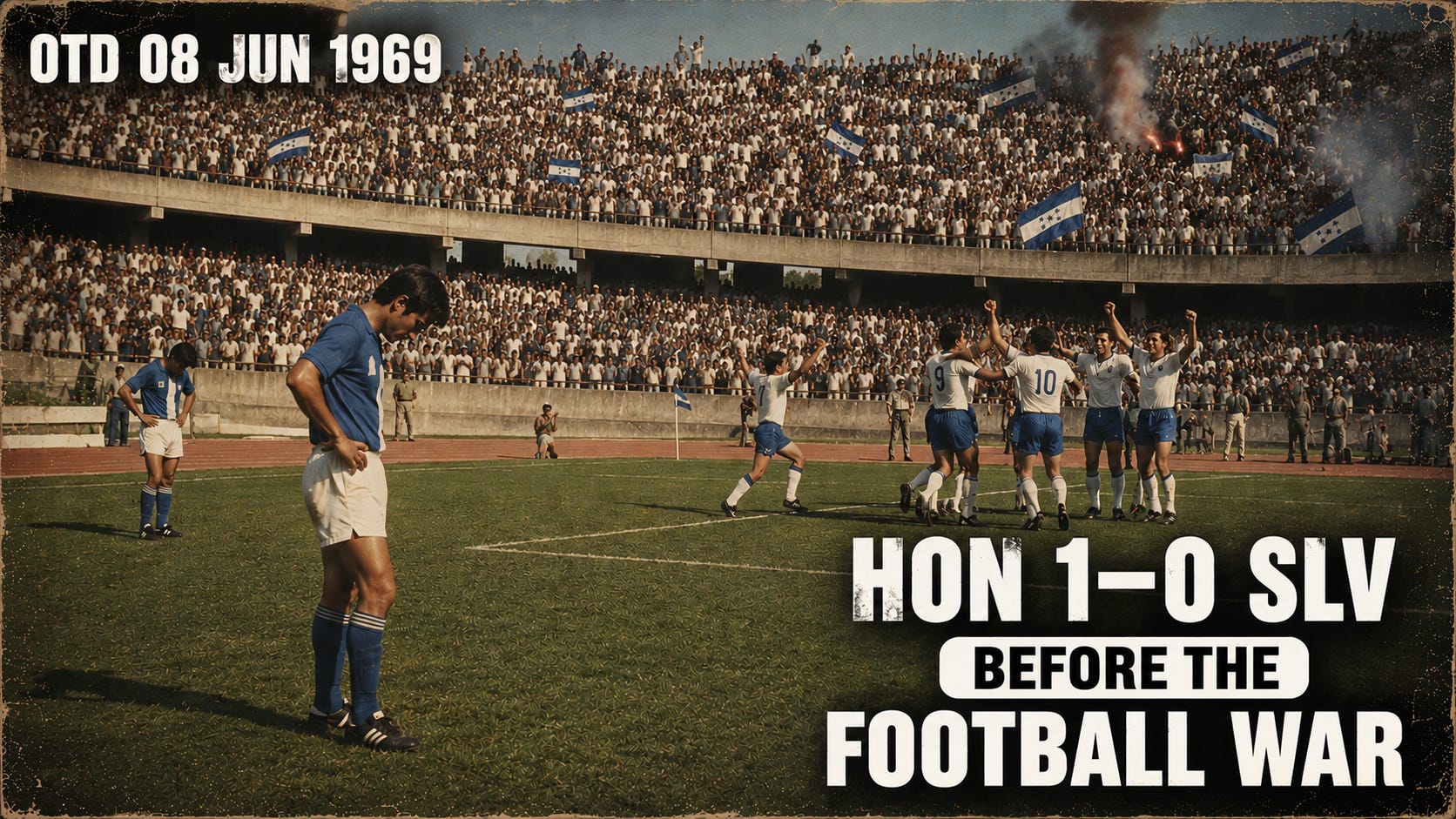
It is 8 June 1969, in Tegucigalpa. Honduras against El Salvador, a World Cup qualifier. Ninety minutes, one late goal, and a result tied forever to one of the most misleading names in political history: the Football War.
Let’s be clear from the start. Football did not cause a war. Football gave an existing crisis a scoreboard. On this day, the fuse moves closer to the flame.
How did we get here? Through land and pressure. El Salvador is small, densely populated, and unequal in land distribution. Honduras is larger, less crowded, but also shaped by unequal land ownership and the power of big landholders. For decades, Salvadorans crossed into Honduras looking for land and work; by the late 1960s, hundreds of thousands lived there — a visible community, useful to the economy, politically vulnerable.
Then Honduras turned inward. Facing pressure over land reform from its own landowners and peasants, the state reached for an easier target than deep structural inequality: the Salvadoran migrant. People who had lived in Honduras for years, sometimes generations, were suddenly treated as squatters and invaders. Evictions rose. Violence rose. Salvadorans fled back across the border with stories of beatings and dispossession — into a country that already couldn’t absorb them. The press on both sides inflamed everything. And then the World Cup draw handed the two nations a public ritual through which all of it could be expressed.
The 1970 World Cup would be in Mexico; CONCACAF had one place. Honduras won their first-round group, El Salvador won theirs, and now they met — not in a friendly, but in a qualifier that the whole region would watch.
On 8 June, the first leg in Tegucigalpa. The atmosphere was hostile before kickoff — Salvadoran players reportedly harassed at their hotel, kept from sleep. The match was tense and goalless for a long time. Then, near the end, Honduras scored (the goal is usually credited to Leonard Welch, though some reconstructions note uncertainty). Honduras 1, El Salvador 0. The result was instantly nationalized — not ‘we lost away,’ but humiliation, grievance, proof of honor injured or defended. One widely-told story holds that a young Salvadoran woman took her own life after the defeat, and the tale became part of the war’s mythology — private despair turned into national theatre.
A week later, the second leg in San Salvador, and now Honduras entered the furnace — harassed, their flag insulted, the stadium venomous. El Salvador won 3-0. Because the tie was decided by games, not aggregate, it was one win each. So a playoff: late June, neutral ground at the Estadio Azteca in Mexico City — neutral in name only. El Salvador won 3-2 after extra time, Mauricio ‘Pipo’ Rodríguez scoring the decisive goal. That eliminated Honduras and pushed El Salvador onward (they still had to beat Haiti to reach the finals).
By then diplomatic relations were collapsing. Violence against Salvadorans in Honduras had become the central charge; national pride had become official policy. On 14 July, El Salvador attacked — air strikes, ground forces, border fighting. The war lasted about one hundred hours before the Organization of American States helped force a ceasefire. But short does not mean small: thousands were killed or wounded, many of them civilians; tens of thousands of Salvadorans were displaced; trade was disrupted and the Central American Common Market damaged. And the name stuck: the Football War.
So what should we take from a name like that? Names can clarify and distort at the same time. ‘Football War’ is unforgettable, which is why it survives — but it risks making the war sound absurd, as if two countries saw a scoreline and chose invasion. That isn’t what happened. The matches intensified the crisis. They staged it. They gave newspapers images, crowds, heroes, enemies, and a chronology, and made the border dispute visible to the world. But the causes were land, migration, inequality, nationalism, state weakness, and the weaponization of migrants as scapegoats. Football was not the root. Football was the loudspeaker.
And that’s why the story matters beyond Central America, because football does this again and again. It doesn’t create politics from nothing; it concentrates politics already in the air. We saw it with Iran against Israel at the 1968 Asian Cup — the match didn’t create that conflict, but it exposed a relationship football could no longer contain. England against Argentina in 1986 didn’t restart the Falklands War, but the Hand of God and the Goal of the Century became a four-minute argument about empire, humiliation and revenge. The Dinamo Zagreb–Red Star Belgrade riot of 1990 didn’t cause Yugoslavia’s wars, but it became a foundational image of a country breaking apart. Serbia–Albania in 2014, Algeria–Egypt in 2009 — the same pattern, football turning abstract history into a body on the pitch: a flag, an anthem, a foul, a goal, a chant, a border in ninety minutes.
Honduras and El Salvador remain the extreme case, because actual war followed so closely. And the sporting epilogue is almost unbearably modest: El Salvador did reach the 1970 World Cup, then lost all three games without scoring. Honduras waited until 1982. The prize that helped magnify the crisis turned out to be small. The human cost did not.
That’s why 8 June 1969 matters — not because the match was beautiful, but because it shows football’s dangerous power as a public stage. The stadium did not create the conflict. It revealed how ready the conflict was to use the stadium.
🎙️ THE PODCAST GOES DEEPER. The full episode has what this post compresses: the deeper land-and-migration history; the three matches in more detail; the OAS ceasefire and the war’s aftermath; and the fuller set of comparisons (Iran-Israel, England-Argentina, Dinamo-Red Star, Serbia-Albania) showing football as accelerant rather than cause. That’s the 10-minute version.
---
🎧 Listen on Spotify, Apple Podcasts, Amazon Music, Overcast, iHeart, and YouTube.
📩 Got an episode idea? otd@17lawsguy.com
Yesterday: 7 June 1970 — Gordon Banks and the Save That Stopped Pelé.
Tomorrow: 9 June 1938 — Cuba’s only World Cup win.