

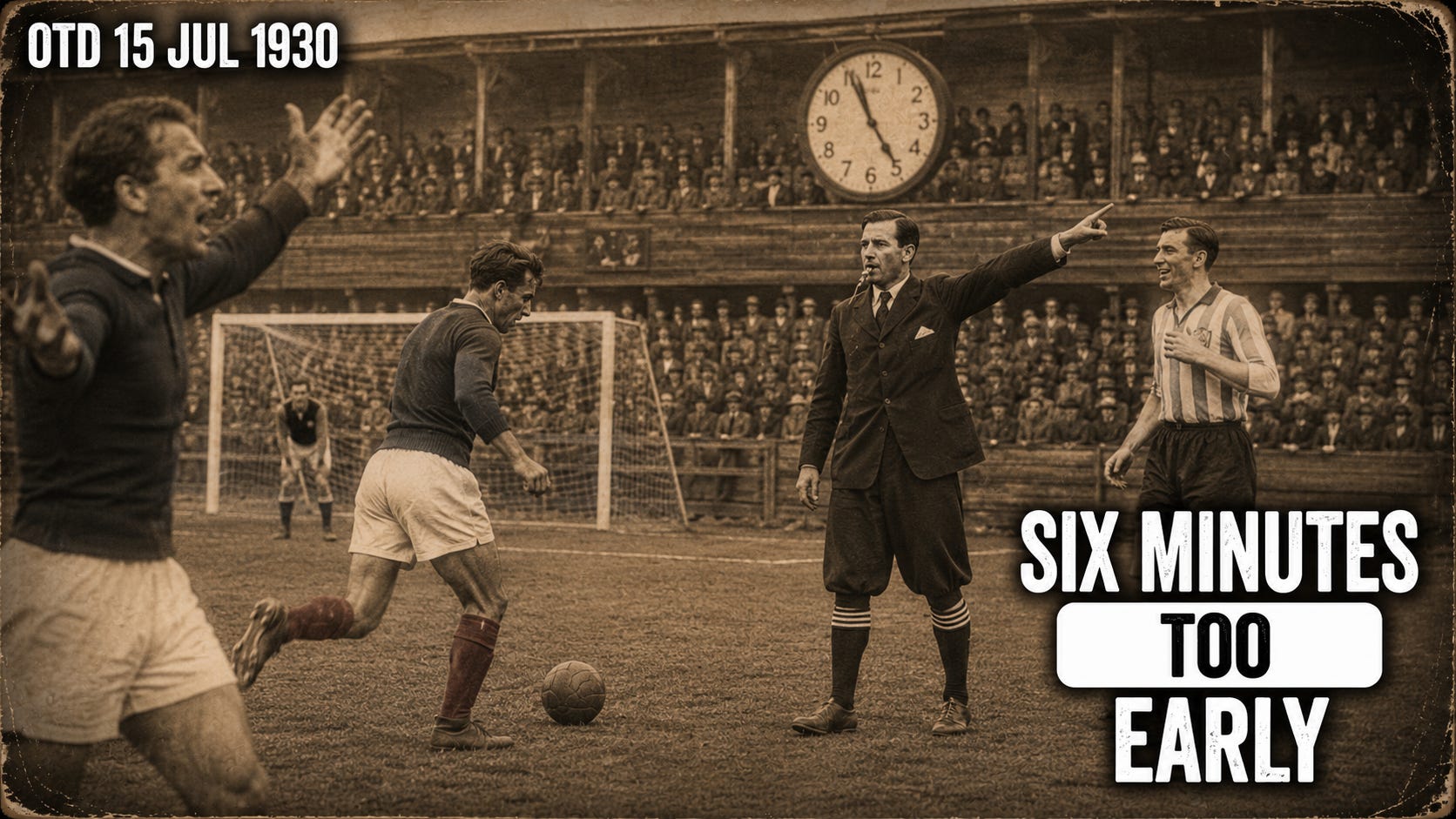
It is July 15, 1930. Montevideo. Gran Parque Central. Argentina against France, the fourth match in World Cup history.
And the referee blows the final whistle. Argentina 1, France 0.
Except there is a problem. There are still six minutes left. And France’s Marcel Langiller is through on goal.
This is no dead match. Argentina are one of the tournament favorites, Olympic silver medalists from 1928, the other giant of the Río de la Plata. France are Jules Rimet’s country, the nation where FIFA was founded, and they scored the first World Cup goal only two days earlier. This is the first ever meeting between the two countries, and it feels like a group decider.
France arrive battered. Forty-eight hours after beating Mexico, goalkeeper Alex Thépot is back despite the injury that forced him off in the opener. Then, early on, Luis Monti goes into Lucien Laurent, the first World Cup goalscorer, with a heavy tackle. Laurent spends most of the match limping; there are no substitutions in 1930. Argentina press. France hold. And the reason they hold is Thépot, still sore, and brilliant. For eighty minutes he keeps Argentina out.
Eighty-first minute. Argentina free kick. Monti stands over it, the wall partly blocks Thépot’s view, and Monti strikes. Argentina 1, France 0. The same Monti who hurt Laurent now scores the goal that breaks France.
But France do not collapse. They push. They chase. And then Langiller breaks clear, running at goal with the equalizer alive.
That is when Brazilian referee Gilberto de Almeida Rêgo blows for full time. At 84 minutes. Not ninety. Eighty-four.
Argentina celebrate. French players protest. The crowd spills emotionally toward the pitch, mounted police get involved, and Argentina’s Roberto Cherro reportedly needs attention after fainting in the chaos. After several minutes, not seconds, the mistake is acknowledged and the players are brought back.
Imagine that. You have already lost. Then you have not lost. But the break has killed the moment. Langiller is no longer running through. The last six minutes are played, nothing changes, and the whistle goes again, properly this time. Argentina 1, France 0. The World Cup is three days old, and it already has its first refereeing controversy.
France’s promising start dissolves; they lose to Chile and go home after the group. Argentina’s road runs through Mexico, Chile, and a 6-1 semi-final demolition of the United States, all the way to the final, where Uruguay beat them 4-2. So the early whistle does not change the champion. But it could have changed the group, the momentum, and the memory of France’s first World Cup.
It also exposes something football has never fully solved: the referee is not just the keeper of order. He is the keeper of minutes. And when the clock is human, mistakes become history. The descendants are famous. In 1978, Clive Thomas blows for time while Zico’s header is in the air. In 1990, Michel Vautrot forgets his watch and lets a period of extra time run about eight minutes long. In 1975, Wolf-Dieter Ahlenfelder calls half-time after 29 minutes of a Bundesliga match, later admitting to pre-game schnapps. In 2021, Janny Sikazwe ends Mali against Tunisia early. Twice.
And under all of it sits the start of one of the great World Cup pairings. Argentina against France begins here, with a free kick and a stolen breakaway. Then 1978 in Buenos Aires, on Argentina’s road to their first title. Then Kazan in 2018, France 4-3, Pavard’s volley and Mbappé’s explosion. Then Lusail in 2022, Messi against Mbappé, maybe the greatest final ever played.
Ninety-two years before penalties in Lusail, the very first chapter ended six minutes early. Football’s oldest new rivalry is not arguing about a goal. It is arguing about time.
🎙️ THE PODCAST GOES DEEPER. The full episode has the early-whistle lineage from Clive Thomas to Janny Sikazwe, Monti’s double role, and the Argentina-France arc to Lusail. That’s the 10-minute version.
---
🎧 Listen on Spotify, Apple Podcasts, Amazon Music, Overcast, iHeart, and YouTube.
📩 Got an episode idea? otd@17lawsguy.com
Yesterday: 14 July 1989, Ruggeri’s second red card against Uruguay in six days.
Tomorrow: 16 July 1950, the Maracanazo, the day Uruguay silenced two hundred thousand people at the Maracanã.