

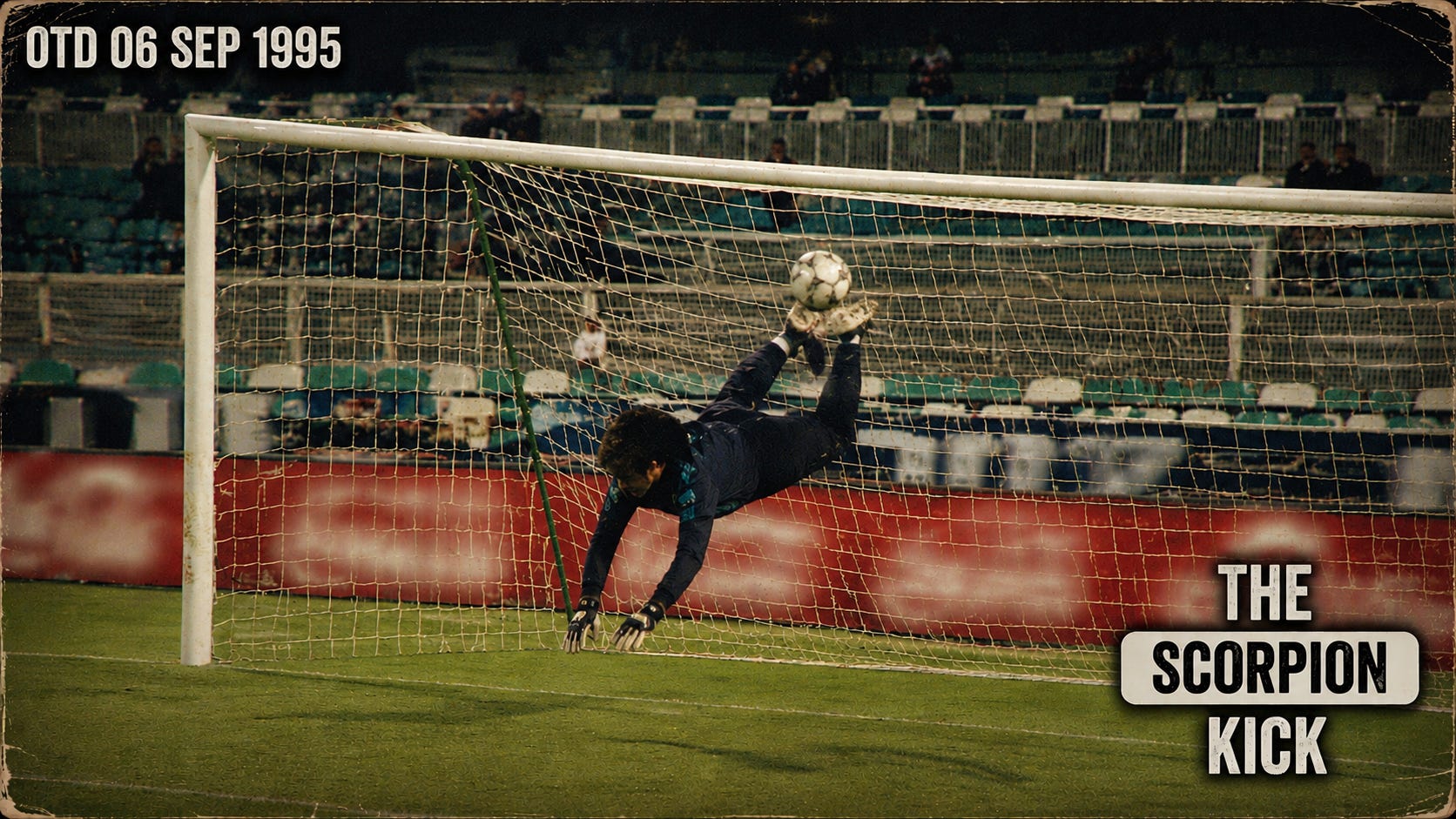
It is September 6, 1995, at Wembley, twenty-one minutes into England against Colombia, when Jamie Redknapp, on his England debut, sends a mishit ball drifting toward the Colombian goal. It is harmless. René Higuita could catch it, punch it, or simply let it fall into his hands. Instead he waits, throws himself forward, plants his hands toward the turf, arches his back and flicks both heels over his own head to hook the ball away behind him. For a moment Wembley does not know what it has seen. Then come the laughter and the applause. Higuita has performed the Scorpion Kick, and the strangest part is that it was not improvisation. He had been waiting years for exactly this ball.
To understand him, start in Medellín, where Higuita was born in 1966 and raised by his grandmother, football offering a way out. He never thought like a conventional goalkeeper. Where that generation’s keepers were essentially territorial, guarding the box and clearing danger, Higuita asked a different question: why surrender the ball if you can keep it? At Atlético Nacional, under Francisco Maturana, the eccentricity became doctrine. Maturana wanted possession and players comfortable on the ball, and Higuita became not merely the last defender but, in effect, the first playmaker, leaving his area to receive passes, dribble and even wander upfield to score. He would finish his career with forty-three goals, from penalties and free kicks. In 1989 the madness produced glory, when Atlético Nacional won the Copa Libertadores, Higuita saving four penalties and converting one himself, to make them the first Colombian champions of South America.
Then came the other side of the same coin. At the 1990 World Cup, in the round of sixteen against Cameroon, Higuita collected the ball thirty metres from his goal, as he always did, and Roger Milla robbed him and ran it into the empty net. Suddenly everything revolutionary about him looked ridiculous. But that is the central tension of René Higuita: you cannot separate the mistake from the genius. The same instinct that gifted Milla a goal in 1990 produced the Scorpion at Wembley in 1995. Remove the risk and you remove Higuita.
Football then began drifting his way regardless. In 1992 the back-pass law changed, so a goalkeeper could no longer pick up a deliberate kick from a teammate. Higuita likes to claim it as the Higuita Law, noting that not even Pelé, Maradona or Messi ever changed a Law of the Game. It is a wonderful boast and too generous to himself: the change was really an attack on time-wasting after the dour 1990 World Cup. But there is a lovely irony in football rewriting the rules to make goalkeepers use their feet just as one keeper was already behaving as if that rule existed.
His life then grew far messier. Higuita knew Pablo Escobar and never hid it, and in 1993 he acted as an intermediary in the release of a kidnapped girl, helping deliver the ransom and accepting money from her family. Colombian law forbade private mediation in kidnappings, and he spent seven months in prison. It was not, as some retellings imply, a goalkeeper joining a kidnapping for profit; he said he had tried to get a girl home safely, and the authorities said he had broken the law in doing it. Either way, it cost him the 1994 World Cup, which Colombia reached without him and which ended in something far darker than football, when his Atlético Nacional teammate Andrés Escobar scored an own goal against the United States and was murdered days after returning home. Higuita attended the funeral.
In 1995 he returned, helping Colombia to third place at the Copa América and scoring a free kick for Atlético Nacional in a Libertadores semifinal. So the man who arrived at Wembley that September was not a novelty act, but one of South America’s most remarkable footballers with unfinished business. The Scorpion itself had been born years earlier, while he was filming an advertisement for a fruit drink and a child bicycle-kicked a ball toward him; he wondered what a bicycle kick performed backwards would look like, tried it, and practised it for years. There is one final wrinkle: an assistant referee had raised his flag, and Higuita later admitted it gave him the courage to try, believing it would protect him if the trick failed. The whistle never came, the flag came down, and play carried on. Almost everything else about the match is forgotten, a little unfair on Redknapp, making his debut, and on John Barnes, winning his seventy-ninth and final England cap. One England career began, another ended, and a Colombian goalkeeper stole the memory from both.
Higuita’s real legacy is not the Scorpion, only his signature. It is the goalkeeper becoming a footballer. Today we have the vocabulary for it, and the likes of Manuel Neuer, Ederson and Alisson are expected to receive under pressure and start attacks from deep. FIFA now calls Higuita a pioneer, whose supposedly absurd logic, that a goalkeeper need not surrender the ball simply because he is the goalkeeper, became ordinary wisdom. He also belongs to a gladder tradition, football’s licensed eccentrics between the posts, from Bruce Grobbelaar and Peter Schmeichel to the scoring goalkeepers José Luis Chilavert and Rogério Ceni. But Higuita’s deeper achievement was that one part of his strangeness stopped looking strange at all.
---
🎧 Listen on Spotify, Apple Podcasts, Amazon Music, Overcast, iHeart, and YouTube.
📩 Got an episode idea? otd@17lawsguy.com
Yesterday: 5 September 1931, Scotland loses its Prince of Goalkeepers.
Tomorrow: 7 September 1957, a brand-new nation stages a football tournament in the spirit of independence.
Wow, Barnes's last game and Redknapp's first too, quite a lot of narrative for a 0-0 friendly!