

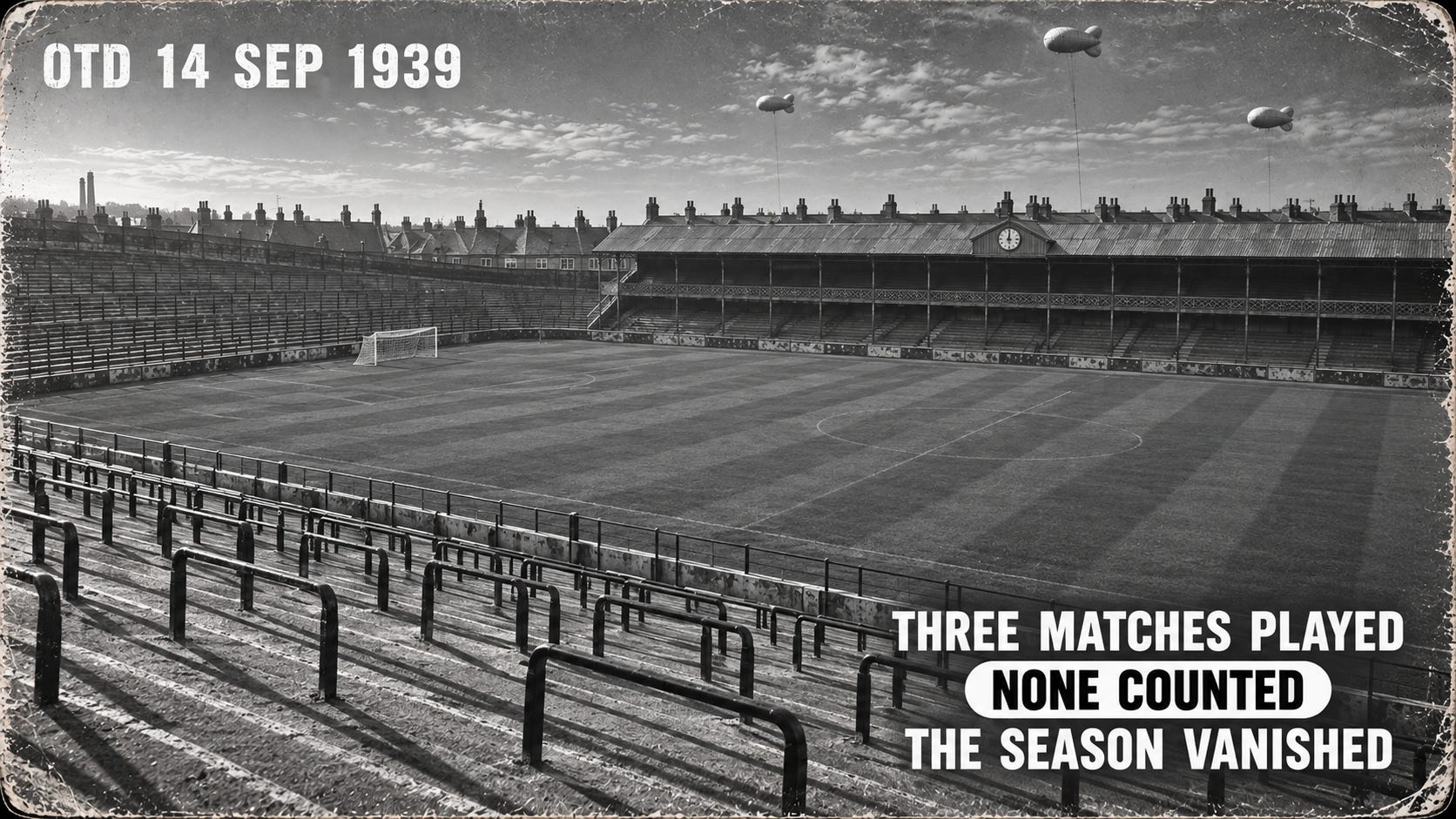
It is September 14, 1939, and Britain has been at war for eleven days. The new Football League season is nineteen days old. Each club has played exactly three matches. Blackpool lead the First Division with three wins out of three. Luton Town lead the Second. Accrington Stanley and Reading top the two regional Third Divisions. And not one of them will be champions, because today the authorities accept what has been obvious for a fortnight: the Football League cannot continue in its normal form. The three completed rounds are declared void. The tables are abandoned. Nobody knows when, or whether, football will look the same again.
The matches have been played. The goals have been scored. Tens of thousands of people watched them. And they are about to be deleted from the record as though they never happened.
How Did We Get Here?
Football had faced a world war before, and it had handled the last one very differently. In August 1914, Britain entered the First World War just as a new season approached, and the Football League simply carried on. It completed the entire 1914-15 campaign. So did the FA Cup. The decision drew ferocious criticism: young men were fighting and dying in France while professional footballers played on and crowds paid to watch them. The War Office had at first wondered whether football might even help morale and recruitment, but the public mood hardened, and after the 1915 FA Cup final national competition finally stopped, replaced by regional wartime leagues until the League proper returned in 1919. Twenty years later, nobody in English football wanted to have that argument again.
This time, at least, the crisis could be seen coming. Germany annexed Austria in 1938, then swallowed Czechoslovakia. In May 1938, the England team played Germany in Berlin and, before kickoff, were instructed to give the Nazi salute. They won the match 6-3, but it is the photograph, not the score, that survived. By the summer of 1939 another European war looked increasingly likely, and yet football did what football does: it prepared for a season. Everton were the defending First Division champions. Portsmouth held the FA Cup. On Saturday, August 26, 1939, the new campaign kicked off.
Then the calendar turned dark with astonishing speed. On Friday, September 1, Germany invaded Poland. The very next day, the League played another full Saturday programme, apparently determined to carry on as normal for as long as normal lasted. Blackpool beat Wolverhampton Wanderers 2-1. Arsenal beat Sunderland 5-2. Liverpool beat Chelsea 1-0. Across all four divisions, clubs completed their third round of matches. And on the Sunday morning, September 3, the Prime Minister, Neville Chamberlain, told the country over the radio that Britain was at war with Germany.
Almost immediately, normal public life shut down. Large gatherings were an obvious danger from the air. Railways, fuel and police were needed elsewhere. Players and supporters alike might be called up for military or civil-defence service. The national network of fixtures, the very thing the Football League had been built around since 1888, had suddenly become a wartime liability: no club could keep sending a team and thousands of travelling spectators across the country every single Saturday.
So the League suspended its championship, froze player contracts, and voided the three rounds already played, which would not count toward anything in the official record. Blackpool's perfect start vanished into nothing. For individual players the erasure could be even crueller. A Football League debut was no longer an official debut. A first League goal was no longer an official goal. Appearances made in front of real crowds, against real opponents, simply fell out of the statistical history of the game.
A game rebuilt for war
Suspending the championship did not mean football itself had to disappear. It meant football had to be redesigned for a country at war. Before long the government permitted matches again, but under severe restrictions. Travel was limited at first to roughly fifty miles, so that no team and no crowd tied up the railways for long. Attendances were capped, initially at eight thousand, though that ceiling later rose. The national divisions were scrapped and replaced by regional groups, in which a proud First Division club might now find itself playing a Third Division neighbour, because geography suddenly mattered far more than status. On October 21, 1939, regional wartime competition began, and its shape kept shifting for the rest of the war, because the war itself kept shifting.
The players scattered. Some enlisted, some were conscripted, some became physical-training instructors, some worked in reserved occupations, and many were posted around Britain and turned out as guests for whichever club happened to be near their base. A Liverpool man might appear for another team entirely. An Arsenal player might line up for West Ham. On any given Saturday, one club's star might officially belong to the opponent he was playing against. Team selection became a weekly act of improvisation, and the old certainties of who played for whom quietly dissolved.
So what?
The first thing to notice is that football proved useful precisely because it was not essential. It offered recreation for servicemen on leave, a release for exhausted factory workers, and a gathering point for communities living through blackout, rationing and bombing. Clubs raised money for wartime causes. Players fronted recruitment drives, trained military personnel and turned out in representative matches. The Football Association worked alongside the armed forces, civil defence and charities, and nearly two hundred grounds became centres for a national fitness scheme. Football was no longer operating outside the war effort at all. It had been absorbed into it.
The second thing is that the war quietly rewrote the relationship between a player and his club. In peacetime, the League's registration system bound a professional tightly to a single employer. Wartime guesting shattered that exclusivity, at least for a while, and supporters saw combinations of players that peacetime rules would never have allowed. It also opened the door for the young. With established professionals away, teenagers and unknowns were handed opportunities they might otherwise have waited years for. Jackie Milburn began to make his name at Newcastle United during the war. Tom Finney turned out for Preston North End while serving in the Army. The matches themselves were unofficial, and will never appear in the record of those careers. The education was entirely real.
And the third thing is the hardest. The war did not merely pause competitions; it erased sporting futures that can never be recovered. The great forgotten English "what if" belongs to Everton. They were the reigning champions, and their centre-forward, Tommy Lawton, was still only nineteen when the doomed season began, having scored thirty-four League goals. Around him stood Joe Mercer, T. G. Jones and the vastly experienced goalkeeper Ted Sagar. This was not an old side reaching its natural end. It was a young champion that looked ready to build a dynasty. Then its next six League seasons simply disappeared. By the time real competition resumed, Lawton had moved to Chelsea, Mercer to Arsenal, and the team had scattered. Everton would not be champions again until 1963. Nobody can ever know what that side would have won, and that unknowability is exactly what makes it a true "what if." The war did not defeat Everton's potential dynasty. It removed the years in which the question could have been answered.
That erasure was worldwide. Italy had won the World Cups of 1934 and 1938, and the next tournament, expected in 1942, never took place. Neither did the one pencilled in for 1946. The Olympic Games of 1940 and 1944 were cancelled as well. Across Europe, footballers lost what should have been the defining years of their careers. Grounds were requisitioned or damaged by bombs. Some players came home when it was over. Some never did.
And yet English football did come back. The FA Cup returned first, in 1945-46. The Football League resumed in 1946-47. Crucially, it did not restart from the erased 1939 table. Clubs simply returned to the divisions they had occupied at the end of the last real season, 1938-39, so that Everton were still the reigning champions and Portsmouth were still the holders of the Cup. Seven years had passed, and yet officially the football calendar had almost been frozen in place. Then the gates opened, supporters poured back in enormous numbers, and football took its place in the restoration of ordinary life. The structure first assembled in 1888 had survived the whole ordeal intact: fixtures, travel, tables, promotion, relegation and an official record.
But September 14, 1939, revealed something that the very first League matchday never could. A season is not really a set of fixtures at all. It exists only because millions of people, clubs and administrators agree to treat its matches as one continuous competition. When that agreement broke, the games did not vanish from memory. Players still remembered their goals; supporters still remembered the results. What ceased to exist was the season itself.
Three things to take away
First, the 1939-40 Football League really did begin. Clubs played three matches, Blackpool won all three to lead the First Division, and then war swept every one of those results out of the official record.
Second, football was suspended, not extinguished. National divisions gave way to regional leagues, restricted travel, reduced crowds and guest players. The game survived by making itself local, flexible and unofficial.
Third, the war did not only erase matches. It erased possibilities. Everton's young champions may have been on the edge of a dynasty. Italy might have chased a third straight World Cup. Footballers all over the world lost the years that should have defined them. We can count the competitions that disappeared. We can never count what might have happened inside them.
On this day in 1939, English football accepted that there could be no normal League while Britain was at war. Three rounds of a brand-new season were wiped away, and in their place came a provisional game for a provisional world. Nobody knew when the real thing would return. But even in the middle of a war, people discovered that life without football was not quite normal either.
---
📩 Got an idea to an OTD story? otd@17lawsguy.com
Yesterday: 13 September 1891, Argentina crowns its first champions, both of them.
Tomorrow: 15 September 1956, Korea win the first Asian Cup.
Damn great read 👏