

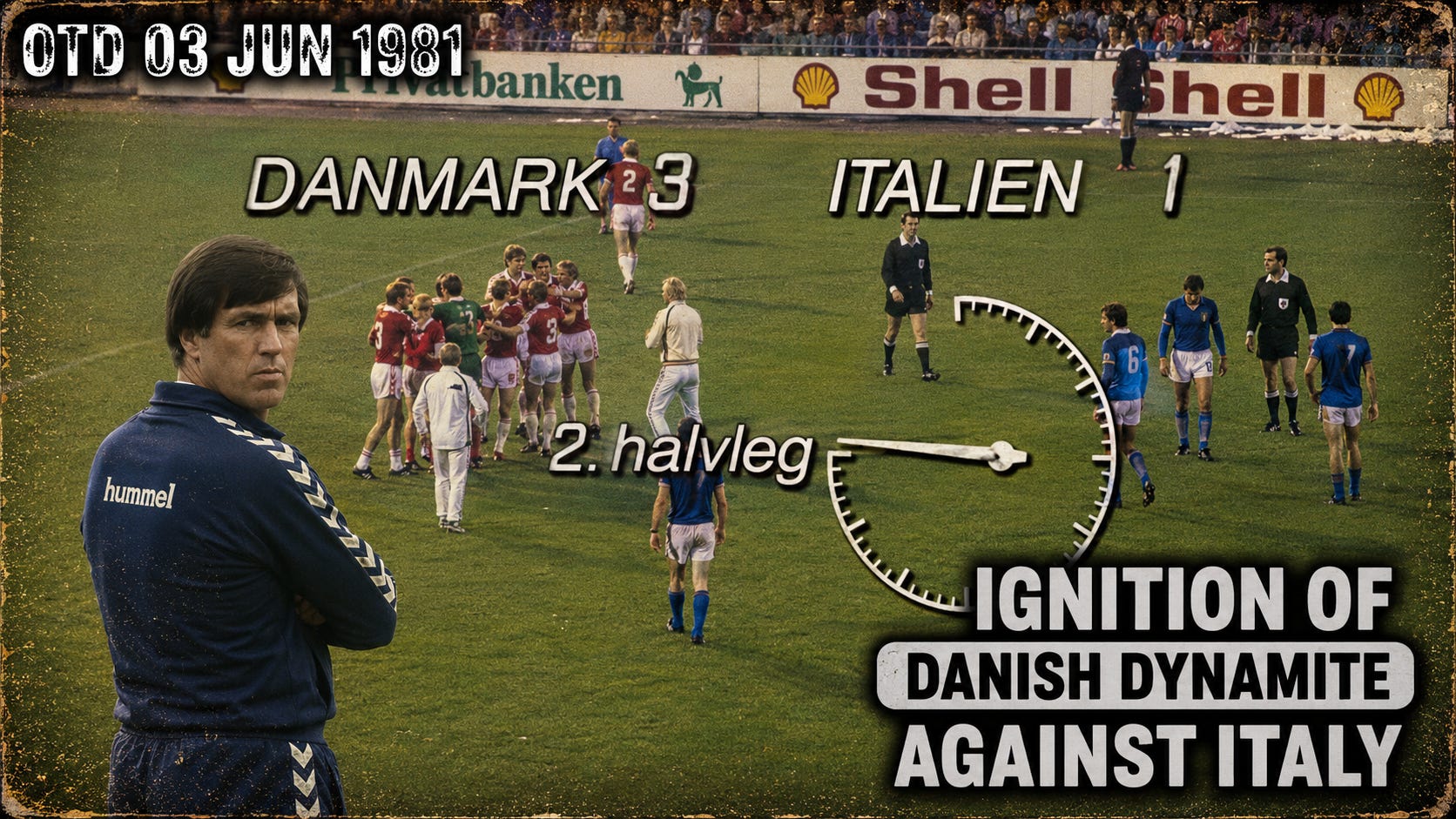
It is 3 June 1981, in Copenhagen. Idrætsparken. A World Cup qualifier: Denmark against Italy. And this should be simple. Italy are two-time world champions, fourth in 1978, a side of Zoff, Scirea, Cabrini, Gentile, Tardelli, Antognoni, Conti, Bettega, Graziani. Denmark are still trying to become Denmark.
Then the match ends: Denmark 3, Italy 1.
At the time it looks like a shock. In retrospect, it looks like ignition. The spark that lit Danish Dynamite.
How did we get here? For most of the twentieth century, Denmark had football talent but no modern football structure. There were Olympic moments — bronze in 1948, silver in 1960 — but the Danish FA clung to amateur ideals for decades. Turning professional meant becoming unavailable to the national team, so Denmark kept exporting its best players and failing to build a side around them. Harald Nielsen, Henning Jensen, Allan Simonsen: proof Denmark could produce quality, and proof of the contradiction — the better you got, the more likely you were to leave.
The 1970s loosened it. Denmark began accepting professionals from abroad, and in 1978 Danish domestic football finally turned professional. That even briefly brought Bobby Moore, England’s 1966 World Cup captain, to the Danish third tier. But habits don’t change just because rules do. The national team still carried the old self-image: happy amateurs, gifted, relaxed, not quite serious enough to threaten the elite.
Then, in 1979, Denmark hired a German. Sepp Piontek — a former Werder Bremen defender, disciplined, dryly funny, and completely unimpressed by Denmark’s inferiority complex. He saw the problem clearly: talent yes, belief no, structure no, professional standards absolutely not. He later said Danes didn’t like the word discipline, and that his job was to make them accept it without making them stop being Danish. That distinction matters. Denmark didn’t become a German team. They became a better Danish team.
And a golden generation was forming: Simonsen, the 1977 Ballon d’Or winner; Frank Arnesen and Søren Lerby, schooled at Ajax; Preben Elkjær, powerful and chaotic and brilliant; Morten Olsen, the libero who became the brain of the side; Bertelsen, Røntved, Busk, Jesper Olsen, soon Michael Laudrup. Not all fully formed in 1981 — but the ingredients were there, and a coach who refused to let them shrug.
The 1982 qualifying group was hard: Italy, Yugoslavia, Denmark, Greece, Luxembourg, two to qualify. Denmark had started poorly enough that this June night wasn’t really expected to send them to Spain. But it could still send them somewhere — into themselves.
And they went at Italy. The first half was tense; the explosion came after the break. Around the hour, captain Per Røntved scored. 1-0. Almost immediately, Frank Arnesen made it 2-0. In two minutes the match had turned, and Italy were not used to being treated like this in Copenhagen — Denmark not sitting deep, not apologizing for ambition, not asking the badge for permission. Graziani pulled one back. 2-1. Here was the old Danish test: do they wobble, do they become the plucky almost-team again? No. Late on, Lars Bastrup made it 3-1.
Denmark had beaten Italy. Not in a friendly. In a World Cup qualifier.
Here’s the irony that makes it matter: that Italy side went on to win the 1982 World Cup. They stumbled through the first group stage with three draws, then Paolo Rossi came alive — they beat Argentina, beat Brazil 3-2 in one of the greatest matches ever played, beat Poland, then beat West Germany 3-1 in the final. And in World Cup competition, qualifiers and finals combined, Italy lost only once between the 1978 third-place game and the 1986 last 16. This match. Denmark 3, Italy 1. Not a random night. A signal.
For Denmark, 1981 was the first real proof that Piontek’s revolution could work — eight wins from nine that year. Then Wembley 1983, where Denmark won 1-0 and Simonsen scored the penalty, with more than 80% of Denmark watching on television. They qualified for Euro 1984, and there the name and the mood all arrived: red and white, fast, fearless, the Roligans in the stands, the song — Vi er røde, vi er hvide - “We are red, we are white.” Danish Dynamite. A 5-0 over Yugoslavia, a comeback from 2-0 down to beat Belgium, a semi-final against Spain lost on penalties. Then Mexico 1986, their first World Cup: Scotland beaten, Uruguay thrashed 6-1, West Germany beaten 2-0 — before the dream broke against Spain, 5-1, after a Jesper Olsen backpass.
Danish Dynamite won nothing. No Euro, no World Cup. And yet it became one of the great cult teams in football history — because football sometimes remembers not who lifted trophies, but who changed the imagination. The roots of Denmark’s actual triumph, Euro 1992, run back through all of this: through professionalism, the foreign-based players, and Piontek’s standards.
Sepp Piontek passed away earlier this year, aged 85. He didn’t lift the 1992 trophy. But he built the belief system that made Danish football modern — he took a country with talent and gave it seriousness, took a group of professionals and gave them a team, added German steel to Danish lightness without destroying the joy.
That’s why 3 June 1981 matters. Not because Denmark qualified — they didn’t. Not because Italy collapsed — they became world champions. It matters because sometimes a revolution announces itself before anyone has a name for it.
🎙️ THE PODCAST GOES DEEPER. The full episode has what this post compresses: the full amateur-era backstory; Piontek’s character and methods; the goal-by-goal of the Italy match; the complete arc through Wembley ‘83, Euro ‘84, the 4-2 over the USSR in ‘85, and Mexico ‘86; and a fuller tribute to Piontek. That’s the 10-minute version.
---
🎧 Listen on Spotify, Apple Podcasts, Amazon Music, Overcast, iHeart, and YouTube.
📩 Got an episode idea? otd@17lawsguy.com
Yesterday: 2 June 1886 — IFAB, The Hidden Government of the 17 Laws.
Tomorrow: 4 June 1950 — the Magical Magyars begin an unbeaten run.
This Danish side is one I want to watch, up to the 86 World Cup. Heard lots about them, have barely seen their class in first person.