

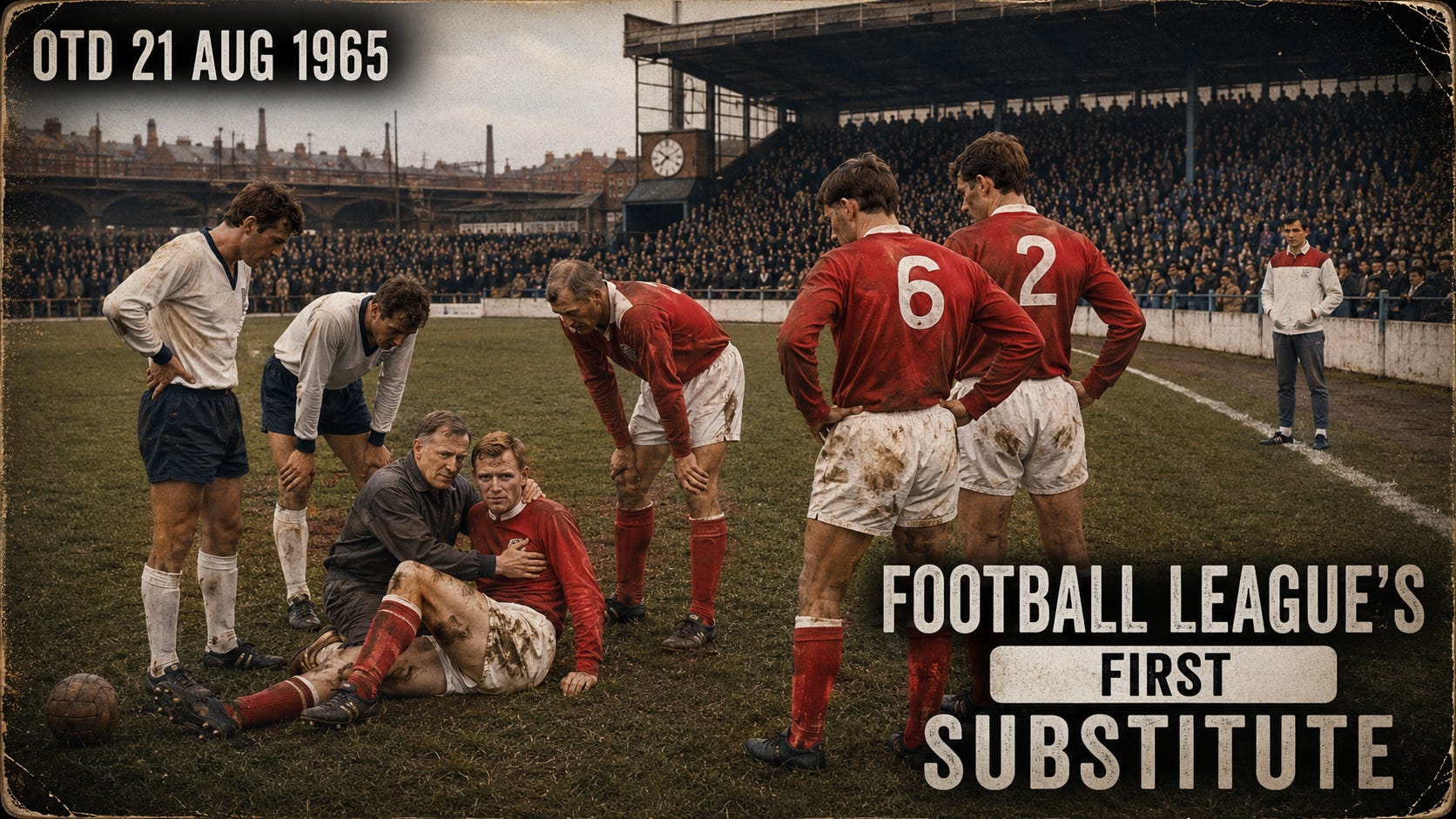
It is August 21, 1965, at Burnden Park, and Bolton Wanderers are eleven minutes into their match with Charlton Athletic when the Charlton goalkeeper, Mike Rose, is injured. For almost the entire history of the Football League, that meant one thing: no replacement. But this afternoon is different. Keith Peacock takes off his tracksuit and comes on, John Hewie goes into goal, and for the first time in Football League history a player has been legally replaced during a match. The substitution, so normal today that it is hard to imagine the game without it, had finally arrived, after seventy-seven Football League seasons of doing without it.
The absence was there from the very start. The original Laws of 1863 contained no mechanism for replacing an injured player, and the consequences appeared almost at once. In the first FA Cup final, in 1872, the Royal Engineers’ Edmund Cresswell broke his collarbone after about ten minutes; with no substitute available he was parked uselessly on the wing, and Wanderers won 1-0. That was not a mistake in the system. It was the system. The eleven who started were expected to finish, and the principle survived even after professionalism was legalized in 1885. People bent it occasionally, one 1885 cup tie saw Notts Rangers allow a reserve named West to replace an injured opponent, but it was a courtesy, never a right.
The Football League arrived in 1888 and carried the same flaw. On the opening day, Everton’s first League match against Accrington saw the visitors’ goalkeeper injured; he had to leave, an outfield player took over in goal, and Everton exploited the extra man to win. An injury was already deciding matches on day one.
There was another reason players fought so hard not to be the injured man: money. Professional footballers of that era were nothing like today’s guaranteed millionaires. Selection affected earnings directly, through appearance payments and bonuses layered on top of a modest weekly wage. In the 1930s a player might earn a small basic wage and a meaningful extra sum simply for holding his first-team place. So an injury could cost far more than a Saturday afternoon: lose your place, lose your bonus, and perhaps watch a replacement play well enough that the place never comes back. Histories of football medicine are full of players explaining why they carried on hurt, out of fear of losing their spot, loyalty to teammates, and hard financial need. So they strapped themselves up, took injections and played through pain, not necessarily fit, just fit enough.
The debate never quite died. In 1923 the Football Association itself persuaded the game’s lawmakers that an injured player could be replaced, but only by prior agreement and, crucially, not in a competitive match. That qualification captures football’s whole dilemma. The medical logic was obvious; the competitive fear was paralyzing. What if a player only pretended to be injured? What if a manager simply wanted to remove someone playing badly? So the casualties kept coming, through the 1953 and 1957 FA Cup finals and right up to Gerry Byrne playing on with a broken collarbone in the 1965 final. The wall was cracking, though. In 1957 FIFA formally pressed the lawmakers to allow substitutes in competition; the four British associations voted it down four to one, but the compromise that followed let each national association decide the question for its own competitions. By the 1960s the Laws were no longer the obstacle. English football’s own reluctance was.
Finally, in June 1965, the Football League clubs voted, thirty-nine to ten, for one substitute from the new season, for injury only, no tactical changes. It took eleven minutes of the new era for Mike Rose to get hurt and Keith Peacock to make history. It did not rescue Charlton, who lost 4-2. Across the League that day thirteen substitutes were used and eight of their teams lost; some crowds even booed the idea as unsporting. But at Barrow, a substitute named Bobby Knox came on and scored, the first in Football League history to do so, and the future was suddenly visible. The bench was already becoming more than insurance.
The injury-only rule quickly created its own problem, because nobody could reliably say how hurt a player really was, and by 1967 English football allowed tactical substitutions. That changed management forever, turning the bench into a weapon. David Fairclough came off it to knock Saint-Étienne out of Europe in 1977 and earn the nickname Supersub. Patrick Kluivert won the 1995 European Cup for Ajax as a substitute; Teddy Sheringham and Ole Gunnar Solskjær scored both Manchester United goals from the bench in the 1999 final; Éder won EURO 2016 for Portugal with a substitute’s goal against the host nation. The rule invented to stop an injury ruining a team had become one of the manager’s greatest tools, and after seventy-seven seasons of the original eleven being expected to see it through, the bench had finally entered the game.
---
🎧 Listen on Spotify, Apple Podcasts, Amazon Music, Overcast, iHeart, and YouTube.
📩 Got an episode idea? otd@17lawsguy.com
Yesterday: 20 August 1916, the national team born abroad.
Tomorrow: 22 August 1964, the BBC points its cameras at Anfield and launches Match of the Day.