

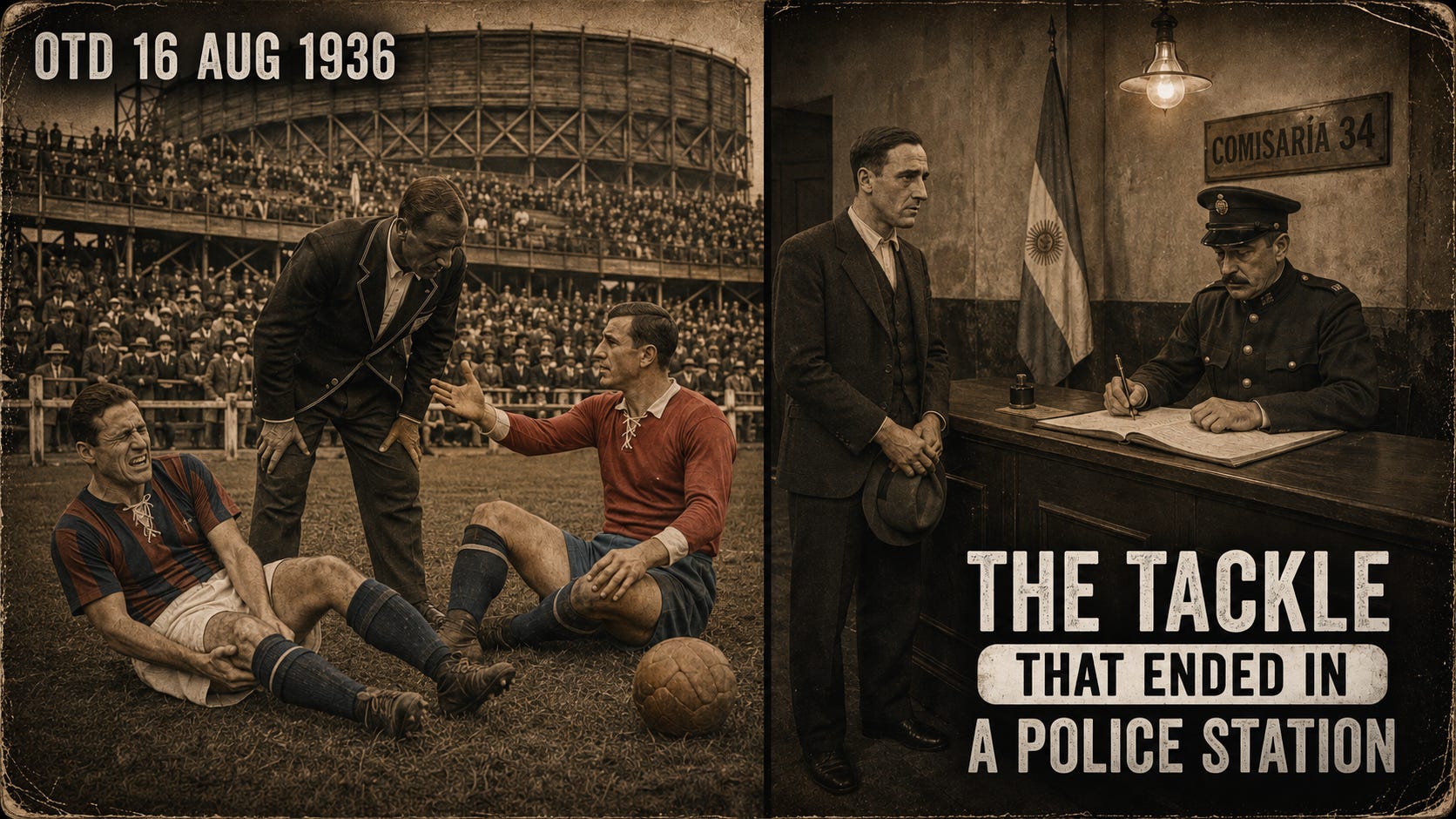
It is August 16, 1936. Buenos Aires. San Lorenzo against Independiente. Seventeen minutes in, San Lorenzo’s Arturo Arrieta passes Independiente’s Fermin Lecea, crosses from the left, and Ruben Cavadini makes it 1-0. Seven minutes later they meet again. This time Arrieta is brought down. He does not get up: his left fibula is broken. The match continues, and San Lorenzo win 2-1. Then, at the final whistle, something happens that you really do not expect at a football match. The police arrest Lecea. By that evening an Argentine newspaper reports that Lecea is detained, at the disposal of the judge.
But how did we get here? Argentine football had been professional since 1931, and by 1936 it was an elite league with Arsenio Erico at Independiente. The 1936 season was split into two one-round tournaments. San Lorenzo had just won the first, the Copa de Honor, and everybody now started again from zero in the Copa Campeonato.
And this was a physical game. The 1936 records are blunt: players expelled for rough play, for attacking opponents, for fighting each other. There were no cards yet, but referees could still send men off. And sometimes discipline did not end the matter. Two years earlier, two players in a Velez against Boca match were expelled for fighting and then taken to the police station. So Lecea’s arrest would be extraordinary, but not without precedent.
Now the two protagonists. Arturo Arrieta was a great early San Lorenzo left winger, at the club from 1927 to 1939. Fermin Lecea came from a different tradition: born in the Basque Country, raised in Argentina, a former welterweight boxing champion. El Grafico later listed him among the surgeons of Argentine football, the hard men, though he could genuinely play. Their positions explain the collisions. In the 2-3-5, Arrieta was the left winger and Lecea the right back, directly opposite, one paid to stop the other.
On August 16, Arrieta wins the first exchange, setting up Cavadini, then comes the collision that breaks his fibula. The contemporary report describes Lecea as having intervened in the play that caused the fracture. That wording matters. We know the injury, we know Lecea was involved, we know what the police did. What we cannot safely reconstruct is intent. Referee Jose Galli does not expel Lecea. And because there were no substitutions in 1936, Arrieta could not be replaced, so San Lorenzo played on a man short and still scored again. Then Galli blew the whistle, and football jurisdiction gave way to state jurisdiction. Lecea was taken to the 34th precinct, where a judicial investigation was opened.
Here the record becomes frustrating. Lecea was arrested and placed before a judge, but there is no reliable evidence of a conviction, a sentence, or even a night in a cell. And one fact tells us a lot: seven days later he started for Independiente against Velez. Arrieta’s recovery was longer, but the fracture did not end his career. The arrest still raises a question the Laws have spent generations managing: where does football violence end and ordinary violence begin? Football later added cards, substitutions, and serious-foul-play rules. But football law and criminal law remain different things, and courts have occasionally decided a red card was not enough. Chris Kamara was convicted of grievous bodily harm in 1988. Duncan Ferguson became the first British professional jailed for an on-field offence, serving forty-four days after a 1994 headbutt. Rachid Bouaouzan got a suspended sentence after a horrific 2004 tackle in the Netherlands. And one famous case belongs here precisely because it is different. In 2001 Roy Keane launched a vicious challenge on Alf-Inge Haaland and was sent off, later fined heavily by the FA after his autobiography, but never arrested. And one myth needs correcting: the tackle did not destroy Haaland’s knee on the spot. Haaland got up, finished the derby, and played for Norway four days later. The tackle struck his right leg; the degenerative condition that ended his career was in his left knee. None of that makes the challenge less appalling. It just makes the history accurate. So the question survives: when does something done in a match stop being football?
🎙️ THE PODCAST GOES DEEPER. The full episode has the brutally physical 1936 season, Lecea’s boxing background, the 34th precinct arrest, and the Ferguson, Bouaouzan and Keane cases. That’s the 10-minute version.
---
🎧 Listen on Spotify, Apple Podcasts, Amazon Music, Overcast, iHeart, and YouTube.
📩 Got an episode idea? otd@17lawsguy.com
Yesterday: 15 August 1948, Colombia turns professional.