

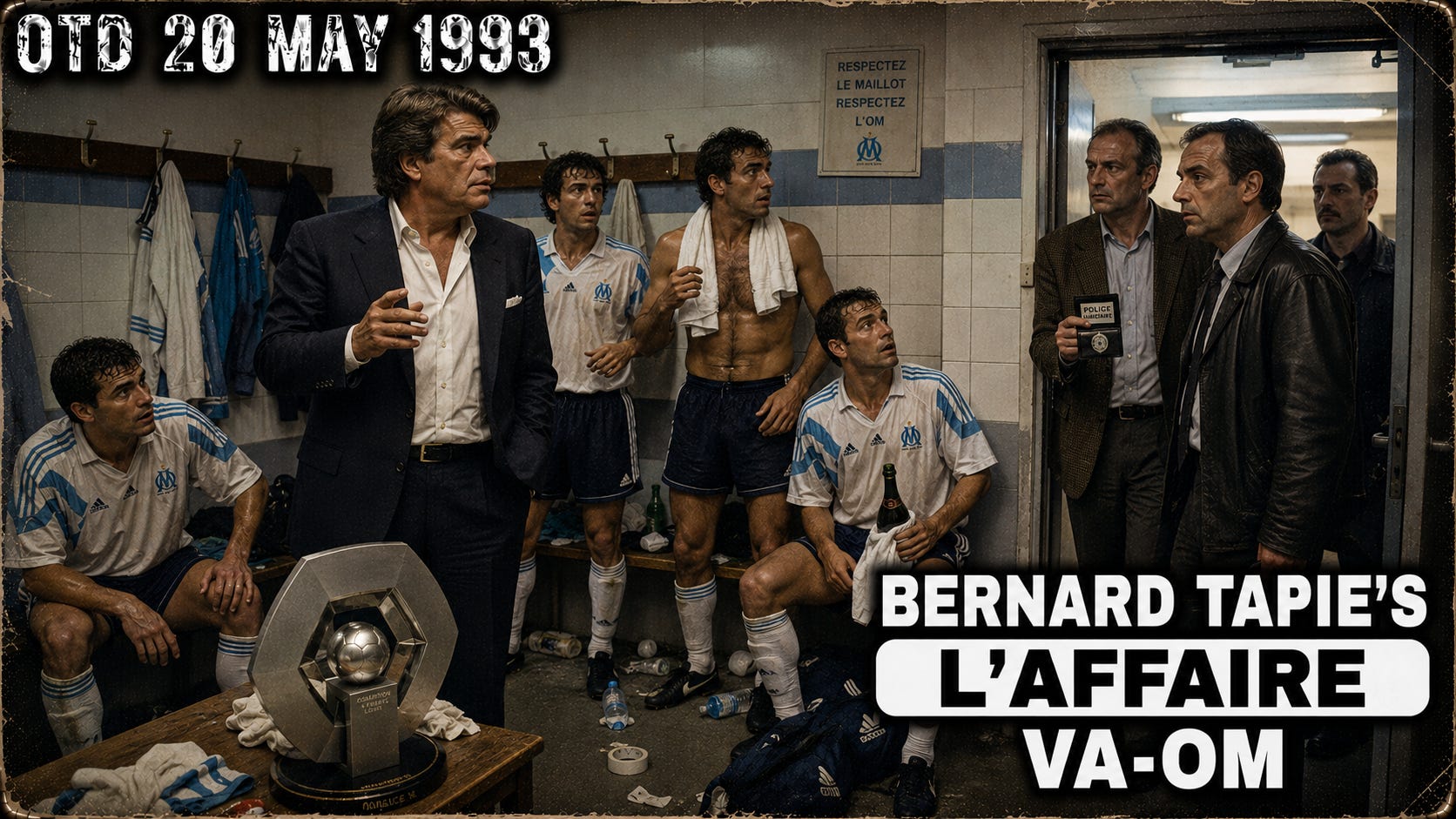
It is 20 May 1993. Stade Nungesser. Valenciennes against Olympique de Marseille.
Marseille win 1-0 through Alen Bokšić and secure what looks like their fifth consecutive French league title.
Then, almost immediately, police enter the Marseille dressing room.
Because this is not just a title-clinching win. It is the start of l’affaire VA-OM: the match-fixing scandal that will strip Marseille of the French championship, send Bernard Tapie toward prison, relegate one of Europe’s strongest clubs, and forever stain the team that, six days later, will win the Champions League.
This is Marseille’s most glorious week. And its most shameful.
Marseille is not just a football club. It is a port-city identity: Mediterranean, working-class, noisy, proud, suspicious of Paris, emotionally extreme. The club had won titles before, especially in the early 1970s, but by the mid-1980s it was far from the power it would become.
Then Bernard Tapie arrived.
Tapie was a businessman, politician, showman and risk-taker. He had built a reputation buying struggling companies, turning them around, selling the story as much as the product. He had sporting success in cycling with La Vie Claire. He bought Adidas. He moved in politics. And in 1986, he took over OM.
French football had not really seen anything like him.
Tapie wanted stars, trophies and European recognition. He brought in players and coaches at a speed that made Marseille look less like a club and more like a project to conquer time: Jean-Pierre Papin, Chris Waddle, Enzo Francescoli, Klaus Allofs, Carlos Mozer, Abedi Pelé, Didier Deschamps, Basile Boli, Marcel Desailly, Rudi Völler, Fabien Barthez, Alen Bokšić — and Raymond Goethals on the bench.
Domestically, OM dominated. Champions in 1989. Again in 1990. Again in 1991. Again in 1992. But Europe kept hurting them.
In 1990, Benfica eliminated them in the European Cup semi-final with Vata’s infamous handball goal. In 1991, Marseille reached the final and lost to Red Star Belgrade on penalties. And that defeat matters deeply to this story, because Marseille went into that final with players missing and players not fully right. Tapie did not want to experience that again.
Meanwhile, the European Cup itself was changing. UEFA had rebranded and reshaped the competition into the Champions League, formalizing the group-stage logic and pointing the tournament toward the television-money era. This was the world of Berlusconi’s Milan, of commercial acceleration, of clubs beginning to understand that Europe was not just prestige. It was revenue, brand, empire.
Marseille wanted to be first in that new world.
In 1992-93, they got there. They survived the early rounds, then topped a Champions League group ahead of Rangers, CSKA Moscow and Club Brugge. AC Milan, Berlusconi’s machine, were waiting in the final in Munich.
But before Munich came Valenciennes.
Before the Champions League final, Marseille travelled north needing to protect the league title and, more importantly, protect the legs that would face Milan.
This is where the scandal begins.
According to the later case, Tapie and Marseille general manager Jean-Pierre Bernès used Marseille player Jean-Jacques Eydelie as the contact man. Eydelie had former Nantes teammates at Valenciennes. The targets were Christophe Robert, Jacques Glassmann and Jorge Burruchaga.
Yes, that Jorge Burruchaga. The man who scored Argentina’s winning goal in the 1986 World Cup final.
The request was not quite “lose 10-0.” It was more cynical than spectacular. Take it easy. Do not injure Marseille players. Let OM get through the match safely before Milan.
Glassmann refused. Robert accepted. Burruchaga’s role became part of the case.
Money changed hands, with 250,000 francs later found buried in the garden of a relative of Christophe Robert.
Then came the match. Bokšić scored in the first half. Robert went off injured early, after a challenge by Éric Di Meco. During the match, Glassmann told his coach, Boro Primorac, what had happened. He also alerted the referee, Jean-Marie Véniel.
After the final whistle, the police went into the Marseille dressing room and began questioning players.
Imagine that scene. A club has just won the league. The Champions League final is six days away. And the dressing room door opens not for champagne, not for photographers, but for investigators.
On 26 May 1993, in Munich, Marseille beat AC Milan 1-0. Basile Boli scored with a header from Abedi Pelé’s corner. Desailly, Boli, Barthez, Deschamps, Angloma, Di Meco — they fought through one of the great Milan sides. Marseille became the first French club to win the European Cup.
And the whole thing was immediately contaminated.
UEFA did not strip the Champions League title. The fixing case concerned a French league match, not the European final. But the shadow was unavoidable. Marseille had conquered Europe with a brilliant team, and at the same time, the club’s leadership had corrupted a domestic match to protect that conquest.
The punishment tore Marseille apart.
The French federation stripped OM of the 1992-93 league title. Paris Saint-Germain, who finished second, refused to accept it. PSG also did not take the Champions League place that opened when Marseille were barred from defending their European crown. Canal+ owned PSG and had strong commercial reasons not to inflame subscribers in Provence.
Marseille were banned from the 1993-94 Champions League, the European Super Cup and the Intercontinental Cup. Later, amid the scandal and financial crisis, they were forced down into Division 2. Bankruptcy followed. They would not return to the top flight until 1996.
The human stories diverged sharply. Jacques Glassmann became the conscience of the affair. He had refused the bribe, spoken up, and paid for it socially and professionally. In 1995, FIFA gave him its Fair Play Award. Christophe Robert and Jorge Burruchaga were punished. Eydelie was punished. Bernès was punished, though he later rebuilt a career as a major agent. Tapie was convicted, sentenced to prison, and became forever tied to the scandal that brought down the empire he had built.
And French football had to live with the paradox. The country’s first European champion was also its most tainted champion.
That is why VA-OM still matters. Not because football had never known corruption before. It had. Italy had Totonero in 1980, later Calciopoli in 2006. Germany would have the Hoyzer referee scandal in 2005. But VA-OM was different because of the timing.
The new Champions League era had just begun. More money was entering the game. Television was changing incentives. Presidents were becoming celebrity power-brokers. The modern game was taking shape — and immediately, one of its first great winners showed how badly power could distort competition.
🎙️ The full episode (linked above) has more — including the detailed legal aftermath, PSG’s principled refusal to accept the stripped title, Valenciennes’ own collapse from Division 1 to bankruptcy, Tapie’s later years, and the wider comparison with Totonero and Calciopoli. The whole arc is in the audio.
---
🎧 Also available on Apple Podcasts, Amazon Music, Overcast, iHeart, and YouTube.
📩 Got an episode idea? otd@17lawsguy.com
Yesterday: 19 May 1968 — Iran Beats Israel and Claims Asia.
Tomorrow: 21 May 1904 — The Founding of FIFA.