

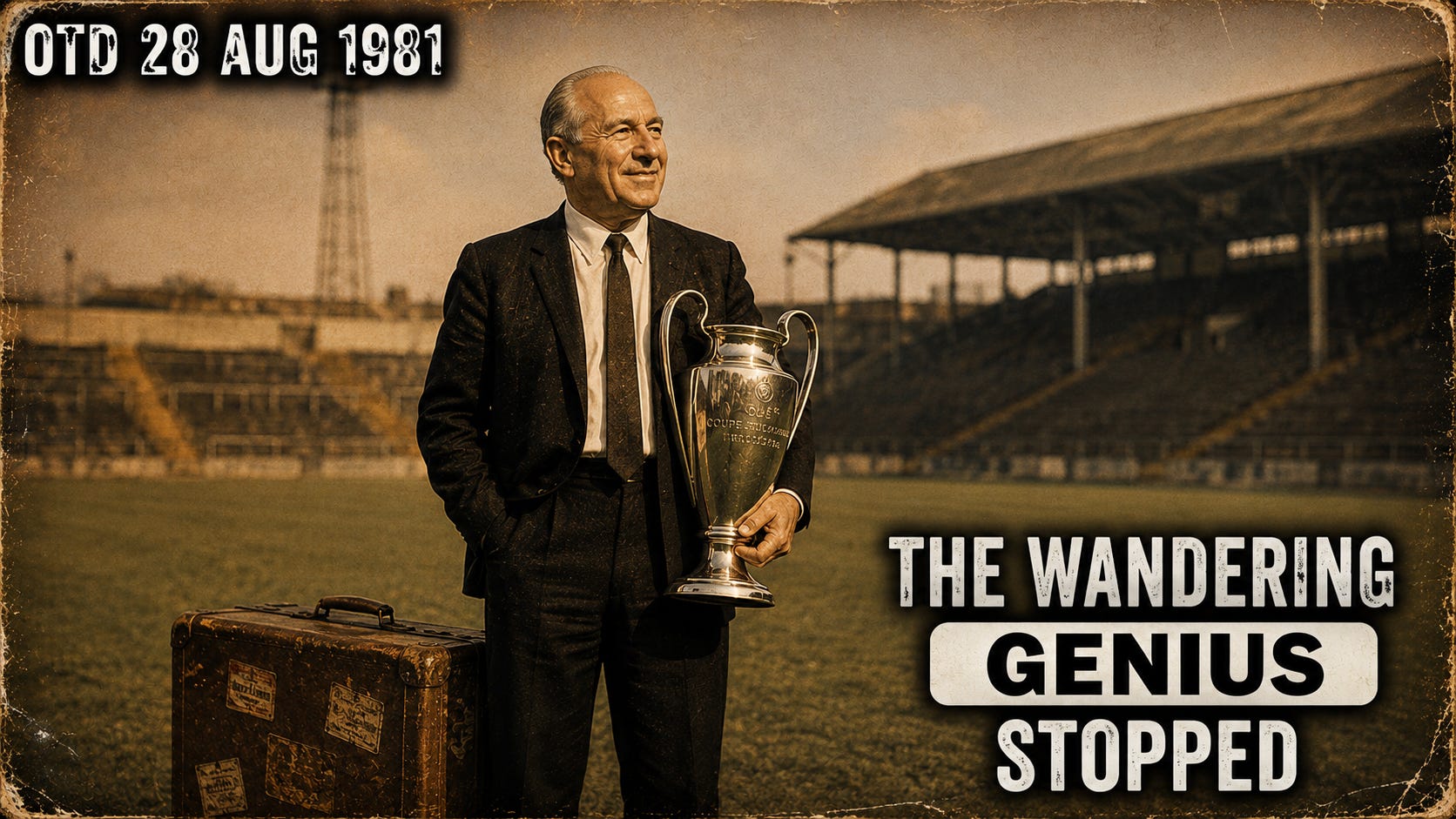
It is August 28, 1981, and in Vienna Béla Guttmann dies at the age of 82. Hungarian, Jewish, a survivor of the Holocaust, and one of football’s first truly global coaches, he had crossed borders again and again, won titles on both sides of the Atlantic, carried a tactical revolution to Brazil, and broken Real Madrid’s grip on Europe with Benfica. A curse is attached to his name, but the curse is the least interesting thing about him. Guttmann did not just win matches. He helped change what a coach could be.
He grew up in Budapest around the turn of the century, the son of dance teachers, and learned to dance himself: balance, footwork, rhythm, movement. It reads like a footnote, and it was not. He joined MTK Budapest, won Hungarian titles in 1920 and 1921, and came up inside the school of Jimmy Hogan, the English coach who had brought the Scottish passing game to Central Europe. Keep the ball on the ground, pass in short combinations, prize technique over force, think about space. Those ideas would eventually run through the Magical Magyars and far beyond.
Then history began to move him. With antisemitism rising, in 1922 he left for Vienna and Hakoah, the proudly Jewish club whose name is Hebrew for strength. They won the Austrian title in 1925 and toured the world, and when 46,000 people watched them at the Polo Grounds in New York in 1926, Guttmann stayed in America. He played, taught dance, tried business, and lost heavily in the Wall Street crash of 1929. On a 1930 tour of South America, a penniless Hungarian named Imre Hirschl asked him for work; Guttmann found him a place as masseur, and Hirschl went on to become one of the great Hungarian coaching exports to Argentina and Uruguay. The network through which Hungarian football ideas travelled was often built on chance meetings like that.
Guttmann came home and became a coach. Hakoah, Enschede, Újpest, a Hungarian title and the Mitropa Cup in 1939. Then history became far bigger than football. Hungary passed anti-Jewish laws, the Nazis occupied the country in 1944, and Guttmann hid in Budapest, was sent to a forced-labor camp, escaped when deportation loomed, and survived the final months of the war in hiding. Many of his family did not. He rarely spoke of it afterward.
Then he went back to football, and barely stopped. Romania, Italy, Argentina, Cyprus, always moving, always arguing, always convinced that the coach, not a director in the grandstand, should run the club. Dismissed by AC Milan while they sat top of the table, he reportedly began inserting a clause into his contracts: if my club is first, you cannot sack me. He decided a third season at any club was fatal, and tended to leave before it could arrive.
Then came Brazil. In 1957 he took charge of São Paulo, won the state championship, and helped popularize the emerging 4-2-4: four defenders, two midfielders, four attackers, width and movement and freedom. He did not invent it. The idea ran through Márton Bukovi’s withdrawn centre-forward and Gusztáv Sebes’s Hungary before Guttmann helped transplant it. But the bridge to what followed is real. The man who coached São Paulo immediately before him was Vicente Feola, and a year later Feola led Brazil to the 1958 World Cup, playing 4-2-4, with a teenager named Pelé, and became world champions. Hungarian ideas had crossed the Atlantic and turned into something unmistakably Brazilian.
Guttmann crossed back. He won the Portuguese league with Porto in 1959, then moved straight to Benfica and built his masterpiece. He cleared out around twenty players, promoted youth, demanded authority, and built around José Águas, Mário Coluna and José Augusto. For the European Cup’s first five seasons, Real Madrid had won every one. In 1961, Guttmann’s Benfica beat Barcelona 3-2 in Bern and broke the monopoly. A year later they met Madrid themselves. Puskás scored a hat-trick, Madrid led, and then a teenager from Mozambique took the game away. Eusébio, spotted in Lourenço Marques by the Brazilian José Carlos Bauer and steered to Lisbon, scored twice. Benfica won 5-3. Back-to-back champions of Europe.
And then, because he was Guttmann, he moved again, to Peñarol in Montevideo. His life is really the argument. The passing game, the withdrawn forward, the back four, the roaming wingers: those ideas travelled because men like him travelled, and they travelled partly because twentieth-century Europe kept forcing people across its borders. He was also, unmistakably, a new kind of manager: theatrical, confrontational, mobile, the coach as protagonist rather than club servant.
The curse came later. After leaving Benfica in a dispute over money, legend says he swore they would not be European champions again for a hundred years, and Benfica have lost European final after European final since. Yet there is no good contemporary evidence he ever said it, and in a 1963 interview he predicted Benfica could win again. The trophies are real. The influence is real. The curse we can leave to mythology, which is almost perfect, because Guttmann never needed it to be fascinating.
---
🎧 Listen on Spotify, Apple Podcasts, Amazon Music, Overcast, iHeart, and YouTube.
📩 Got an episode idea? otd@17lawsguy.com
Yesterday: 27 August 1960, rain wins a Manchester derby.