

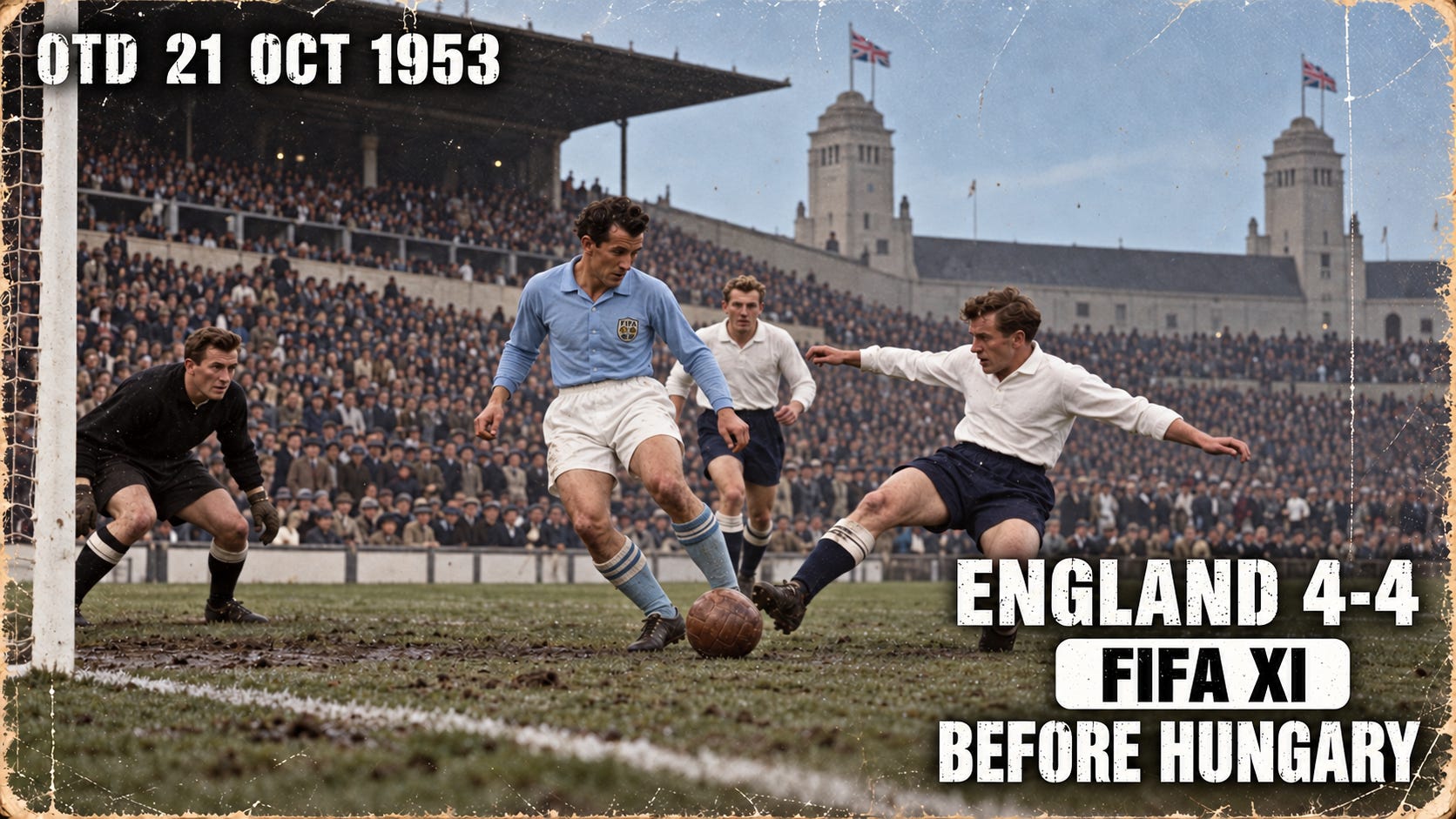
Ninety years after the Football Association had helped turn a schoolboy game into the world’s most portable sport, Wembley was meant to host a birthday party. On Wednesday, 21 October 1953, 96,000 people came to see England play a FIFA XI billed on the programme as “The Rest of the World.” They got eight goals, Stanley Matthews in his thirty-ninth year, and a last-minute penalty that kept England from losing its own anniversary celebration.
It sounded like a harmless gala. It was not quite that. The visiting side contained some of Europe’s finest footballers, among them Italy’s Giampiero Boniperti, Sweden’s Gunnar Nordahl, Austria’s Ernst Ocwirk and Gerhard Hanappi, Yugoslavia’s Bernard Vukas and Branko Zebec, and the wonderfully complicated László Kubala. By the final whistle, Kubala had scored twice, Boniperti twice, and England had required Alf Ramsey’s penalty with seconds left to escape at 4-4.
Thirty-five days later, Hungary arrived at the same stadium and won 6-3. The anniversary game did not cause that result, and it was not a tactical rehearsal in any literal sense. But it was an unusually public warning: the continent had more than enough players, ideas and confidence to trouble England at Wembley. England enjoyed the entertainment. It did not yet fully hear the message.
How Did We Get Here?
The match belonged to a form of international football that now feels almost vanished: the representative XI. Before a packed calendar of qualifying windows, club competitions, television contracts and player-load arguments, a national association could mark an anniversary, a political occasion or a charitable cause by inviting a selected side to meet the hosts. The name changed—Rest of Europe, FIFA XI, Rest of the World, continental selection—but the promise was the same. It offered a one-off assembly of players who would never normally be team-mates.
The FA had used the idea before. England had met a Rest of Europe side in 1938, during the FA’s seventy-fifth anniversary year. Other European associations also made commemorative fixtures part of their public language: the Danish, Dutch and German associations staged anniversary programmes and representative occasions of their own. The match was usually both theatre and diplomacy. It could celebrate an institution, provide a prestigious gate, honour a visiting association or direct money toward a cause. It also allowed football to present itself as a European family even when its ordinary business remained resolutely national.
The most revealing immediate predecessor came at Hampden Park in 1947. The four British associations had returned to FIFA after their long separation, and Great Britain met a Rest of Europe XI before a crowd of about 137,000. Britain won 6-1, but the point was larger than the score. The receipts—roughly £35,000—were put at FIFA’s disposal at a moment when the war had badly interrupted its finances. That match displayed football as post-war repair: reconciliation on the pitch, a large public spectacle in the stands, and practical support for the international body.
That comparison also guards against an easy assumption about Wembley in 1953. Anniversary football did not always mean the same beneficiary. Some matches openly raised funds for a governing body, relief or charity; others were principally association celebrations, with the host using the gate to underwrite its own programme and the occasion’s costs. The surviving match material for England–FIFA makes the anniversary purpose and the attendance clear, but it does not establish a comparable charitable destination for the Wembley receipts. What can be said safely is that the gate was part of the attraction. A near-capacity house turned a ceremonial fixture into an event of real financial and cultural weight, while the players received an audience normally reserved for England’s most consequential internationals.
Six years later, Wembley’s occasion carried some of the same mood. Britain was still living in the long shadow of the Second World War: rationing had only recently ended, and international travel and cultural exchange retained a glamour that later generations would take for granted. A midweek crowd of 96,000 for an exhibition fixture was not a diversion at the margins. It was national entertainment on a grand scale. The FA’s programme placed England against FIFA under the heading “International Football,” and its blue portrait of captain Billy Wright made the invitation feel ceremonial as well as competitive.
Who picked the visitors? Not a coach with months of training-ground work, and certainly not an algorithm. These sides were assembled through FIFA and the participating associations: availability, club obligations, travel, national politics and personal reputation all mattered. The nominal manager here was Karel Lotsy, the Dutch administrator and former Feyenoord figure. His job was less that of a modern head coach than of a selector and host of an international cast. The very impossibility of making a settled team was part of the attraction. Supporters came to see great names placed together in an experiment.
The names were formidable. At centre-forward stood Nordahl, the devastating Milan scorer. Boniperti, still only twenty-five, was already Juventus’s elegant leader in waiting. Ocwirk, the Austria captain, was one of the outstanding midfielders in Europe. Hanappi had brains and grace; Vukas and Zebec brought Yugoslav imagination. There was also a goalkeeper change at half-time that now looks wonderfully unbranded: Vladimir Beara replaced Walter Zeman without wearing a shirt number.
The most striking selection was Kubala. By October 1953, his football identity had been repeatedly disrupted by twentieth-century Europe. Born in Budapest to a Slovak father and Hungarian mother, he had played for Czechoslovakia and Hungary, fled the new Communist order, and then built a new career in Spain with Barcelona. National eligibility and political recognition did not fit him neatly. He had become, in a sense, exactly the kind of player a representative team could accommodate: famous enough to command a place, gifted enough to transcend the paperwork, and unable to be reduced to one simple national story.
That made the “FIFA” badge unusually apt. This was not a full international in the normal sense, though it was conducted with full international seriousness. England selected Walter Winterbottom’s familiar 3-2-5: Gil Merrick in goal; Alf Ramsey and Bill Eckersley at full-back; Wright, Derek Ufton and Jimmy Dickinson across the middle; Matthews, Stan Mortensen, Nat Lofthouse, Albert Quixall and Jimmy Mullen up front. Ufton, the Charlton Athletic centre-half, was winning his only England cap. The stage was a celebratory one; the selections still carried consequence.
It was also an intriguing moment in the organisation of the European game. UEFA did not yet exist. The conversations that would lead to it had already started: administrators including Ottorino Barassi, Henri Delaunay and José Crahay had been talking in Zurich, Paris and Helsinki, and FIFA had just approved a statutory basis for continental confederations. But UEFA would not formally be founded until June 1954, and the European Champion Clubs’ Cup was still another season and a half away. Europe possessed extraordinary players and increasingly connected administrators, but not yet its durable continental competitions. A FIFA XI was one way of making that Europe visible.
The match began by puncturing English comfort. Kubala scored from the penalty spot in the fifth minute. Mortensen replied three minutes later, but Boniperti struck in the fifteenth and again before half-time. Mullen’s goal just before the interval gave England a way back, yet the visitors led 3-2 at the break.
Mullen levelled again four minutes into the second half. Then Kubala restored the visitors’ advantage in the sixty-fourth minute. The score remained 4-3 deep into the afternoon. England had Matthews, Lofthouse and Mortensen in the same forward line; the representative side had never had time to become a club-like unit. Still, the supposedly temporary combination looked coherent enough to take the party away from its hosts.
Only at the death did England escape. Zlatko Čajkovski brought down Mortensen, Ramsey took the penalty, and 4-4 became the final score. For the anniversary crowd, that was a satisfying ending. For anyone looking carefully at the direction of the game, it should have been unsettling.
So What?
Contemporary reaction caught both sides of the occasion. The quality of the visiting side was admired—one account in the following day’s Manchester Guardian said the Europeans had blended “like good tobacco”—but much English attention naturally rested on the relief of the late equaliser. The penalty was debated as generously awarded. That, too, mattered. A draw can be filed as a pleasant, high-scoring exhibition; a home defeat to an improvised European side would have been much harder to domesticate.
The result did not create a national panic about Hungary. England were still capable of treating Europe as a collection of talented individuals rather than a challenge to their assumptions about space, movement and tactics. Yet the coincidence is too sharp to ignore. The Olympic champions were due at Wembley on 25 November. They would bring a settled, highly drilled side led by Ferenc Puskás, a different level of collective understanding, and the confidence of a country that knew it had something new. The FIFA XI had shown that foreign stars could make England uncomfortable. Hungary demonstrated that a team built around a modern system could do much more than that.
The bombshell of 6-3 therefore lands differently when placed beside the 4-4. England had not gone from perfect security to shock in a single autumn afternoon. At Wembley in October, an international selection had already found four goals against them and required a dubious-looking late rescue to be held. In November, the warning became a historical rupture.
Kubala’s part gives the earlier match its own afterlife. He was a rare international chance in the most literal sense: a celebrated footballer whose route through Hungary, Czechoslovakia, exile and Spain had made normal representation difficult. He would go on to play for Spain, but not at the 1954 World Cup. Wembley had briefly put him alongside the men who represented more settled football nations, and he had been one of the day’s decisive figures. His two goals made the FIFA XI more than a collection of exotic names.
That was the representative XI’s special power. These games gave supporters encounters that ordinary fixtures could not: Nordahl with Boniperti; Kubala beside Vukas; later, Alfredo Di Stéfano, Ferenc Puskás, Lev Yashin, Eusébio, Francisco Gento, Uwe Seeler and Denis Law in the Rest of the World side chosen for the FA centenary in 1963. They could raise money, celebrate an association, express post-war reconciliation or give a public a glimpse of football as a shared continental culture. They also created great little counterfactuals. What might a real team made from these players have achieved with time?
The answer, of course, is that they rarely had time. That was always the weakness and part of the charm. Selectors could gather brilliance but could not manufacture habits. The 1953 side had enough class to expose England, but not enough preparation to become Hungary. The 1963 all-stars could delight a crowd, but they could not replace the emotional stakes of a World Cup or a national shirt.
By the later twentieth century, the calendar began to defeat the idea. Club football became richer and more demanding; European club competition expanded; broadcasters paid for competitive inventory rather than charming exceptions; and international windows acquired qualifying obligations. The political changes after the Cold War added new national associations to UEFA and more fixtures to the route into major tournaments. That was a genuine triumph of representation—more countries could play under their own flags—but it left less room for temporary composite ones.
The tradition never disappeared completely. Benefit matches and anniversary selections still surface, and football has repeatedly rediscovered the appeal of an all-star occasion. But they now tend to feel exceptional, promotional or charitable. In 1953, the representative XI still belonged to the mainstream international imagination. A crowd of 96,000 could treat it as a major event, newspapers could assess it seriously, and the best players of several countries could form one afternoon’s answer to England.
That is why this 4-4 deserves to be remembered as more than a footnote before Hungary. It was a celebration of the FA’s past, but it was also a glimpse of football’s future: international, commercially attractive, administratively European before UEFA existed, and capable of moving its greatest players across borders that had recently been battle lines. England left Wembley unbeaten. The rest of Europe had made the point anyway.
The applause at full time was genuine. So, in retrospect, was the warning beneath it.
Three Things to Take Away
A birthday match became a warning. England needed Ramsey’s last-minute penalty to draw 4-4 with a FIFA selection only five weeks before Hungary’s 6-3 triumph at Wembley.
Representative XIs made football’s internationalism visible. They gathered players such as Kubala, Boniperti, Nordahl and Ocwirk for occasions that mixed spectacle, solidarity, commemoration and, sometimes, fundraising.
Their decline tells its own story. More national teams, denser qualification schedules, richer clubs and expanded European competitions made these once-central gala fixtures harder to stage.
On This Day
On 21 October 1953, England drew 4-4 with a FIFA XI at Wembley in the Football Association’s ninetieth-anniversary match. László Kubala and Giampiero Boniperti scored twice each for the visitors; Jimmy Mullen scored twice for England, while Stan Mortensen and Alf Ramsey supplied the other goals.
Do you have a programme, photograph or family memory of this match? I would love to hear from you at otd@17lawsguy.com.
Yesterday: 20 October 1982 — The Night Moscow Was Told Not to Remember.