

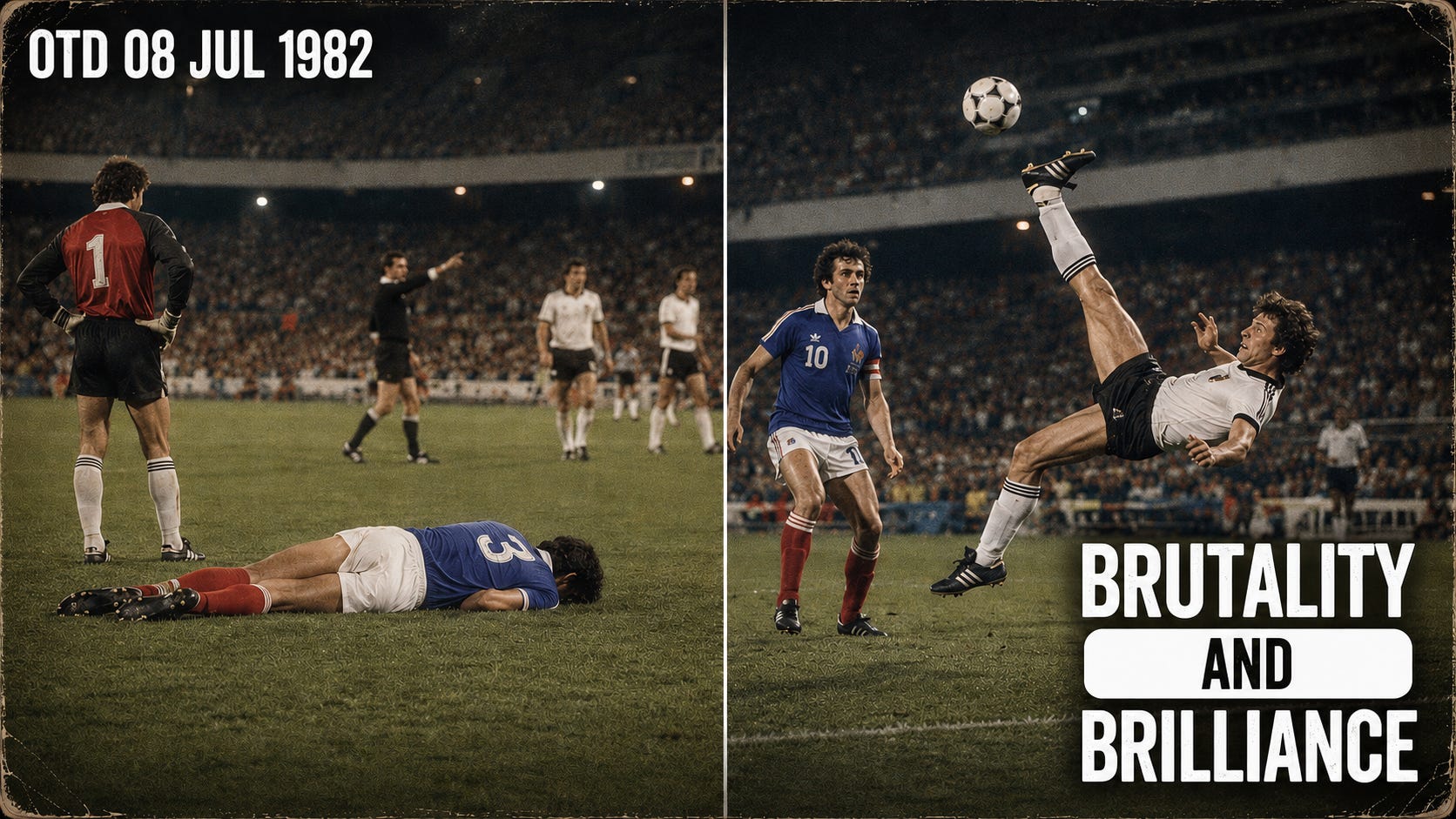
It is 8 July 1982, at the Ramon Sanchez Pizjuan in Seville. France against West Germany, a World Cup semifinal. It becomes one of the greatest matches ever played, and one of the most disturbing, and both facts start with Patrick Battiston. In the second half, level at 1-1, Michel Platini threads him through on goal. Battiston reaches the ball first and knocks it past Harald Schumacher. Then Schumacher arrives, leaping and turning his hip and body into Battiston’s head. Battiston collapses, unconscious, teeth broken, ribs damaged. Platini later said he thought his teammate was dead. The referee gave a goal kick. No foul. No card. Nothing.
That silence of the Law is what still makes the moment feel insane. Cards existed in 1982. Serious foul play existed. Under today’s Law 12, a challenge that endangers an opponent’s safety with excessive force is a straight red, almost certainly reviewed by VAR, with Battiston removed under a concussion protocol. Instead Schumacher simply waited by his goal, France used a substitution to carry off their stricken player, and the match went on. That it did not collapse into a brawl is its own small miracle.
To understand the stakes, you have to know both teams were at a peak. West Germany were reigning European champions under Jupp Derwall, carrying the long German winning line forward through Rummenigge, Breitner, and Littbarski. France were something newer: the coming-out party of a rebuilt football nation, with the midfield they called the Magic Square, Platini, Giresse, Tigana, and Genghini, playing the most beautiful French football in a generation. This was the team that would win Euro 1984, arriving a tournament early.
After the horror, the match refused to die down. It went to extra time at 1-1, and France seemed to settle it: Marius Tresor volleyed them ahead, then Giresse curled in off the post for 3-1. In most matches that is the end. But Germany are Germany. Rummenigge, half-fit, came off the bench and pulled one back. Then, on 108 minutes, Klaus Fischer met a knockdown with his back to goal and scored with an improvised bicycle kick, more scrambled than textbook, and perfect anyway. France 3, West Germany 3.
And so it went to the first penalty shootout in World Cup history. The competition had finally replaced replays and coin tosses with the cruelest tiebreaker of all, and it debuted on the biggest possible stage. France led it. Rocheteau made it 3-2, and when Uli Stielike’s kick was saved, he sank to the turf believing he had lost the semifinal, only for Schumacher, of all people, to haul him up. Then Schumacher saved from Didier Six, and the momentum turned. Littbarski, Platini, and Rummenigge all scored. Four-four, and into sudden death. Maxime Bossis walked forward for France, Schumacher saved again, and Horst Hrubesch scored to send West Germany to the final. The goalkeeper who should have been sent off had kept them alive and then won them the shootout.
West Germany lost that final to Italy and Paolo Rossi, a small justice some found comforting. Battiston recovered, and years later even spoke with Schumacher, though the image never faded. France carried the wound into the triumph of 1984. What Seville left behind is the hardest question football asks about itself. It was a masterpiece: six goals, staggering swings, the first shootout, courage everywhere. It was also a moral disgrace, a near-fatal assault that went unpunished and helped decide who reached a World Cup final. Both things are true, and the match makes you hold them at once.
🎙️ THE PODCAST GOES DEEPER. The full episode has the Battiston collision under Law 12, both teams’ roads to Seville, and the shootout kick by kick. That’s the 10-minute version.
---
🎧 Listen on Spotify, Apple Podcasts, Amazon Music, Overcast, iHeart, and YouTube.
📩 Got an episode idea? otd@17lawsguy.com
Yesterday: 7 July 1974, Total Football meets Die Mannschaft.
Tomorrow: 9 July 2006, Italy’s last World Cup after Zidane’s headbutt.