

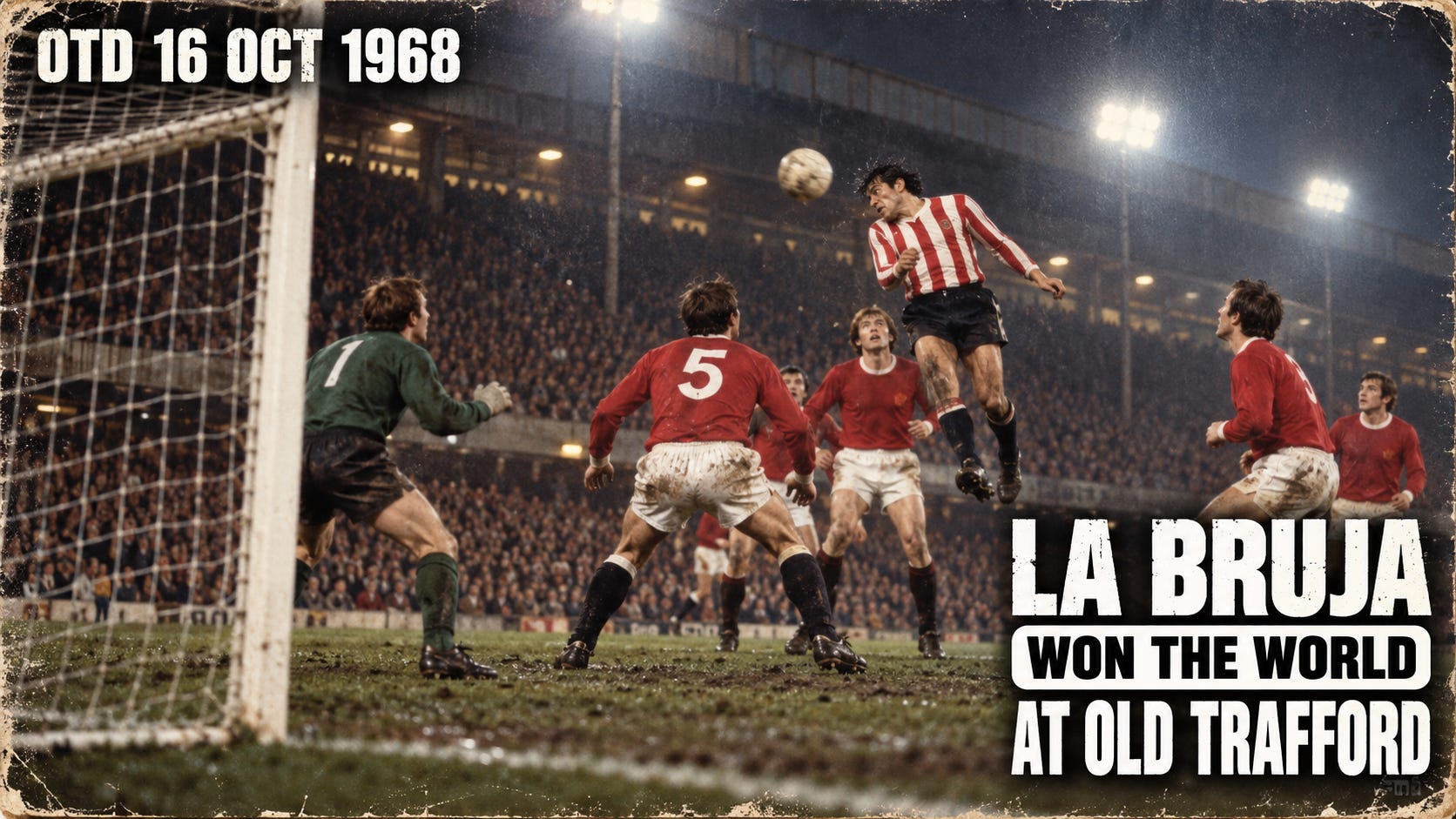
On October 16, 1968, the second free kick of the night floated into the Manchester United penalty area. Raúl Madero had not delivered it toward the obvious crowd. He sent it deeper, toward the far side, where Juan Ramón Verón had found the space that Estudiantes had rehearsed into existence.
Verón rose and turned his header across Alex Stepney. Seven minutes had passed at Old Trafford. Manchester United had begun the evening needing to erase a 1‑0 defeat from the first leg. Now the European champions needed two goals simply to force a playoff.
The scorer was known as La Bruja, the Witch. The nickname suggested mystery. The goal was almost the opposite. It came from preparation, movement and a team that treated detail as a weapon. Estudiantes had crossed the Atlantic carrying a narrow lead and a reputation for making opponents play the match they least wanted. One set piece had made their position almost impregnable.
More than 63,000 people watched United attack, Estudiantes resist and the occasion curdle. George Best and José Hugo Medina were dismissed near the end. Willie Morgan finally equalized in the final minute. It changed the score to 1‑1. It changed nothing else.
Estudiantes had become champions of the world at Old Trafford.
How did we get here?
The match existed because two continental competitions had created a new argument. The European Cup began in 1955. The Copa Libertadores followed in 1960. Once Europe and South America could each name a champion, UEFA and CONMEBOL paired them in the Intercontinental Cup. The prize offered a wonderfully direct answer to a question football had asked through tours and friendlies for decades: which club was best in the world?
The early format was severe. The champions met home and away, but results earned match points rather than forming a conventional aggregate score. A win was worth two points and a draw one. If the clubs finished level on points, they played a third match at a neutral venue. In 1968, this rule mattered. Estudiantes did not need to protect a one-goal aggregate advantage at Old Trafford. A draw would give them the trophy with a 3‑1 lead in match points. A United win by any score would force a playoff.
The competition was only eight years old and already carried glory and menace in equal measure. Real Madrid had demolished Peñarol 5‑1 at the Bernabéu to win the first edition. Peñarol answered by becoming champions in 1961 and 1966. In 1967, Racing Club and Celtic required three matches, six dismissals in the playoff and police intervention before Racing became the first Argentine club to take the title. The Battle of Montevideo left the Intercontinental Cup with a promise and a threat: the two great football continents would meet as peers, and nobody could guarantee what the meeting would become.
Manchester United arrived in 1968 through the most emotional European Cup victory English football had yet seen. Matt Busby had taken United into Europe against the instincts of the English establishment in the 1950s. The Munich air disaster of 1958 killed eight players and shattered the young side he had built. Busby survived, rebuilt and returned.
On May 29, 1968, United met Benfica at Wembley. Bobby Charlton headed them in front. Jaime Graça equalized. The final went to extra time, where Best, Brian Kidd and Charlton scored in a decisive burst. United won 4‑1 and became the first English club to lift the European Cup. Ten years after Munich, Busby had reached the destination around which so much of his life had been organized.
United’s glamour was almost unfair. Charlton had won the World Cup and the Ballon d’Or. Denis Law had also won the Ballon d’Or. Best would receive it for 1968. Behind them stood Nobby Stiles, Bill Foulkes, Pat Crerand, Stepney and the nineteen-year-old Kidd. They were European champions with a front line that seemed designed for mythology.
Estudiantes arrived by breaking a different order.
For most of Argentina’s professional era, championships belonged to the five giants of Buenos Aires and Avellaneda: Boca Juniors, River Plate, Independiente, Racing Club and San Lorenzo. Estudiantes came from La Plata, carried less money and less historical weight, and had never won a major professional title.
Osvaldo Zubeldía turned that exclusion into an identity. His Estudiantes studied opponents, practiced set pieces, drilled the offside trap and treated fitness, positioning and psychology as connected parts of the same contest. His players could pass and improvise, but nothing was left to romance if it could be prepared in advance. Carlos Bilardo, the midfielder who would coach Argentina to the 1986 World Cup, absorbed the method from inside the team.
In the 1967 Metropolitano, Estudiantes beat Platense 4‑3 in the semifinal and Racing 3‑0 in the final. Madero, Verón and Felipe Ribaudo scored. The victory made Estudiantes the first club outside the traditional five to win a professional Argentine league championship.
The 1968 Copa Libertadores proved that the breakthrough was not temporary. Estudiantes advanced through a campaign that repeatedly placed them against established power. They beat Independiente twice in the first phase, met them again in the next group, then faced reigning South American and world champions Racing in the semifinal.
Estudiantes won 3‑0 in La Plata. Racing won 2‑0 in Avellaneda. The playoff finished 1‑1, and Estudiantes advanced on goal difference. Verón’s equalizer was an overhead kick, a flash of invention from the player who supplied magic inside Zubeldía’s machine.
The final against Palmeiras also required three matches. Estudiantes won 2‑1 in La Plata, lost 3‑1 in São Paulo and met the Brazilian champions again at the Centenario in Montevideo. Ribaudo scored after thirteen minutes. Verón added the second late. He had scored in all three final matches. Estudiantes were champions of South America in their first Libertadores campaign.
That route explains why reducing them to cynicism misses the team. They did intimidate, provoke and operate beyond acceptable limits. Their reputation was earned. Yet it sat beside exceptional organization and repeated achievement. They had beaten Independiente, Racing and Palmeiras. Their players understood space, timing and the emotional temperature of a match. Their set pieces were years ahead of the casual restarts common elsewhere.
The first Intercontinental Cup leg was played at Boca Juniors’ La Bombonera on September 25. Estudiantes pressed, disrupted and made United uncomfortable. Marcos Conigliaro headed the only goal after twenty-seven minutes. Stiles was sent off in the second half. United lost 1‑0 and returned to England convinced that the tie had been dragged away from football.
The atmosphere had begun tightening before kickoff. United’s players encountered noise, objects and an opponent determined to make every exchange personal. Best was closely marked. Law found little room. Charlton and Crerand could not give the visitors control. Conigliaro’s goal came from the kind of second ball Estudiantes hunted: Madero’s corner reached the danger area, the contest continued rather than clearing, and the forward finished from close range. Stiles’ dismissal in the seventy-ninth minute completed United’s sense that the match had become a trap.
Yet the 1‑0 score also showed Estudiantes’ restraint. They did not turn pressure into a reckless chase for a larger lead. Under the points system, any victory put them in command. The first leg gave them the tactical position Zubeldía wanted: United would have to advance at Old Trafford, while Estudiantes could prepare the spaces that urgency would leave behind.
Estudiantes returned convinced that they had made it their kind of football.
Three weeks later, Old Trafford waited in heavy rain. Supporters queued for hours. United needed a victory of any size to force a third match. Busby selected Stepney; Tony Dunne, Foulkes, David Sadler and Shay Brennan; Crerand and Charlton; Morgan, Kidd, Law and Best. Zubeldía kept the eleven that had won the first leg: Alberto Poletti; Oscar Malbernat, Ramón Aguirre Suárez, Madero and Medina; Bilardo, Carlos Pachamé and Néstor Togneri; Ribaudo, Conigliaro and Verón.
The names read like two different football futures meeting in one match.
United attacked first. Crerand tested Poletti from distance. Then Estudiantes won the free kick, Madero shaped his delivery and Verón headed across Stepney. The prepared move had survived the journey from La Plata to Manchester.
United’s problems deepened when Law was injured and replaced by Carlo Sartori before halftime. Conigliaro struck the crossbar with Stepney beaten. After the interval, Kidd hit the bar at the other end. Poletti saved, Estudiantes countered and the clock became another defender.
The match’s hostility kept rising. Morgan and Medina clashed. With the end approaching, Best struck Medina and pushed Togneri. Best and Medina were dismissed. The contest that had begun with a rehearsed act of precision was ending in the ugliness that already haunted the Intercontinental Cup.
Morgan finally beat Poletti in the final minute. The crowd roared, but the 1‑1 score was not a rescue. Under the points system, Estudiantes had taken three points from the two legs and United one. The whistle confirmed not an upset achieved by surviving Old Trafford, but a world title completed there.
Estudiantes tried to begin a lap of honor. Objects came from the stands and the celebration was curtailed. The champions left the field carrying a trophy, a grievance and a name that would never again sound foreign in Manchester.
So what?
The victory made Estudiantes more than a challenger to Argentina’s old order. In sixteen months, the club had won the Metropolitano, the Libertadores and the Intercontinental Cup. A provincial outsider had conquered Argentina, South America and the European champions on their own ground.
It was the beginning, not the end. Estudiantes retained the Libertadores in 1969 by beating Nacional and again in 1970 by beating Peñarol, becoming the first club to win three consecutive editions. The system reproduced itself because it was a system: preparation, collective belief, tactical clarity and a willingness to take every contest to its limit.
The limit became the problem. In the 1969 Intercontinental Cup against Milan, violence overwhelmed football. Néstor Combin suffered serious facial injuries, and Argentine authorities arrested Estudiantes players after the second leg. The competition’s reputation deteriorated. Ajax, Bayern Munich and Liverpool were among the later European champions who declined to participate. In 1980, the Intercontinental Cup became a single match in Japan, trading the home-and-away ordeal for a controlled neutral event.
The 1968 tie therefore stands at the balance point. Estudiantes’ achievement was genuine. So was United’s anger. The South American champions were not fraudulent winners hiding behind brutality; they were an advanced, accomplished team whose competitive methods included behavior that damaged the very stage they had mastered. Admiration and discomfort belong in the same sentence.
Manchester United’s arc bent downward after Wembley. Busby stepped aside in 1969. The European champions did not become a sustained continental dynasty and were relegated in 1974. Their next European Cup arrived in 1999, when another late surge, this time against Bayern Munich in Barcelona, restored the trophy after thirty-one years.
That victory gave United another Intercontinental Cup. In Tokyo, Roy Keane’s goal beat Palmeiras 1‑0. The club that had been denied the world title at Old Trafford finally won it on neutral ground under the format created to escape nights like 1968.
Then came the most elegant return of all.
In July 2001, United paid a British-record £28.1 million for Juan Sebastián Verón. La Brujita, the Little Witch, was Juan Ramón’s son. Thirty-three years after the father had scored against United at Old Trafford, the son walked into the same stadium wearing United red.
His two seasons in Manchester never matched the scale of the transfer. The Premier League often moved too quickly for the pauses from which he controlled matches, although his European performances offered glimpses of the player United thought it had bought. The move still gave the old final an extraordinary second life. Old Trafford had not simply remembered Verón. It had signed him.
The family arc returned to La Plata. Juan Sebastián went home, captained Estudiantes and led the club to the 2009 Copa Libertadores. In the final, Estudiantes drew 0‑0 with Cruzeiro in La Plata, then won 2‑1 in Belo Horizonte. The son lifted the same continental trophy his father had won three times.
That victory sent Estudiantes to the Club World Cup final against Barcelona. They led through Mauro Boselli and came within two minutes of another world title before Pedro equalized. Lionel Messi scored in extra time. Barcelona won 2‑1, but the line from 1968 remained visible: a club from outside Argentina’s traditional aristocracy, carrying a Verón at its center, once again stood one moment from the summit.
The old opponents eventually returned to the same ground without the rage. In 2018, fifty years after the final, members of the Estudiantes party visited Old Trafford and met former United players. Juan Ramón was among them. The stadium that had cut short the champions’ lap of honor now welcomed them back as honored guests. Time did not rewrite the match. It allowed the men who had lived it to stand inside a story that had become larger than the hostility of one night.
Juan Ramón died in 2025 at eighty-one. By then, Juan Sebastián was again leading Estudiantes from the boardroom. The father’s header had become institutional memory, the son’s career had joined La Plata to Manchester, and the Verón name had passed from player to player to president without ever leaving the club’s idea of itself.
The competition itself also completed a long transformation. The Intercontinental Cup ended in 2004 and folded into FIFA’s world championship structure. Its winners were later formally recognized as world club champions. What began as a direct argument between Europe and South America expanded into a global tournament, while the original title survived in memory because its simplicity had been so powerful. Two champions. Two continents. One claim to the world.
Juan Ramón Verón called the header at Old Trafford the goal of his life. That is not difficult to understand. He scored in all three matches of the Libertadores final, but the goal in Manchester carried Estudiantes beyond South America. It made the club’s greatest era global, made La Bruja eternal and gave his family a story that football would keep rewriting for decades.
Three things to take away
Estudiantes won through preparation as well as resistance. Verón’s early header came from a rehearsed free kick, the signature of a team whose tactical detail was central to its success.
The 1968 rules were based on match points. The 1‑0 first-leg victory and 1‑1 draw gave Estudiantes a 3‑1 advantage in points. The same two results also produce 2‑1 when added, but aggregate score was not the deciding regulation that year.
The Verón story did not end with the goal. Juan Ramón conquered Old Trafford in 1968. Juan Sebastián joined Manchester United for a British-record fee in 2001, then returned home and captained Estudiantes to the Libertadores in 2009.
On This Day...
On October 16, 1968, Old Trafford expected Best, Charlton and Law to pull the European champions back into the world final. Instead, a free kick traveled from Madero’s boot to the head of La Bruja, and the night, the trophy and the future of one extraordinary football family all turned with it.
Questions, corrections or story ideas: otd@17lawsguy.com
Yesterday: October 15, 1887, 26‑0. Hyde’s Best Player Was the Goalkeeper.