

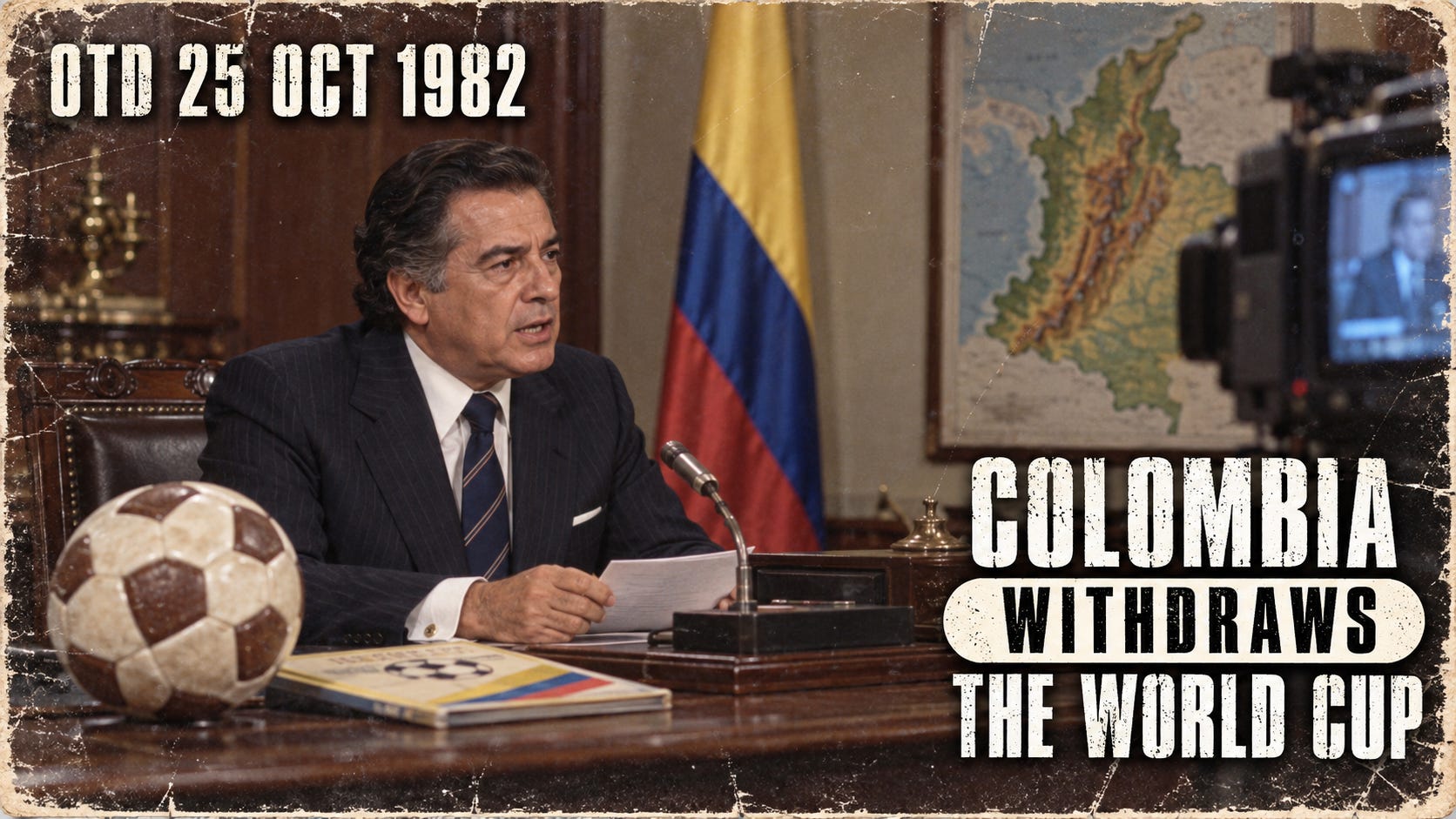
On October 25, 1982, President Belisario Betancur went on Colombian television and did something no national leader had done before. He gave back a World Cup.
“The 1986 World Cup will not be held in Colombia,” he told the country. The sentence was not an admission that football did not matter. It was an argument about what mattered more. Colombia, he said, had many other things to do and no time for “the extravagances of FIFA and its partners.” His sharper formulation became the line that survived: the World Cup should serve Colombia, not Colombia the World Cup multinational.
Four years before the tournament, the host had vanished. FIFA had to find another country in a hurry. Mexico took the event, became the first two-time host and staged the tournament that gave the world Diego Maradona’s most complete World Cup. Colombia was left with an abandoned promise, an unfinished stadium project and a useful warning about the moment when a sporting showcase becomes too large for the public bargain that was supposed to justify it.
How Did We Get Here?
The first surprise is how little the original selection resembled a modern World Cup contest. Colombia did not defeat a packed shortlist in 1974. At the FIFA Congress in Frankfurt, the long-established continental rotation said that 1986 should return to the Americas after West Germany in 1974, Argentina in 1978 and Spain in 1982. Alfonso Senior Quevedo, the influential Colombian football leader, had been promoting the idea since 1973. Colombia was the sole declared candidate, and FIFA confirmed the country as host in June 1974.
Senior’s dream was audacious but not ridiculous. Colombia had football cities, packed domestic grounds and a growing appetite to be seen as more than an exporter of coffee, emeralds and bad news. Bogotá, Medellín, Cali, Bucaramanga and Barranquilla were envisaged as hosts. The latter was to receive a new Metropolitan Stadium. In the early 1970s, the World Cup was a different object: a 16-team finals, fewer matches, fewer host cities, smaller broadcast operations and a much looser idea of what a host government owed the tournament.
That last distinction became fatal. FIFA was changing faster than Colombia’s original promise. In 1978, it approved expansion from 16 teams to 24, beginning in Spain in 1982. The new tournament needed more group-stage matches, more accommodation, more transport, more television capacity and more certainty. João Havelange’s FIFA was also learning how valuable the World Cup could become. The host no longer offered stadia and hospitality alone. It was expected to provide a national platform for a rapidly globalizing commercial event.
For Colombia, that produced a moving target. The requirements circulated for 1986 called for twelve first-phase stadia of at least 40,000 capacity; four grounds above 60,000 for the later rounds; and two above 80,000 for the opening match and final. There were demands concerning airports able to receive jets, roads and rail connections between host cities, a communications tower in Bogotá, hotel-price guarantees, foreign-currency arrangements and transport for FIFA officials. The country’s plan had revolved around five cities. It had not been chosen for a twelve-stadium, 24-team machine.
The issue was not simply that Colombian football lacked passion. It was that Colombia’s geography, finances and state capacity did not make the added promises easy to translate into reality. Three Andean ranges divide the country. Building a tournament transport network across that terrain was not the same as polishing a few grounds. Barranquilla’s new stadium did rise, and investments were discussed, but a World Cup asks a government to make spending choices years before a ball is kicked. Colombia was facing economic strain, political violence and an increasingly dangerous narcotics economy. It had needs that could not be disguised by a drawing of a new stand.
Natural disaster deepened the doubt. In November 1980, an earthquake struck the southern region around the Ecuadorian border. Then, on September 18, 1985, the Mexico City earthquake would demonstrate how exposed a World Cup can be even in a country with existing infrastructure. That later disaster did not cause Colombia’s decision, but it gives the story a strange symmetry: Mexico took a World Cup from a country whose leaders had decided other priorities came first, and then had to prove that it could still stage it after its own catastrophe.
The immediate pressure on Colombia built through 1982. FIFA wanted a binding response. Senior and other football people kept arguing that the tournament could be made to fit the country. Betancur had entered office only in August. He saw a different ledger. On October 25, he chose not to compete with FIFA’s timetable. The President did not offer a soft postponement or ask for a smaller event. He withdrew.
The speech was memorable because it reversed the usual hierarchy. Host governments normally promise that a World Cup will transform a country. Betancur said the country should not transform itself around FIFA’s demands. He also noted, with Colombia still celebrating Gabriel García Márquez’s Nobel Prize four days earlier, that the nation had other ways to be recognized. Whether one reads that as a rhetorical flourish or a political rebuke, it was a striking assertion of national dignity.
FIFA formally accepted Colombia’s withdrawal on November 5. The scramble began. Brazil, Canada, Mexico and the United States emerged as possibilities. Brazil withdrew. The United States put together an ambitious bid, associated with Henry Kissinger and the fading North American Soccer League, but it did not yet have the football infrastructure or internal FIFA support it would later mobilize for 1994. Canada was also interested. Mexico possessed the decisive advantage: it had hosted in 1970, it had Estadio Azteca, it had a tested organizing network and it could promise a quick solution in the Americas.
In May 1983, FIFA’s Executive Committee met in Stockholm, and chose Mexico unanimously. It was the first time a country had been awarded a second men’s World Cup. The choice was not free of controversy. Mexico did not meet every capacity threshold that had been stated to Colombia, and the United States believed its presentation was stronger. Yet an emergency replacement is not a normal bid. FIFA needed a host able to turn existing venues and experience into a tournament within three years. Mexico had that answer, and FIFA accepted it.
There is an uncomfortable lesson in that comparison. Host requirements are never merely neutral engineering standards. They are also a governing body’s statement about the tournament it wants, and about how much risk it is prepared to carry. Colombia’s leaders could plausibly say that the list had been written after their original selection and was disconnected from the country that had been invited to host. FIFA could plausibly say that a bigger finals could not be improvised in five modest venues. Both propositions can be true. What made the dispute historic was that Colombia possessed the political space to say no.
Nor should the story be reduced to a tale of one honest president confronting one extravagant federation. Senior had worked for years to put Colombia in the room, and his campaign operated within a football world where personal relationships, regional alliances and private assurances mattered enormously. Havelange had won the FIFA presidency in the same 1974 Congress that confirmed Colombia’s World Cup. The tournament was already becoming a political and commercial prize. But evidence for particular bribes in Colombia’s award is not established, and it does not need to be invented. The more revealing truth is public: the country was selected under the old system, while the event became something new before it arrived.
That is why the official images from the period feel so poignant. The Colombian World Cup emblem existed. Promotional material existed. Barranquilla’s new stadium was under construction. The country had not failed to dream, and it had not simply done nothing. It had reached the point at which every new promise carried a public cost, and the President concluded that the costs were no longer defensible. A withdrawal can be an admission of incapacity. It can also be a decision not to allow prestige to dictate public policy.
So What?
For Colombia, the aftermath was neither immediate ruin nor a simple recovery. The World Cup did not arrive, but the Metropolitano in Barranquilla opened in 1986 and became an important home of the national team. Colombia continued to enter the qualification competition for the finals it had surrendered, but did not qualify. The team lost its 1985 play-off to Paraguay. The country’s football story then took a different path: the rise of Carlos Valderrama, the golden generation of the late 1980s and 1990s, and qualification for the 1990 World Cup in Italy.
“Fully recovered” is therefore the wrong measure. Colombia did not have to prove that it could one day reproduce FIFA’s 1982 checklist. It had to prove that it could host on terms that made sense in its own time. In 2001 it staged the Copa América, its first major continental championship as host. The event was fraught: security concerns led CONMEBOL briefly to remove the tournament before restoring Colombia as host days later. But it took place, Colombia won it and the image was the opposite of 1982: not a country yielding a tournament, but a country insisting that it could carry one through.
Mexico’s reward was a World Cup of extraordinary consequence. The 1986 finals brought the first global stage for Denmark’s “Danish Dynamite,” whose exhilarating group performances made an entire football culture visible, before Spain ended the run. It brought England and Argentina together in the quarter-final remembered for Diego Maradona’s “Hand of God” and his slaloming second goal. It brought Maradona’s Argentina all the way to the trophy. None of that makes Colombia’s decision a mistake. It shows the scale of the history that moved elsewhere once Colombia said no.
Mexico itself then had to survive its own hosting test. The September 1985 earthquake killed thousands and devastated parts of Mexico City. The country rebuilt and the tournament opened in May 1986, but under the shadow of a disaster infinitely more serious than football. The contrast with Betancur’s argument is useful. Neither country was choosing between “football” and “nothing.” Both were deciding how a vast sporting event sat among housing, safety, infrastructure, reconstruction and public credibility.
Host replacement is rare but football has known other versions of it. The Second World War cancelled the 1942 and 1946 World Cups altogether; there was no substitute host because there could be no tournament. In 2021, Colombia and Argentina both lost planned Copa América hosting roles, for different combinations of civil unrest, pandemic conditions and public-health concern, and Brazil staged the tournament instead. In 2001, Colombia briefly lost the Copa América on security grounds before CONMEBOL restored it. The lesson is not that sport always finds another venue. It is that the decision turns on time, safety, money and whether a governing body is willing to adjust its own ambitions.
Could Colombia’s 1982 case happen in the same way today? The precise answer is unlikely. Modern FIFA World Cup selection uses formal bidding regulations, host agreements, bid books, inspection visits, risk assessment, published evaluation reports and a Congress appointment after the FIFA Council designates candidates. The 2026 process involved an evaluation task force and independent audit; the 2030 and 2034 processes included published reports, targeted dialogue and host agreements. A future host that could not meet the required terms would be detected earlier, and a contract would give FIFA more leverage before a public withdrawal reached the President’s desk.
But “unlikely” is not “impossible.” A host can still face war, economic collapse, disaster, political upheaval or a health emergency after being selected. The existing rules make selection more bureaucratic; they cannot remove reality. A replacement would still be a political and commercial emergency, and FIFA would still have to decide whether to shrink, postpone, co-host or relocate its flagship competition.
That is why Colombia 1986 still matters. It is not merely the preface to Mexico 1986. It is the clearest football case of a country looking at the World Cup’s demands and refusing to confuse a global event with national development. Betancur’s sentence remains a useful question for every host: who is serving whom?
It is a question that becomes harder, not easier, as the tournament grows.
Three Things to Take Away
1. Colombia was awarded the 1986 World Cup in 1974 as the sole declared candidate for the Americas’ turn. It had been chosen for a smaller 16-team event, then confronted a 24-team tournament and a far larger list of FIFA demands.
2. On October 25, 1982, President Belisario Betancur withdrew Colombia. His central argument was that the World Cup should serve the country, not the other way around.
3. Mexico became the first two-time host and staged one of football’s defining tournaments. Colombia later hosted Copa América in 2001, but the abandoned World Cup remains a lesson about the price of hosting.
On This Day
On October 25, 1982, Colombia relinquished the 1986 World Cup. Mexico inherited the finals, and football inherited one of its great tournaments. Colombia kept a more complicated legacy: the country that decided a World Cup was not worth becoming its servant.
Have a football memory, a correction or a story that belongs here? Write to otd@17lawsguy.com.
Yesterday: The FIFA President History Forgot — Daniel Burley Woolfall, 24 October 1918.