

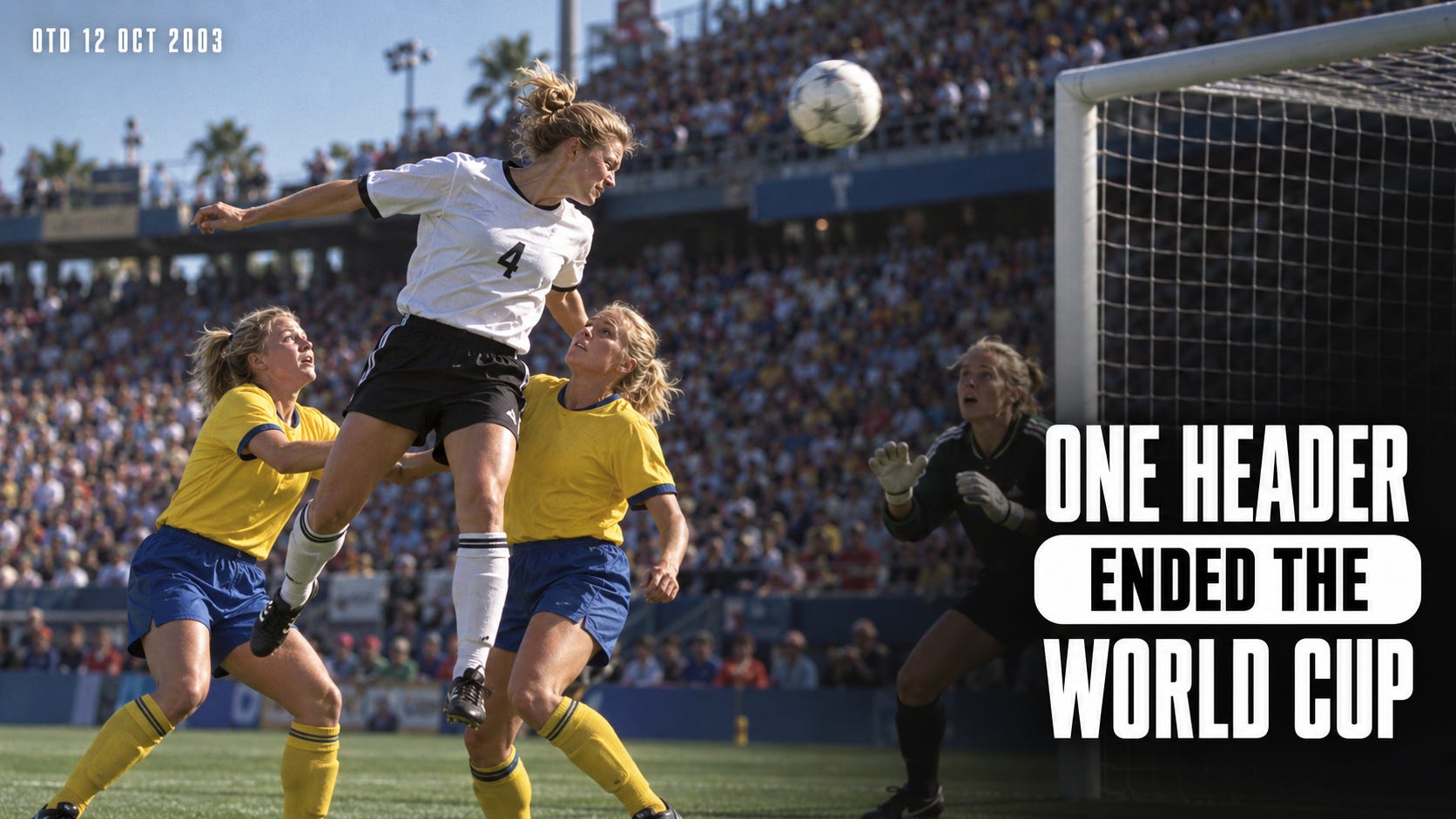
It is 12 October 2003 at the Home Depot Center in Carson, California. Germany and Sweden have been playing for ninety-eight minutes. They are level at 1-1 in the Women’s World Cup final, but the stadium clock is no longer counting toward an ordinary conclusion.
The next goal ends everything.
Renate Lingor stands over a free kick on the right. Before delivering it, she adjusts her hair and calls the name of a teammate who has been on the field for only ten minutes. Lingor curls the ball toward a crowd near the penalty spot. Nia Künzer attacks it, rises between Swedish defenders and turns a glancing header beyond Caroline Jönsson.
The ball reaches the net. The final is over. No restart, no opportunity for Sweden to answer and no need to complete the first period of extra time. Germany have won their first Women’s World Cup through the first, and still the only, golden goal ever to decide a World Cup final, men’s or women’s.
Eight months later, football abolished the rule that made the ending possible.
How did we get here?
Women’s football in Germany had spent much of the twentieth century fighting its own governing body. The German Football Association, the DFB, banned women’s teams from its clubs in 1955, claiming the game was incompatible with female nature. The prohibition lasted until 1970. An official West German national team did not play until 1982, when Gero Bisanz coached a 5-1 victory over Switzerland.
Once admitted, Germany advanced rapidly. Bisanz created a technical structure, and a generation led by Silvia Neid established the national team as Europe’s dominant force. West Germany won the European Championship in 1989. Reunified Germany retained it in 1991, then added titles in 1995 and 1997. Tina Theune-Meyer, formerly Bisanz’s assistant and the first woman to earn Germany’s highest coaching license, succeeded him in 1996. Her team won another European title in 2001.
The World Cup remained missing. Germany finished fourth at the inaugural tournament in 1991 and reached the 1995 final, where Norway beat them 2-0. In 1999, the United States eliminated Germany 3-2 in a memorable quarterfinal. By 2003, Germany were five-time European champions but not yet world champions, a continental power still waiting for global confirmation.
Sweden’s history ran beside theirs. Sweden had won the first European women’s championship in 1984, beating England on penalties over two legs. At the 1991 World Cup, the Swedes defeated Germany 4-0 in the third-place match. Yet a country that consistently produced elite teams had also accumulated near misses: European runners-up in 1987, 1995 and 2001, then quarterfinal exits at the 1995 and 1999 World Cups.
The 2001 European final supplied an omen. Germany and Sweden finished ninety minutes scoreless in Ulm. Under the golden-goal rule, Claudia Müller scored in extra time and the match stopped immediately. Two years later, the same countries would play another final under the same unforgiving condition.
They were not originally supposed to meet in California.
China had been selected to host the 2003 Women’s World Cup. In early 2003, severe acute respiratory syndrome spread across Asia. With SARS creating a public-health emergency, FIFA removed the tournament from China in May, less than five months before kickoff. The United States, already equipped from the hugely successful 1999 World Cup, accepted an organizational sprint. Six stadiums across the country were arranged for a tournament played from September 20 to October 12. China retained its automatic place and was awarded the 2007 edition.
The emergency move changed the setting, but not the favorites. The United States were reigning champions, hosts and the game’s most visible team. China had been one penalty shootout from the title in 1999. Norway were former world and European champions. Brazil brought a seventeen-year-old Marta to her first World Cup.
Germany arrived with experience and an extraordinary attacking spine. Goalkeeper Silke Rottenberg had been an international since 1993. Bettina Wiegmann was appearing at her fourth World Cup. Maren Meinert supplied intelligence between midfield and attack. Birgit Prinz combined speed, strength and finishing and was approaching the peak of a career that would make her one of the women’s game’s defining players.
Künzer did not occupy the same place in the hierarchy. Born in Botswana in 1980 while her parents worked in development aid, she grew up in Germany and became a powerful defender and midfielder for 1. FFC Frankfurt. Her club résumé was already formidable, but her body had repeatedly interrupted her progress. Three anterior cruciate ligament tears preceded the 2003 World Cup. She recovered just in time to make Theune-Meyer’s squad, largely as a reserve.
Germany opened against Canada and fell behind after four minutes. They responded with four goals. Japan were beaten 3-0, Argentina 6-1. Germany reached the quarterfinals with thirteen goals in three matches, although Steffi Jones was lost to a knee injury during the group stage.
Russia were overwhelmed 7-1 in the quarterfinal. The semifinal against the United States was different. Kerstin Garefrekes headed Germany ahead after fifteen minutes in Portland, then Rottenberg survived sustained American pressure. Meinert and Prinz scored in the final minutes to produce a 3-0 score that made the match look less balanced than it had been. The defending champions were out on home soil.
Sweden’s route was rougher. Marika Domanski Lyfors’s team lost its opener 3-1 to the United States, leaving no room for a slow recovery. Sweden beat North Korea 1-0 and Nigeria 3-0 to advance. In the quarterfinal against Brazil, Victoria Svensson and Malin Moström scored in a 2-1 victory. Canada then led the semifinal until late. Moström equalized in the 79th minute, and substitute Josefine Öqvist completed a 2-1 comeback seven minutes later.
The finalists represented European women’s football at full strength, but their styles differed. Germany possessed the tournament’s leading scorer in Prinz and had scored twenty-three goals. Sweden were compact, quick in transition and supplied two of the competition’s most dangerous forwards in Svensson and Hanna Ljungberg.
The 10 a.m. local kickoff was scheduled for European television. Germany adapted with a final training session at five in the morning, playing a small-sided exercise on a parking deck before daylight. In Germany, 13.6 million viewers watched. ARD delayed the country’s Sunday-night television institution, *Tatort*, to show the conclusion.
The Home Depot Center had opened only months earlier. Its crowd of 26,137 saw Germany make the stronger start, with Prinz threatening twice. Sweden offered a warning when Malin Andersson’s long-range effort dipped onto the roof of the net.
In the 41st minute, Sweden struck. Svensson released Ljungberg down the left. She accelerated clear and slid the ball beyond Rottenberg. Sweden, seeking its first world title, led 1-0 at halftime.
Germany required forty-three seconds to answer. Prinz moved into the right channel and played the ball inside. Meinert drove a low shot past Jönsson for 1-1. The goal was not spectacular, but its timing changed the emotional terms of the match before Sweden had settled into the second half.
Germany pushed. Ariane Hingst’s header was saved, Pia Wunderlich shot over and Jönsson denied Meinert. Sweden were just as dangerous late on. Rottenberg preserved Germany’s position through a series of chances as regulation time closed.
Theune-Meyer had sent Martina Müller on for Garefrekes in the 76th minute. In the 88th, with extra time close, she replaced the exhausted Wunderlich with Künzer. Her instruction was wonderfully direct: make sure Germany did not concede, and score one at the other end.
Extra time began under football’s most absolute experiment. Since the 1990s, FIFA and UEFA had used the golden goal in selected competitions to settle matches tied after ninety minutes. The intention was to discourage teams from merely waiting for penalties. In practice, the knowledge that one mistake would end the match could make players more cautious, not less. Every tackle, run and free kick carried terminal risk.
Eight minutes into extra time, Sweden’s Frida Östberg fouled Müller on Germany’s right. Lingor prepared the free kick. She had noticed Künzer’s aerial ability and called toward her before sending the ball into the area.
Künzer made the decisive movement. Her header was not powered downward or struck cleanly into a corner. It glanced from her head, changed the ball’s flight and floated beyond Jönsson toward the far side. For a fraction of a second, everyone watched to learn whether it would reach the net.
Then a substitute with one previous international goal had ended the World Cup.
So what?
The immediate achievement was historic in several directions. Germany became women’s world champion for the first time and the first country to win both the men’s and women’s World Cups. Only Spain, after its women’s victory in 2023, has since joined that club. Theune-Meyer became the first woman to coach a World Cup-winning team. Prinz won both the Golden Boot, with seven goals, and the Golden Ball as the tournament’s best player.
Künzer’s distinction was more concentrated. She played only four matches at the tournament, all as a substitute, and scored once. That one goal was voted Germany’s 2003 Goal of the Year, the first time a woman’s goal had won the national award. It remains the only golden goal in any senior World Cup final.
The celebrations showed what the victory had opened. Two days after the final, 8,000 people gathered at Frankfurt’s Römer to welcome the team home, a civic stage associated with the men’s national side. Each player received a bonus of €21,000, modest beside men’s football but a new level for the German women’s team. The next European Championship qualifier, a 13-0 victory over Portugal, was moved to an evening kickoff for television and sold out with 15,000 spectators.
The triumph did not solve the structural inequalities around women’s football, but it enlarged the audience and strengthened a national program already built to last. Germany retained the World Cup in 2007 under Silvia Neid without conceding a goal, won further European titles and hosted the 2011 World Cup. The 2003 squad connected Bisanz’s pioneering generation to the professionalizing era that followed.
For Sweden, the ending preserved a different kind of legacy. The country has still never won the Women’s World Cup. The 2003 silver remains its best finish, followed by bronze medals in 1991, 2011, 2019 and 2023 and Olympic silver in 2016 and 2021. Sweden’s consistency has been extraordinary; the missing world title makes Künzer’s floating header more painful with time.
Her own playing career remained fragile. A fourth cruciate-ligament injury followed after the World Cup, and she retired in 2008 with thirty-four Germany caps. Yet the goal kept her in public life rather than trapping her in one replay. She became a respected television analyst and worked in development and social policy. In January 2024, the DFB appointed her sporting director for its women’s national teams. The substitute once summoned to protect a lead that did not exist became one of the people responsible for Germany’s future.
The rule itself had a much shorter future.
Football’s golden goal was formalized internationally in the 1990s, though FIFA avoided the harsher phrase “sudden death.” The first in a UEFA final came when Pierluigi Orlandini won the 1994 European Under-21 Championship for Italy against Portugal. Oliver Bierhoff’s goal against the Czech Republic decided Euro 1996. David Trezeguet ended the Euro 2000 final for France against Italy. At the 1996 Olympics, Nwankwo Kanu completed Nigeria’s extraordinary semifinal comeback against Brazil.
World Cups produced their own abrupt endings. Laurent Blanc scored the first men’s World Cup golden goal when France eliminated Paraguay in 1998. In 2002, Henri Camara beat Sweden, Ahn Jung-hwan eliminated Italy and İlhan Mansız sent Turkey past Senegal. No men’s World Cup final was decided that way. The women’s final in Carson became the experiment’s supreme and solitary example.
By then, administrators were already searching for a compromise. UEFA introduced the silver goal in 2003: if a team led at the end of the first fifteen-minute period of extra time, the match ended then, rather than at the instant of the goal. It preserved urgency while allowing an opponent at least the remainder of the period to respond.
The compromise survived barely a year. On February 28, 2004, the International Football Association Board decided to remove both golden and silver goals. From July 1, competitions were to return to two complete periods of extra time, followed by penalties if necessary. Euro 2004, which had begun under existing competition rules, finished its use of the silver goal; Greece’s Traianos Dellas ended the semifinal against the Czech Republic at the close of the first extra-time period on July 1.
The abolition reflected the experiment’s central contradiction. Administrators hoped the promise of instant victory would encourage attacking football. Coaches and players often saw the opposite side of the equation: instant defeat. A single error could erase the chance to recover, so extra time could become more fearful. The golden goal intensified drama when a goal arrived, but did not reliably make that goal more likely.
Restoring the full thirty minutes also restored a basic rhythm. Football normally gives an opponent time to reply. A goal changes the game but does not close it. The clock, rather than the ball entering the net, determines when the contest ends. Künzer’s header therefore belongs to a discontinued conception of football time.
That is what makes the moment greater than a winning goal. Geoff Hurst’s third in 1966 still left England to play. Andrés Iniesta’s winner in 2010 was followed by several desperate Dutch minutes. Carli Lloyd’s hat-trick goal in 2015 transformed a final without terminating it. Künzer’s contact did three jobs at once: it scored, sounded the final whistle and awarded the World Cup.
No future player can reproduce that sequence under the present Laws. A substitute may score an extra-time winner in a World Cup final. A header may create a first championship. A goal may become a country’s national Goal of the Year. But the scoring act itself cannot now end the final before another second is played.
Three things to take away
The final was an emergency production. SARS forced FIFA to move the tournament from China to the United States with less than five months’ notice. An event displaced by a global health crisis ended with one of football’s most singular goals.
Germany’s breakthrough rested on long preparation. Five European titles, an established coaching succession and a team led by Prinz, Meinert and Rottenberg came before the first World Cup. Künzer supplied the final touch to a structure built over two decades.
The winner became permanently unrepeatable. IFAB abolished golden and silver goals in 2004. Künzer remains the only player whose goal has ended a senior World Cup final at the instant it crossed the line.
On This Day...
On 12 October 2003, Renate Lingor lifted a free kick into Sweden’s penalty area and called for Nia Künzer. The substitute rose, glanced the ball toward the far side and watched it cross the line. Germany were world champions. Tina Theune-Meyer had become the first woman to coach a World Cup winner. Künzer had produced the first goal by a woman to be named Germany’s Goal of the Year. And football’s golden-goal experiment had found its perfect ending just before the Laws consigned it to history.
---
Questions, corrections or story ideas: otd@17lawsguy.com
Yesterday: 11 October 1958, Bill Nicholson’s Big Bang.
The rise and fall of the Golden Goal - and it's unique place in history. Wonderful story - thanks for sharing.
That golden goal felt like something straight out of a movie script. Coming off the bench to instantly end a World Cup final with a header? Absolute legendary status!