

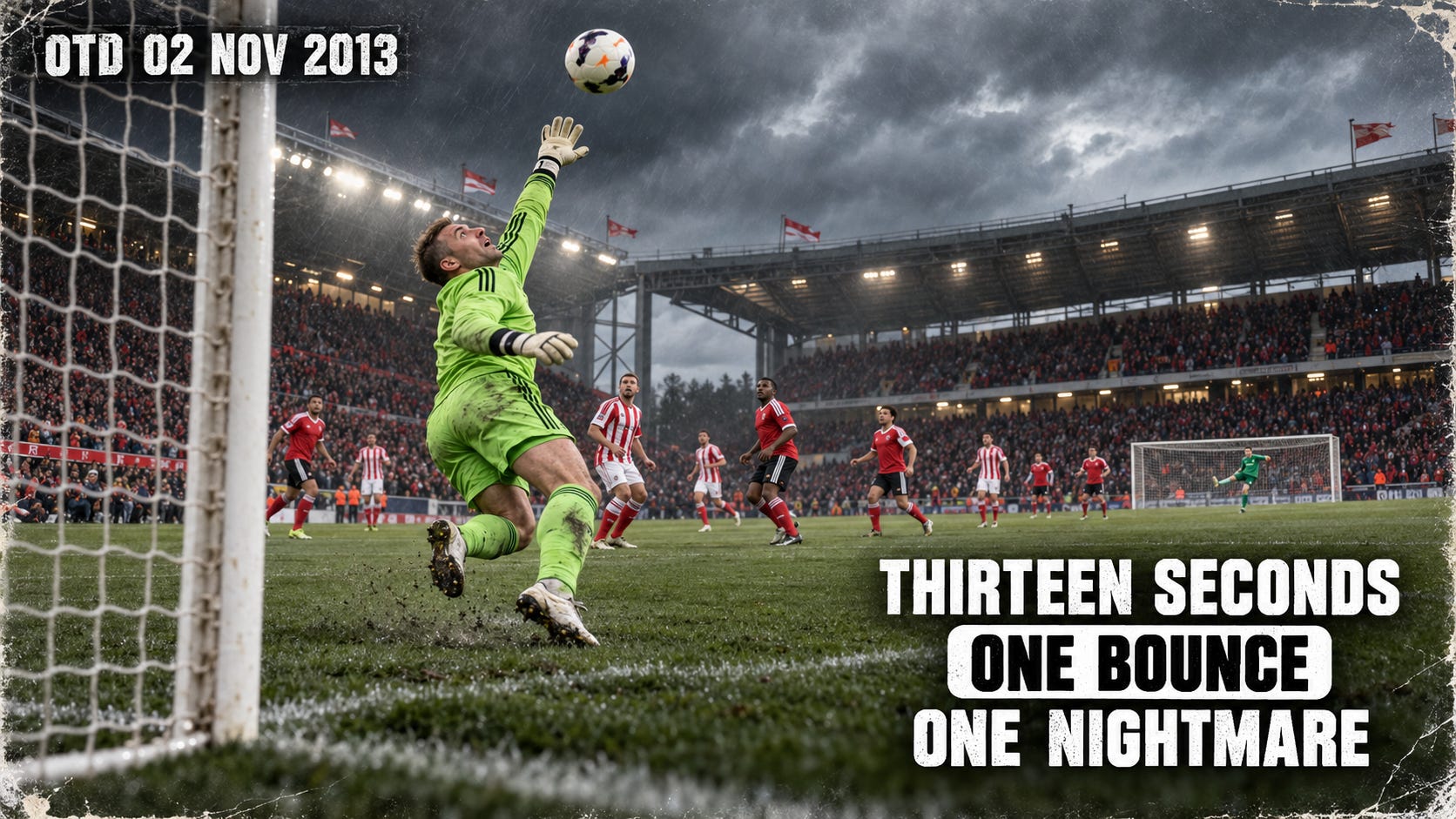
It is 02 November 2013, at the Britannia Stadium in Stoke-on-Trent. Southampton kick off. The ball goes forward, Erik Pieters intercepts it and turns back toward his own goal. Seven seconds have passed when Asmir Begović steps into the return pass and drives it upfield.
There is no shot to save, no corner to attack and no desperate instruction to join the forwards. Stoke City’s goalkeeper is simply clearing the ball.
It climbs into the Staffordshire wind, crosses halfway and drops behind Southampton’s defence. Artur Boruc waits near the edge of his penalty area, where a modern goalkeeper is supposed to wait when his team have possession. The ball hits the turf once. The bounce is enormous. Boruc backpedals, reaches, and watches it sail over him.
Thirteen seconds. Stoke 1, Southampton 0. The scorer has never scored a professional goal before and will never score another.
Begović does not celebrate. He knows that somewhere beneath the spectacle is another goalkeeper’s humiliation.
How did we get here?
Asmir Begović’s route to Stoke began with two forced departures. He was born in Trebinje in 1987, in what was then Yugoslavia. His father, Amir, had been a goalkeeper; his mother was studying law. When war reached Bosnia and Herzegovina, the family fled to Germany. Asmir was four.
They rebuilt, then had to move again when he was ten. Canada offered safety, but it meant another language, another school and another football culture. Begović has described himself as a refugee twice over: first from Bosnia, then from a life in Germany that the family had just managed to establish. Football was the constant. His father trained him, Oliver Kahn became an early model, and Edmonton eventually produced a goalkeeper good enough to represent Canada at youth level.
At sixteen, Begović crossed the Atlantic alone to join Portsmouth. The path from prospect to Premier League goalkeeper was not direct. He went on loan to La Louvière in Belgium, Macclesfield Town, Bournemouth, Yeovil Town and Ipswich Town. He made only eleven league appearances for Portsmouth before Stoke paid about £3.25 million for him in February 2010.
That résumé matters because the goal can make Begović look like the accidental hero of a viral clip. He was much more than that. By November 2013 he was an established Premier League number one, Stoke’s player of the year and the goalkeeper of a Bosnia and Herzegovina side closing in on its first World Cup. He had built his career through repetition, patience and the unglamorous accumulation of loans.
Stoke were also changing. Tony Pulis had taken the club into the Premier League, kept it there and made the Britannia one of English football’s least comfortable away trips. The methods were direct, physical and proudly unfashionable: long throws from Rory Delap, aerial power, set pieces and an insistence that opponents earn everything.
Pulis left in May 2013 after seven years. Mark Hughes arrived with a mandate to preserve Stoke’s competitive edge while making the football more expansive. That transition was uneven. Entering the Southampton match, Stoke had won only two of their first nine league games and scored just six goals. Begović’s name was about to join the list of scorers because Stoke’s forwards had not done so often enough.
Southampton represented a different new beginning. Mauricio Pochettino had replaced Nigel Adkins in January and rapidly built one of the league’s most compelling young sides. They pressed high, moved the ball quickly and trusted emerging players such as Luke Shaw and James Ward-Prowse alongside Adam Lallana, Jay Rodriguez, Morgan Schneiderlin and Rickie Lambert.
The contrast was sharper than the table suggested. Stoke were trying to evolve from the Pulis years. Southampton already looked like a glimpse of the league’s tactical future. They arrived sixth, unbeaten in six league matches and with the Premier League’s best defensive record: only three goals conceded in nine games.
Then came the weather.
The Britannia stood exposed on high ground beside the A50. It was famous for cold nights, open corners and wind that could make a routine high ball behave like a practical joke. On 02 November 2013, the gusts were strong enough that both managers later said the conditions damaged the match.
Goalkeepers warm up for that. They watch the flight of crosses, feel which end carries the ball and learn what the surface gives back. Boruc knew the danger. But knowledge offers limited protection when the wind changes a kick’s range and the ground supplies a bounce no calculation can fully absorb.
Southampton started the match. A forward pass was cut out by Pieters, who rolled the ball back to Begović. The goalkeeper took one touch and cleared right-footed from inside his penalty area.
The kick was long and clean, but not initially absurd. Southampton’s defenders watched it pass over them. Boruc was positioned high enough to collect behind his back line, exactly the space a goalkeeper in Pochettino’s team was expected to command.
Then the ball landed.
The wind had supplied distance. The hard surface supplied violence. Instead of checking, the ball reared over Boruc’s head. He twisted and chased, but the contest was already between gravity and the goal line. The ball dropped into the empty net.
Contemporary measurements first described the kick as 97.5 yards. When Guinness World Records assessed it for its 2015 edition, the distance was registered as 91.9 metres: 100.5 yards, or a little more than the full length of an American football field without the end zones. It was recognized as the longest goal scored in a competitive football match.
The timing was just as extraordinary. Thirteen seconds made it one of the fastest goals in Premier League history and, by a considerable margin, the fastest scored by a goalkeeper. Yet the goal contained no attack. Southampton had kicked off, Stoke had intercepted one pass, and Begović had returned the ball toward the other end.
His reaction is the human detail that makes the clip endure. Teammates ran toward him. Begović looked almost apologetic. He later said it was a “cool feeling,” but also a fortunate incident, and explained that he did not celebrate because he understood what the bounce had done to Boruc.
That was not false modesty. Goalkeepers inhabit the same exposed profession. A striker can miss several chances and still score the winner. A midfielder can misplace passes far from consequence. A goalkeeper can make the sensible decision, encounter one wicked bounce and become the image attached to somebody else’s record.
Boruc blamed the wind and apologized to teammates and supporters. His description was bleaker and more accurate: he knew after the bounce that he was “in the middle of nowhere.” He had conceded only three times in Southampton’s first nine league matches. Thirteen seconds into the tenth, the best defence in the division had been beaten by the opposing goalkeeper.
Southampton did not unravel. Rodriguez headed Ward-Prowse’s cross down and over Begović shortly before half-time. Stoke had chances, Southampton pressed for more, and a late handball appeal against Ryan Shawcross was rejected. The match finished 1-1.
In one sense, the equalizer rescued Boruc. In another, it made the story even stranger. Both the Begović goal and the result were preserved without the match becoming a rout or a comeback. Ninety minutes produced two goals and one point each. Thirteen seconds produced everything people remember.
So what?
Begović was only the fifth goalkeeper to score in the Premier League. The list reveals three distinct ways the position can invade the scoresheet.
Peter Schmeichel and Brad Friedel went forward because time was running out. Schmeichel volleyed for Aston Villa at Everton in 2001, although Villa still lost 3-2. Friedel equalized for Blackburn at Charlton in 2004, only for Claus Jensen to score at the other end almost immediately.
Paul Robinson, Tim Howard and Begović scored from distance. Robinson’s 2007 free kick for Tottenham bounced over Watford goalkeeper Ben Foster. Howard’s 2012 clearance for Everton rode the wind and flew over Bolton’s Ádám Bogdán. Howard barely celebrated, for the same reason Begović would not: a goalkeeper recognizes the cruelty before everyone else recognizes the comedy.
The sixth member arrived in 2021 and belongs to a category of his own. Liverpool needed a winner at West Bromwich Albion to keep its Champions League hopes alive. In the fifth minute of stoppage time, Alisson Becker came forward for a corner and directed a centre-forward’s header into the far corner. It was the first competitive goal by a Liverpool goalkeeper, the first headed goal by a goalkeeper in Premier League history and, unlike the five before it, a winning Premier League goal.
There is a longer history beneath those six. Manchester City’s Charlie Williams is generally credited as the first goalkeeper to score in English league football, from a long clearance against Sunderland in 1900. Pat Jennings beat Alex Stepney from distance in the 1967 Charity Shield, Tottenham’s goalkeeper scoring past Manchester United’s in a 3-3 draw. Peter Shilton scored for Leicester against Southampton later that year. Southampton, it seems, had been here before.
Then there are goalkeepers for whom scoring became an additional craft rather than a meteorological accident. Rogério Ceni converted penalties and free kicks for São Paulo until his career total reached 131. José Luis Chilavert scored more than sixty times and remains the only goalkeeper to have completed a hat-trick in a senior professional match, all three from penalties for Vélez Sarsfield. Hans-Jörg Butt specialized in penalties so successfully that he scored in the Champions League for three different clubs—and all three goals came against Juventus.
Those men trained to score. Begović trained to distribute.
That distinction is important. A goalkeeper’s clearance has always carried attacking potential, but it is usually recorded as territory, not a shot. The Begović goal belongs to the tiny class in which distribution travels uninterrupted from one penalty area into the other net. The scorer does not defeat ten outfield players so much as bypass them.
It also exposes the risk hidden inside modern goalkeeping. Boruc’s position was not foolish. A keeper standing deep on his line would leave an enormous space behind his defence and make Southampton easier to attack in every normal passage of play. Sweeping high was part of the system. The freak event punished the correct long-term choice.
That is why the goal’s physics should not become a prosecution. The ball was struck well. The tailwind extended its flight. A firm pitch returned more energy than Boruc expected. The first bounce compressed his reaction time and reversed the geometry: one moment he was moving forward to collect, the next he was retreating beneath a ball already above him.
Guinness gave Begović the world record in September 2014. It lasted seven years. On 19 January 2021, Newport County goalkeeper Tom King took a goal kick at Cheltenham Town. Wind caught it, the ball cleared Joshua Griffiths and dropped in from 96.01 metres. That match also finished 1-1. Goalkeepers can apparently rewrite distance records without changing the allocation of points.
King’s goal removed Begović’s superlative but not his place in Premier League history. The thirteen seconds remain unmatched by another goalkeeper. Nor did the lost record diminish the career around it.
Eight months after the Southampton match, Begović played all three of Bosnia and Herzegovina’s games at the 2014 World Cup, the country’s first appearance at the tournament. In 2015 he joined Chelsea, later winning a Premier League medal, and went on to Bournemouth, Qarabağ, AC Milan, Everton, Queens Park Rangers and Leicester City. By the time Leicester signed him in 2025, he had made 256 Premier League appearances and won 63 caps for Bosnia and Herzegovina.
The arc is larger than one bounce. A child displaced from Bosnia to Germany and then Canada returned to Europe, represented two countries at youth and senior levels, reached the World Cup with the nation of his birth and built a two-decade career in England. He later used that experience to support refugee causes and young goalkeepers.
Yet football memory is wonderfully disproportionate. Careers are built across thousands of training sessions and hundreds of matches. Sometimes the permanent image occupies thirteen seconds.
Boruc’s dignity belongs in that memory too. He recovered immediately, helped Southampton extend its unbeaten run to seven games and finished the season as first choice for a side that came eighth with the best Premier League points total in the club’s history at the time. One bounce did not define his quality. It simply guaranteed that, whenever Begović’s goal is replayed, Boruc must appear inside it.
That is the strange intimacy of the goalkeeper goal. The scorer receives a rarity. The goalkeeper at the other end receives an unwanted form of immortality. They understand each other better than the crowd understands either of them.
After the final whistle at the Britannia, Begović and Boruc shook hands.
Three things to take away
The goal punished good positioning. Boruc was high because Southampton’s system required him to cover the space behind the defence. Wind and bounce turned a normal starting position into apparent embarrassment.
Begović’s record was measured later. Early reports varied, but Guinness registered the strike at 91.9 metres in 2014. Tom King surpassed it with a 96.01-metre goal for Newport County in 2021.
The scorer’s life was bigger than the clip. Begović was twice displaced as a child, developed in Canada, became Bosnia and Herzegovina’s World Cup goalkeeper and played 256 Premier League matches. The famous goal was an accident inside a career built deliberately.
On This Day...
On 02 November 2013, Asmir Begović cleared a back-pass into the wind at the Britannia Stadium. One bounce later, Artur Boruc was stranded and Stoke City were ahead. Thirteen seconds, 91.9 metres, one goalkeeper credited and another condemned by the same piece of football weather.
---
(This story was first published as a podcast episode on 02 Nov 2025.)
Questions, corrections or story ideas: otd@17lawsguy.com
Yesterday: 01 November 1955, The Night a Club Between Countries Beat Milan.