

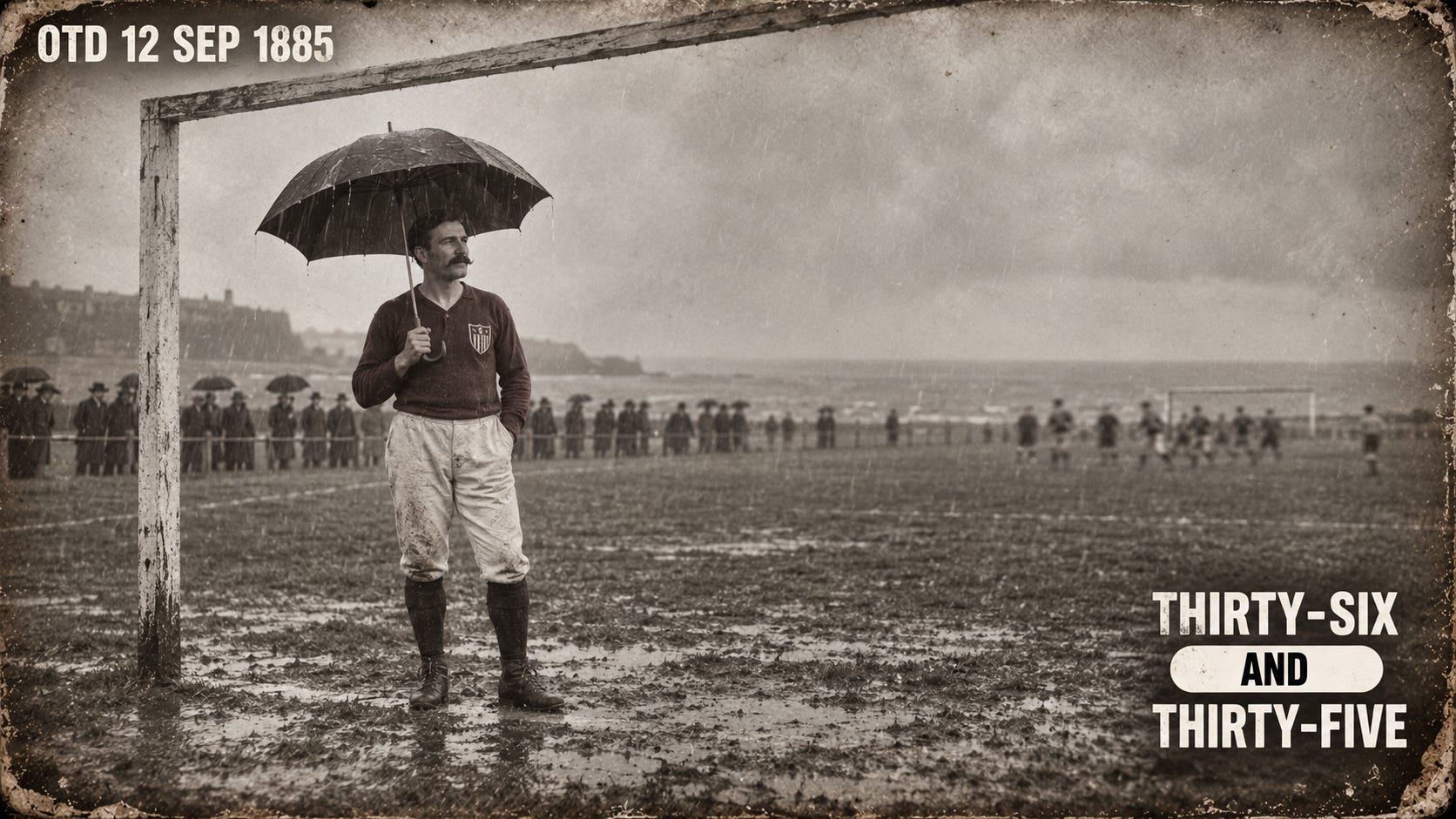
It is September 12, 1885, in Dundee, and a Scottish Cup tie has just finished. The referee looks at his notes and reckons Dundee Harp have scored thirty-seven against Aberdeen Rovers. The Harp secretary disagrees: they counted carefully, and it was only thirty-five. The referee accepts the correction, and 35-0 is telegraphed to the Scottish Football Association as, surely, a world record. Harp’s full-back Tom O’Kane is especially pleased, because he used to play eighteen miles up the coast for Arbroath, so his club fires off a telegram to his old side that amounts to: beat that. A reply comes back. Arbroath 36, Bon Accord 0. Everyone in Dundee laughs. Very funny. Except Arbroath are not joking.
To see how two such scores could happen on one afternoon, you have to picture Scottish football in 1885. Scotland had built its own structure in 1873, when Queen’s Park and other leading clubs formed the Scottish Football Association and created a Challenge Cup modeled on the FA Cup. Queen’s Park won the first final in 1874, and the original trophy is still presented today, the oldest existing association-football trophy in the world. But there was no Scottish league yet, which would not arrive until 1890, and no legal professionalism until 1893, only weeks after England had finally legalized it. The Scottish Cup was the national measuring stick, and it threw established clubs and brand-new ones together in knockout football, so enormous mismatches were routine. This very tournament produced 881 goals in 146 matches, and Queen’s Park opened it by beating St Peter’s 16-0. Scores of 35 and 36 were extreme, but they grew from an ecosystem already capable of the extreme.
First, a myth to kill. For years the story went that Bon Accord, Arbroath’s opponents, were a cricket team entered in the football cup by mistake. It is a lovely tale, and untrue. Bon Accord were a real football club, founded in 1884, and here is a better fact: one week before this match, they had actually beaten Aberdeen Rovers, the very side Dundee Harp were thrashing that same afternoon, by 1-0. Seven days later, one of those Aberdeen clubs lost 36-0 and the other lost 35-0. Football history has rarely shown regression quite so efficiently.
It was raining at Gayfield, and Bon Accord were using a stand-in goalkeeper. Arbroath started scoring and did not stop: fifteen-nil at half-time, another twenty-one after it. Their eighteen-year-old, John Petrie, scored thirteen goals by himself, a figure that still stands as a record in a senior match. At the other end, the Arbroath goalkeeper had so little to do that, the story goes, he borrowed an umbrella from someone in the crowd. And even thirty-six may understate it, because the referee later admitted he had disallowed seven Arbroath goals and rather regretted some of those decisions. The score could have been forty-three.
Meanwhile, in Dundee, Harp were doing almost exactly the same thing to Aberdeen Rovers: sixteen at the break, another nineteen after. The difference was the counting. The referee made it thirty-seven, the Harp secretary insisted on thirty-five, and, because Victorian sport apparently still contained honesty, the club argued their score down to the smaller number, and 35-0 went into the records. Then O’Kane started celebrating a record his new club did not, it turned out, hold. When Arbroath wired back their thirty-six, Harp assumed a wind-up, and Arbroath assumed Harp were in on the joke. Nobody had a phone, or a scores app, or a search engine. O’Kane took the late train home to Arbroath, and when people there told him, seriously, thirty-six, he barely slept, then got up on the Sunday morning and ran the eighteen miles back to Dundee to break the news to the Harp officials in person.
Neither freak result won anybody the Scottish Cup. Arbroath rolled on, 9-1 and 7-1, for fifty-two goals in three ties before Hibernian finally stopped them 5-3. Harp advanced too before Vale of Leven beat them 6-0. Queen’s Park won the Cup, as they usually did, their eighth in thirteen editions. Arbroath are still at Gayfield today; Dundee Harp, weighed down by money troubles, disappeared in 1894, and Bon Accord and Aberdeen Rovers faded from senior football too. The great mismatch belonged to a football world in which clubs could appear, enter the national cup, and vanish again remarkably quickly.
But thirty-six endures. It was finally equalled in 2015, when an Estonian club beat an amateur side 36-0, though not surpassed in a comparable senior match. Bigger numbers exist only if you loosen the definition: a Madagascan side once lost 149-0, but every goal was a deliberate own goal in protest. Australia beat American Samoa 31-0 in a 2001 World Cup qualifier, with one player scoring thirteen, exactly Petrie’s number, and even then the scoreboard first read 32-0 until someone recounted. Which is somehow the perfect footnote, because thirty-plus goals eventually defeat arithmetic. This particular double, though, is almost impossible to reproduce now, not because football has cured mismatches but because mature systems sort teams into leagues and divisions and qualifying rounds before they can meet. In 1885 the national cup was simply where everyone met. And on one impossible afternoon, eighteen miles apart, two developing Aberdeen clubs conceded seventy-one goals between them, and football needed a calculator it had not yet invented.
---
🎧 Listen on Spotify, Apple Podcasts, Amazon Music, Overcast, iHeart, and YouTube.
📩 Got an episode idea? otd@17lawsguy.com
Yesterday: 11 September 1927, the day Meazza and quantum physics shared a city.
Tomorrow: 13 September 1891, Argentina crowns its first champion, and even that comes with complications.