

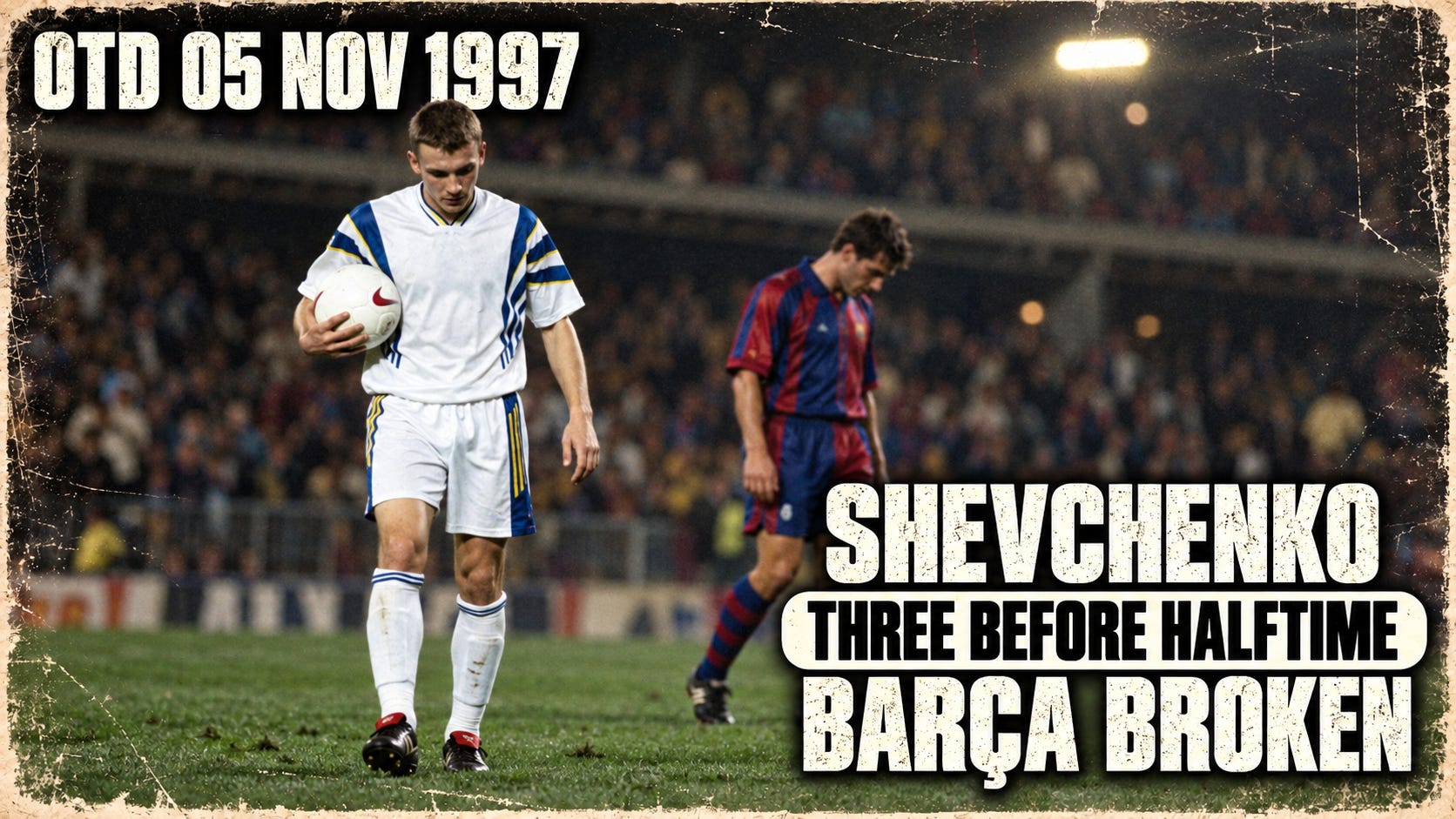
Barcelona had already received the warning. On 5 November 1997, two weeks after a 3-0 defeat in Kyiv, they welcomed Dynamo to Camp Nou and discovered that the first defeat had contained no exaggeration. Before halftime, Andriy Shevchenko had scored three times. The visitors’ superiority now traveled with them.
This was a particularly brutal reversal of the week’s expectations. Four days earlier, Barcelona had won 3-2 at Real Madrid. Louis van Gaal’s team led the Spanish league. Rivaldo and Luís Figo (yes, this was before his “Impossible Move”) gave them attacking talent of the highest order. Against Dynamo, reputation offered little protection when the ball changed hands.
Shevchenko was twenty-one. He scored with two headers and a penalty, combining movement, anticipation and nerve while Barcelona’s defense struggled to account for him. Serhiy Rebrov would supply the fourth goal. Across the two group matches, Dynamo won 7-0. There was no knockout aggregate to overturn, only two separate examinations that Barcelona had failed comprehensively.
The young striker would become the enduring face of the result. Yet the larger revelation occupied the technical area. Valeriy Lobanovskyi, back at Dynamo after years in the Middle East, had assembled another team capable of making an established European power look slow. His methods belonged to a long history. The football looked alarmingly current.
How Did We Get Here?
Dynamo’s European credentials were considerably older than independent Ukraine. Under Lobanovskyi, they had won the Cup Winners’ Cup in 1975 and again in 1986. The first generation featured Oleh Blokhin; the second included Ihor Belanov. Both men won the Ballon d’Or. Producing a great forward inside a highly organized collective was already a Kyiv tradition.
The Soviet Union’s dissolution changed the framework around the club. Dynamo became the dominant force in Ukraine’s new championship, but domestic supremacy no longer guaranteed exposure to the strongest possible opposition every week. Winning at home and competing with Europe’s best became increasingly different tasks. A club accustomed to representing a Soviet republic now carried the name of a sovereign country onto the international stage.
There was also a darker recent history. In September 1995, UEFA expelled Dynamo from the Champions League after Spanish referee Antonio López Nieto reported an attempted bribe before their match against Panathinaikos. Dynamo denied wrongdoing. The three-year exclusion was lifted in April 1996, permitting a return the following season, but the lost campaign and damaged reputation remained. Sporting rehabilitation required more than another Ukrainian title.
The first European return went badly. Rapid Wien eliminated Dynamo from Champions League qualifying, and Neuchâtel Xamax then removed them from the UEFA Cup. The club needed to recover its ability to compete abroad. Lobanovskyi’s return, arranged late in 1996 and made official at the start of 1997, addressed that problem directly.
He returned to a different world from the one in which he had built his earlier champions. Wealthy investors had replaced the old institutional arrangements. Players had greater freedom and foreign clubs offered careers beyond the former Soviet Union. A coach could still demand obedience, but keeping a talented team together now meant working against the pull of a much larger labor market.
Lobanovskyi’s response remained rooted in preparation. With scientist Anatoliy Zelentsov, he had developed ways of measuring the actions that made a team function: movement, involvement, decisions and errors. The value of a performance extended beyond the player who supplied its most memorable touch. A forward’s responsibilities continued after possession was lost; a midfielder’s contribution could not be judged solely by elegance on the ball.
The aim was to make coordinated play repeatable under pressure. Fitness allowed the work to continue. Rehearsal gave the players shared expectations. Analysis made individual performances available for scrutiny afterward. Long before football’s modern appetite for data became an industry, Dynamo had made the relationship between measurement and collective behavior central to their training.
The system could be severe. It could also reveal abilities that a fixed job description concealed. Andriy Husin had been a forward struggling to establish himself. His move into midfield began in the reserves; under Lobanovskyi, he established himself in the first team there, giving Dynamo height, running power and an attacking player’s understanding of the spaces ahead. The transformation mattered at Camp Nou: Husin supplied the cross for Shevchenko’s second goal.
Up front, Shevchenko and Rebrov offered different solutions to the same defensive problem. Shevchenko could attack space with extraordinary acceleration, then finish with either foot or his head. Rebrov could withdraw, connect play, occupy defenders and arrive in scoring positions himself. Their relationship made the movement around them more dangerous. Following one striker could open the route for the other.
That partnership also represented a choice. Viktor Leonenko, formerly an important attacking figure, fell out of the first-team picture as Lobanovskyi built around the younger pair. The returning coach was selecting players for a model of play. Established status alone did not secure a place in it.
Dynamo’s route into the 1997-98 Champions League began against Barry Town, then continued against Brøndby. It was an instructive journey through the competition’s changing geography. UEFA had admitted runners-up from its eight highest-ranked leagues, expanding the group stage to twenty-four clubs. Barcelona entered after finishing second in Spain. Ukraine’s champions still had to negotiate qualifying rounds.
The draw placed Dynamo alongside Barcelona, PSV and Newcastle United. Six groups produced only eight quarterfinalists: the six winners and the two best runners-up. There was little room for an expensive side to recover from a poor start, or for an unfashionable champion to survive on reputation alone.
Dynamo began by winning 3-1 at PSV. They then led Newcastle 2-0 before conceding twice late in a 2-2 draw. When Barcelona arrived in Kyiv on 22 October, Rebrov, Yuriy Maksymov and Yuriy Kalytvyntsev scored in a 3-0 victory. Shevchenko did not need to appear on the scoresheet to help dismantle the visitors. The attack already worked as a collective.
Barcelona had their own complications. Ronaldo had left for Internazionale after his spectacular season under Bobby Robson. Van Gaal had arrived from Ajax, bringing a demanding positional conception of football. Rivaldo joined an attack that could hurt almost anyone, but the transition had not produced a dependable European team. Newcastle had beaten them, PSV had drawn with them, and Kyiv had exposed them.
Even so, victory at the Bernabéu offered reassurance before the return meeting. Barcelona could beat a great opponent away from home. Camp Nou might restore the expected order against Dynamo. That was the emotional opportunity awaiting the Ukrainians, who arrived with grievances of their own.
Dynamo lodged a formal complaint about their treatment on the trip. Their spokesman said the party had endured a two-hour airport delay, an inadequate training pitch and police ordering them away from another ground. These were Dynamo’s allegations, rather than proof of a Barcelona conspiracy. They supplied an abrasive backdrop to a match in which the visitors were determined to establish their standing through football.
The first goal came in the ninth minute. Kalytvyntsev delivered a free kick from the right, and Shevchenko headed Dynamo ahead. Barcelona had allowed the visiting striker to turn a routine restart into an immediate crisis. The familiar home surroundings had changed nothing essential about the matchup.
Barcelona’s starting goalkeeper was Vítor Baía. Ruud Hesp had been sent off in Kyiv and was suspended for the return. Dynamo therefore confronted a different goalkeeper, but again found uncertainty between the defensive line and the man behind it. Their runs kept asking questions that Barcelona answered too late.
In the thirty-second minute, Husin sent the ball into the area. Baía came out, and Shevchenko reached it ahead of him, heading the second goal. The finish required more than speed. He recognized where the delivery and the goalkeeper would meet, then arrived first. An attack built through the collective ended with an individual winning the decisive fraction of space.
The third goal arrived just before halftime. Sergi brought Shevchenko down in the area, and Scottish referee Hugh Dallas awarded the penalty. Shevchenko converted in the forty-fourth minute. Three goals, all his, before the interval. Barcelona had now conceded six unanswered goals to Dynamo across the two meetings.
Any remaining hope of a different second half contracted almost immediately. Sergi handled the ball and received a second yellow card. Dynamo’s three-goal lead had been established against eleven; the dismissal deepened Barcelona’s difficulties rather than explaining the result. Van Gaal now had to manage a beaten side with a player missing.
Dynamo continued to find routes through. Their threat was especially punishing because Barcelona needed possession and territory to rescue something from the evening. Each unsuccessful attack risked exposing the defense again. The home team’s urgency became another condition the visitors could exploit.
In the seventy-ninth minute, Rebrov capitalized on another defensive mistake to score the fourth. It was an appropriate conclusion to the partnership’s work: Shevchenko owned the hat trick, but the other striker put the final number on the scoreboard. Some spectators had already left. Those who remained included Barcelona supporters willing to applaud the visitors.
Lobanovskyi had brought a team to one of football’s grandest stages and watched it execute its work. No appeal to history, budget or celebrity could reduce the result. Dynamo had beaten Barcelona at home, then gone to Barcelona and beaten them more heavily.
So What?
The defeat left Barcelona with one point from four group matches and Dynamo with ten, on the threshold of progression. Barcelona never recovered their European campaign. The completed group would leave Kyiv first with eleven points and Barcelona last with five. The difference was competitive, not merely theatrical.
Yet this was no straightforward tale of a great club entering terminal decline. Barcelona recovered to win the Spanish league and Copa del Rey that season. Van Gaal’s domestic success coexisted with European failure. That makes Dynamo’s achievement more revealing: they had dismantled a team with enough quality to win a major double, rather than simply encountering an institution that had forgotten how to compete.
For Shevchenko, the evening concentrated an emerging reputation into an unforgettable demonstration. A young player from Ukraine had scored a first-half hat trick at Camp Nou. The setting made his abilities legible far beyond the audiences already following Dynamo. Speed, aerial timing and composure had all survived examination against celebrated opponents.
The distinction between discovery and creation matters. Barcelona did not create Shevchenko, and one match did not turn an ordinary forward into a great one. His development was already under way. What changed was the scale of recognition. A name increasingly familiar to scouts became attached to a performance that could travel around Europe without explanation.
Dynamo’s subsequent results also prevented the match from becoming an isolated curiosity. They reached the quarterfinals, drew 1-1 at Juventus, then lost 4-1 in Kyiv as Filippo Inzaghi scored a hat trick. The reversal exposed vulnerabilities that Barcelona had failed to punish. A brilliant attacking team still had lessons to learn about controlling an elite knockout tie.
The following season brought a more substantial challenge. Dynamo eliminated holders Real Madrid in the quarterfinals, with Shevchenko scoring both goals in the 2-0 home victory after a 1-1 draw in Spain. The promise visible in Barcelona had developed into a credible attempt to win the competition.
Against Bayern München in the semifinal, Dynamo led 3-1 in Kyiv before the first leg escaped them. It finished 3-3. A 1-0 defeat in Munich ended the run. The narrowness of that failure became part of the team’s identity: close enough to make the lost opportunity tangible, never close enough to lift the trophy.
Bayern’s next destination supplied a painful geographical echo. The 1999 final was played at Camp Nou, where Manchester United won with two late goals. Dynamo had helped write one of that stadium’s great European stories, but another club would complete the journey there. Lobanovskyi’s final great side remained a contender remembered partly for what it could not finish.
Then the partnership began to disperse. Shevchenko joined Milan in 1999; Rebrov moved to Tottenham Hotspur the following year. Milan provided Shevchenko with a different environment and new tactical demands. He finished his first Serie A season as leading scorer with twenty-four goals, won the Champions League in 2003 and received the Ballon d’Or in 2004.
His success extended the Kyiv lineage of Blokhin and Belanov while also illustrating the changed economy around it. Earlier Dynamo teams had accumulated their finest players inside a system that restricted movement abroad. The post-Soviet team could produce a striker of comparable stature, but keeping him indefinitely was another matter. European recognition increased both the team’s possibilities and the demand for its players.
For independent Ukraine, Dynamo’s performances offered a powerful form of international visibility. The club brought a history that predated the state’s independence, and its dressing room drew on the former Soviet football world. That inheritance did not disappear when the flag changed. It became part of the sporting identity taking shape under Ukraine’s own name.
Camp Nou made that identity visible through accomplished football. Dynamo were neither anonymous survivors from a collapsed system nor a nostalgic exhibition of old methods. They could prepare, press, combine and finish against the strongest Western clubs. Their players were making a contemporary claim to belong.
The apparent contradiction between Lobanovskyi’s collective and Shevchenko’s stardom was therefore productive. The coach’s system supplied repetition, fitness and coordinated opportunities. The striker supplied judgments and finishes no training diagram could guarantee. Individual excellence gave the method its sharpest expression. At Camp Nou, the scientist’s team had produced an artist’s headline.
Three Things to Take Away
1. The 7-0 described two group-stage victories, not a knockout tie. Dynamo won 3-0 in Kyiv and 4-0 in Barcelona, establishing superiority in both settings.
2. Shevchenko’s hat trick was the visible edge of a collective achievement. Rebrov’s partnership, Husin’s transformed role and Lobanovskyi’s preparation helped create the chances the young striker finished.
3. Dynamo’s rise continued to a Champions League semifinal, but success also increased the pressure on the team to disperse. Europe celebrated its talent, then offered that talent new homes.
On This Day
On 5 November 1997, Dynamo Kyiv beat Barcelona 4-0 at Camp Nou, with Andriy Shevchenko scoring three times before halftime. Two weeks earlier, the same opponents had conceded three in Kyiv. The warning had been delivered clearly. By the interval in Barcelona, its young messenger had put his name on every goal.
Have a football memory, a correction or a story that belongs here? Write to otd@17lawsguy.com.
Yesterday: Two Cup Winners. Six Goals. One Very Small World. - 04 November 1876.
I remember this match very well. And the Champions League season was terrible. Dynamo Kyiv beat us twice.