

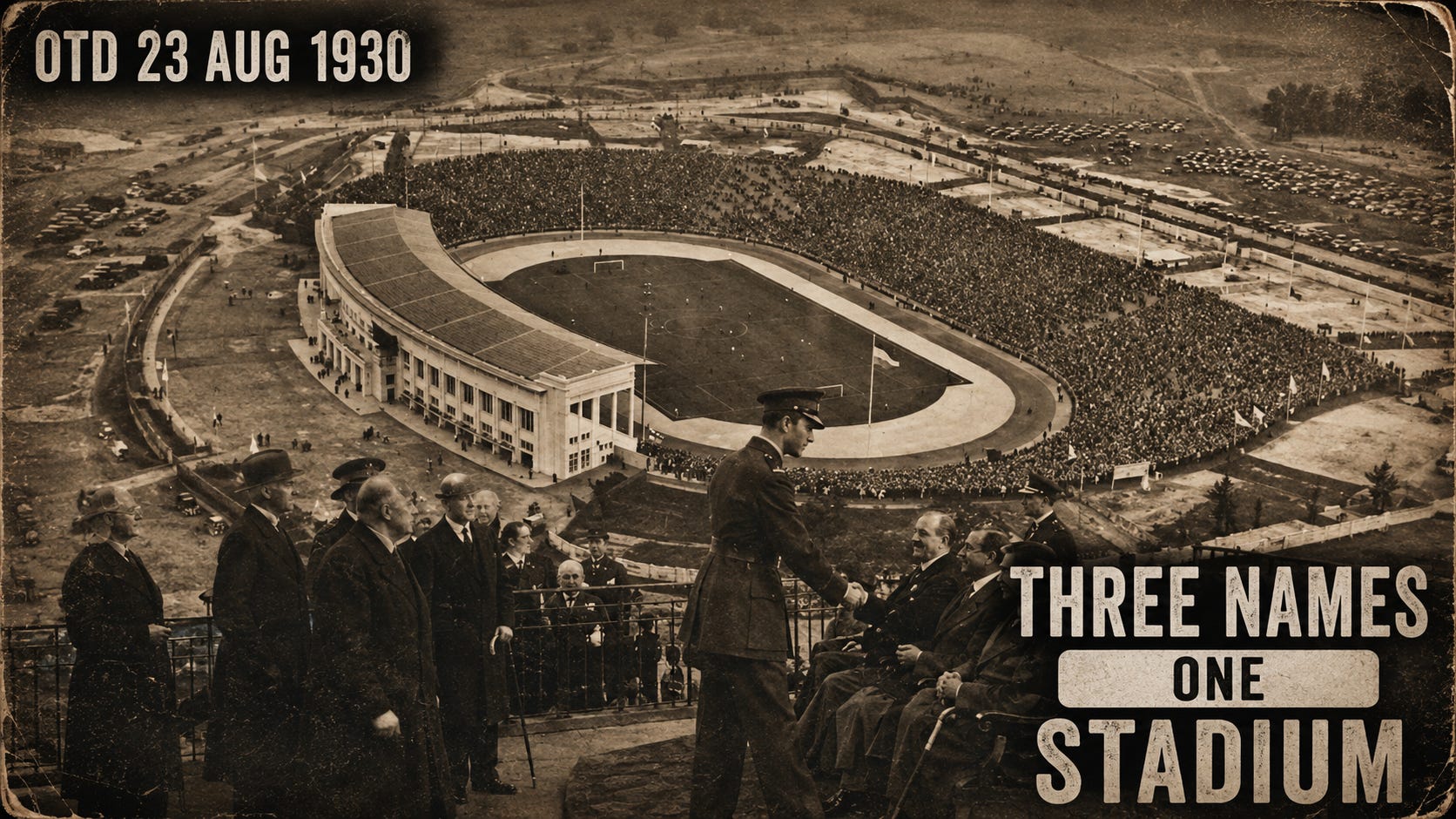
It is August 23, 1930 on the Heysel Plateau in Brussels, and Belgium is celebrating one hundred years of independence with the opening of a vast new national stadium. It holds around seventy thousand people and contains a football pitch, an athletics track and a wooden cycling track. It is called the Centenary Stadium, or the Jubilee Stadium. Later the world will know it simply as Heysel. And exactly sixty-five years from this day, the same ground will open again under a third name, the King Baudouin Stadium.
Belgium had become independent in 1830, and a century later Brussels wanted a monumental celebration, with sport at its heart. Belgian football already had real history, including Olympic gold at Antwerp in 1920, which remains the senior men’s team’s only major title. But the national team had no true home, so the capital wanted a stage worthy of it. There was a second motive too: Brussels was planning the enormous International Exposition of 1935, and the Heysel Plateau was being transformed into a new exhibition district, of which the stadium became the first great structure. The architect Joseph Van Neck designed it, Mayor Adolphe Max laid the foundation stone in October 1929, and less than a year later it opened on this day for the Track Cycling World Championships. Football followed three weeks later, when Belgium beat the Netherlands 4-1 in an unofficial international, a fittingly symbolic opponent for a centenary of Belgian independence. Crown Prince Leopold attended. And between those two opening dates, on the seventh of September, Leopold and Princess Astrid had a son named Baudouin. Remember that name.
From 1931 the stadium became the principal home of the Red Devils. After the Second World War the ground changed identity: the wooden cycling track had gone, reportedly used as firewood during the occupation, and in 1946 the Centenary Stadium became the Heysel Stadium, after the district around it. It grew into one of European football’s great stages. Real Madrid beat Milan there in the 1958 European Cup final, Di Stéfano scoring and Gento winning it in extra time; more European Cup finals followed; and in 1972 Heysel staged the European Championship final, where West Germany, with Beckenbauer, Netzer and Gerd Müller, beat the Soviet Union 3-0. In 1976 Anderlecht won the Cup Winners’ Cup there. By then Heysel was not merely Belgium’s national stadium but one of UEFA’s preferred showpieces.
The building itself, however, was ageing. A modern athletics track arrived in 1971 and new floodlights in 1974, but much of the basic structure was still from 1930, and this was not a uniquely Belgian problem. Across Europe the game was outgrowing stadiums built for another age: vast terraces, poor crowd circulation, weak segregation, and fences increasingly designed to contain spectators. At the same time hooliganism was becoming a serious problem, especially in English football, and European competition was exporting that violence across borders.
Then came the twenty-ninth of May 1985, and the European Cup final between Liverpool and Juventus. The stadium was in visibly poor condition, with parts crumbling, and both finalists had questioned whether it was suitable, but UEFA kept the match there. A disastrous arrangement placed Liverpool supporters beside a supposedly neutral section holding large numbers of Juventus fans, separated only by temporary fencing. Objects were thrown, Liverpool supporters charged, the barrier gave way, and people fleeing toward a retaining wall could neither reach the pitch nor escape quickly enough. The crush became unbearable and the wall collapsed. Thirty-nine people, most of them Juventus supporters, died, and more than six hundred were injured. The match was played anyway, because authorities feared that cancelling it might trigger even greater disorder; Juventus won 1-0, but the football was irrelevant. Heysel cannot be reduced to a single cause. Hooligan violence was central, but so were the stadium’s condition, its ticketing, its segregation, its policing and its administration. Fourteen Liverpool supporters were eventually convicted of manslaughter, and a Belgian police captain was convicted too. English clubs were banned from European competition for five years, Liverpool for six. The tragedy landed within a wider crisis: only eighteen days earlier fifty-six people had died in the Bradford City fire, and four years later came Hillsborough. The disasters had different causes, but together they made one truth impossible to ignore, that football grounds and crowd management had to change.
Heysel did not immediately disappear; Belgium kept playing internationals there until, in 1990, UEFA barred the country from hosting a European final for at least ten years. The stadium needed transformation, not repair, and with EURO 2000 approaching, it was almost completely rebuilt, only the monumental original entrance surviving. And here the royal story returns. The Crown Prince who had attended the 1930 opening became King Leopold III, whose 1940 surrender against his government’s wishes triggered the bitter postwar Royal Question and, in 1951, his abdication. His successor was the baby born between the stadium’s two opening events, Baudouin, who reigned for forty-two years. When Baudouin died in 1993, the reconstructed stadium was named after him. It reopened on the twenty-third of August 1995, exactly sixty-five years after the original, with Belgium losing 2-1 to Germany. The result hardly mattered; the ground had been born again, and it soon regained European trust, hosting the opening match of EURO 2000. Three names, one stadium, and an extraordinary amount of European history in between.
---
🎧 Listen on Spotify, Apple Podcasts, Amazon Music, Overcast, iHeart, and YouTube.
📩 Got an episode idea? otd@17lawsguy.com
Yesterday: 22 August 1964, football comes to the sofa.
Tomorrow: 24 August 1963, sixteen clubs line up and the Bundesliga finally kicks off.