

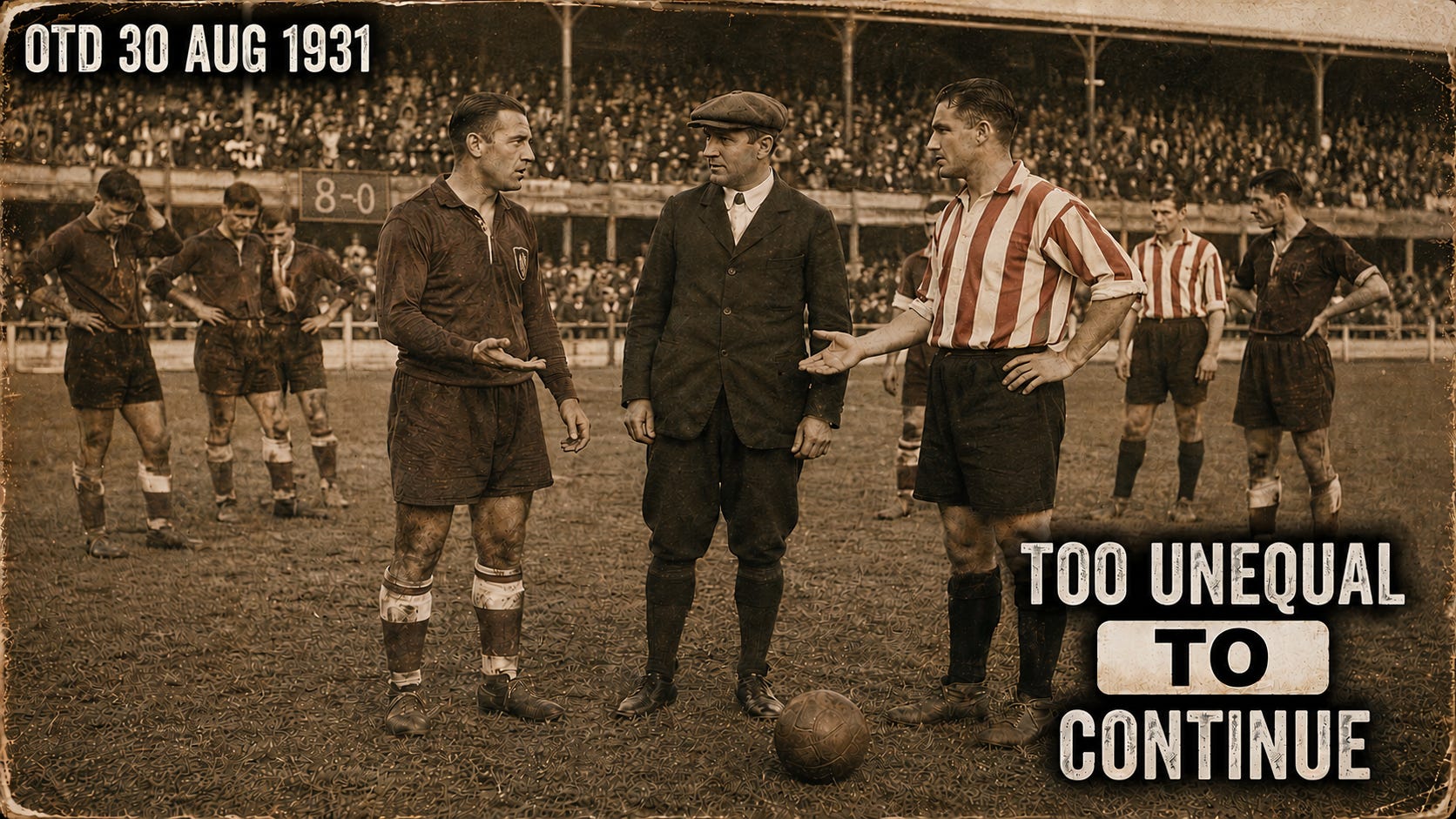
It is August 30, 1931, in La Plata, and Estudiantes are beating Lanús 8-0 with more than twenty minutes still to play. Then the Lanús captain, Edmundo Piaggio, decides he has seen enough. He asks the referee, Lorenzo Martínez, to end the match, and Martínez agrees. The explanation history remembers is a single, extraordinary word: desigualdad. Inequality. A professional football match, stopped because one club was simply too much better than the other.
To understand how that could happen, you have to understand how new professionalism was. Argentine football was old, its first championship played in 1891 and a durable association following in 1893, but its administration was a mess. The country had already run parallel, rival championships twice, and even the 1926 reunion left the top division bloated past thirty clubs, with unwieldy seasons and endless transfer disputes. Players were officially amateurs, yet many were quietly paid, a system Argentines nicknamed amateurismo marrón, brown amateurism. Worse, a player could not simply leave one club for another, because the registration rules let clubs keep their grip on him. In April 1931 the players struck, and their central demand was not just money but the freedom to move. The irony is that they did not win it. What the dispute killed was the pretense of amateurism. On May 18, eighteen leading clubs broke away to form the Liga Argentina de Football, and on May 31 the first openly professional season began, eighteen clubs and thirty-four rounds, with Boca Juniors on their way to becoming the first champions.
Two of those eighteen clubs were Estudiantes de La Plata and Lanús, and they could hardly have been further apart. Estudiantes, founded in 1905 and champions as far back as 1913, had one of the great forward lines in the country: Miguel Ángel Lauri, Alejandro Scopelli, Alberto Zozaya, Manuel Ferreira and Enrique Guaita, a five known as Los Profesores, the Professors. Zozaya would top the league with 33 goals and Scopelli score 31, and the club would rattle in more than a hundred on their way to third. Lanús, founded in 1915 as a community club, were living a very different first professional season, and would finish seventeenth of eighteen with 82 goals conceded. On August 30 they travelled to La Plata to meet perhaps the worst possible opponents.
The Professors started teaching at once. Zozaya scored in the tenth minute and again two minutes later, Scopelli added a third, Ferreira a fourth, Guaita a fifth, and it was 5-0 at the interval. It did not slow down. Zozaya completed his hat-trick nine minutes into the second half, Ferreira made it seven, and on 67 minutes Zozaya scored his fourth for 8-0. That is when Piaggio walked over to Martínez and asked him to end the martirio, the martyrdom. One account says the Estudiantes captain, Ferreira, agreed. Martínez blew his whistle after about sixty-eight minutes, and the match was over.
Martínez is worth a moment himself. He was no novice, having refereed at the 1928 Olympic Games in Amsterdam, but he was also capable of joining the drama. Five years earlier, when a player named José Maiorano protested a decision, Martínez had punched him. Now he had made a call that looks almost unimaginable today, stopping a professional league match because the two teams were so unequal.
Was he even allowed to? The 1931 Laws make the answer more interesting than a flat no. The game was meant to last ninety minutes, and referees were explicitly warned that in a competition with a prescribed duration they could not casually shorten it. But the Laws also gave the referee a broad power to suspend or terminate a match for darkness, crowd interference, or any other cause he judged necessary. There was no eight-goal mercy rule, no line that let everyone go home once a team fell far enough behind. There was simply that phrase, other cause, and Martínez reached for it. The practical case is easy to feel. The losing captain had asked for mercy, the winning captain seemed content, and nobody was in danger. They were being spared another twenty minutes of football. But that is exactly why it looks so strange in a championship, because competitive sport never promises equality of ability, only equality of rules.
History supplied a neat rebuttal just four years later. On April 7, 1935, the same two clubs met, Estudiantes won 9-1, and the ninth goal came in the eighty-third minute. Nobody stopped it because the gap had grown embarrassing; they simply finished. That is how senior football has almost always treated a mismatch. Borussia Mönchengladbach beat Borussia Dortmund 12-0 in 1978 and played the full ninety. Australia beat American Samoa 31-0 in 2001 with goals still going in at the death. Mercy rules do exist further down the pyramid, where some youth competitions in the United States start a running clock at a five-goal gap and end the game at nine, but the crucial thing is that those rules are written down before kickoff. That is a world away from a referee looking at a professional scoreline and deciding, on the spot, that enough is enough. Which is what makes Martínez halting the Professors so genuinely rare.
---
🎧 Listen on Spotify, Apple Podcasts, Amazon Music, Overcast, iHeart, and YouTube.
📩 Got an episode idea? otd@17lawsguy.com
Yesterday: 29 August 1970, a broken crossbar and the whole history of the goal.