

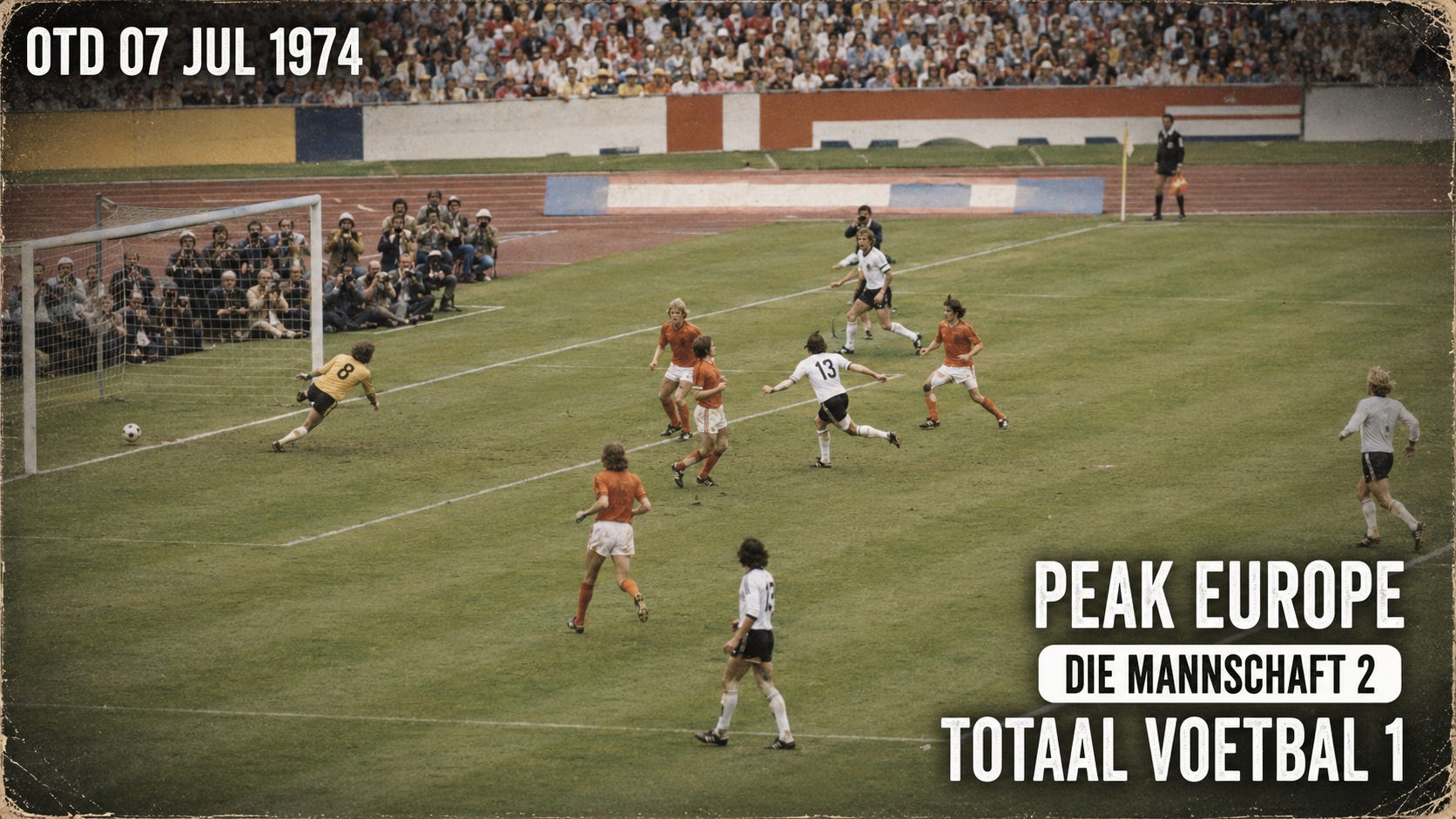
It is 7 July 1974, at the Olympiastadion in Munich. West Germany against the Netherlands, the World Cup final. Total Football against Die Mannschaft, Cruyff against Beckenbauer. And before a single German player has touched the ball, the Netherlands lead 1-0. Johan Cruyff wins a penalty in the opening minute, Johan Neeskens buries it, and the Dutch have turned a World Cup final into a demonstration. Then West Germany win it 2-1.
The match sits on a hinge in football history. Behind it lay the Brazil era, the joy and color of 1958, 1962, and 1970. Ahead lay the Argentina era, Kempes and then Maradona. But in between, from the late 1960s into the early 1980s, Europe built machines. Not machines as in cold, but as in systems: pressing, rotation, positional intelligence, the whole pitch squeezed and stretched by players who understood space together. Two models stood above the rest, and this final was their collision.
The Dutch machine came out of Ajax, European champions three years running, built by Rinus Michels into pressing, interchanging clockwork with Cruyff as its brain and blade. The German machine came out of the Bundesliga and Bayern Munich, assembled by Helmut Schön into a side of extraordinary balance: Maier in goal, Beckenbauer sweeping from the back, Breitner, Overath, Hoeneß, and the deadliest finisher alive in Gerd Müller. One was a football idea in orange shirts. The other was a nation’s best club ideas turned into a team.
The opening was as perfect as football gets. The Dutch kicked off, passed the ball among themselves again and again, and West Germany simply could not touch it. Then Cruyff accelerated through the center, was brought down, and Neeskens struck the penalty hard and straight past Maier. One minute gone, no German touch, and the Netherlands ahead. It may be the greatest opening statement in the history of the fixture.
It also carried a danger. Having shown their superiority so fast, the Dutch seemed to start enjoying it, playing to prove a point as much as to win. West Germany recovered. Berti Vogts began to strangle Cruyff’s supply, Beckenbauer steadied everything, and on twenty-five minutes Bernd Hölzenbein went down under a challenge in the box. The Dutch were furious, certain he had dived, but Breitner leveled from the spot. Then, two minutes before halftime, Rainer Bonhof drove to the byline and pulled the ball back low, Müller took a scruffy touch, turned, and finished. The touch was not clean, which somehow made it more his. West Germany led, and never let the lead go.
That is the Dutch paradox. They lost in 1974, lost another final in 1978, lost again in 2010, and still have no men’s World Cup. And yet the 1974 Netherlands are among the most important teams ever assembled, because Total Football did not die in Munich. It traveled, to Barcelona, through Cruyff, into La Masia, and on to Guardiola, and it rewrote how the game is played and taught. The Dutch lost the trophy but changed the language.
West Germany, meanwhile, proved that systems need winners too. This was a different kind of intelligence, not cynical, not anti-football: Beckenbauer stepping out from the back, Vogts marking the best player in the world out of the game, Müller turning half a chance into history. Munich 1974 was not simply Total Football falling short. It was the moment European system football reached its highest stage, Dutch movement against German machinery, beauty against proof, and only one of them was crowned.
🎙️ THE PODCAST GOES DEEPER. The full episode has the rise of the Dutch and German machines, the two first-half penalties in detail, and how the rivalry ran on to 1988 and 1990. That’s the 10-minute version.
---
🎧 Listen on Spotify, Apple Podcasts, Amazon Music, Overcast, iHeart, and YouTube.
📩 Got an episode idea? otd@17lawsguy.com
Yesterday: 6 July 1960, the Euros begin with a 5-4 thriller.
Tomorrow: 8 July 1982, the wild night in Seville.