

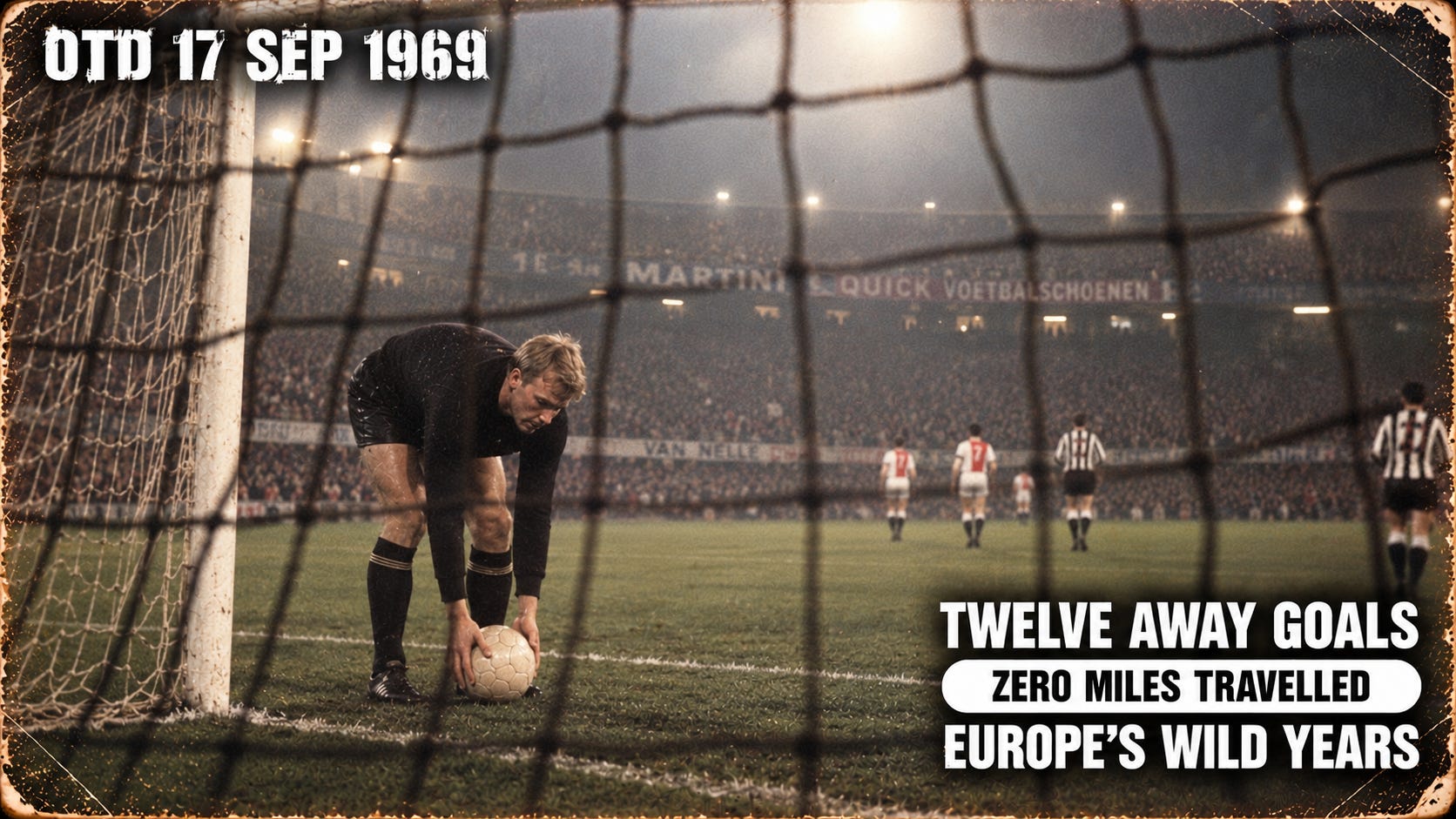
It is September 17, 1969, at De Kuip in Rotterdam, and the European Cup draw insists that this is KR Reykjavík against Feyenoord, with the Icelandic champions as the home team. Except the match is not in Reykjavík. It is in Feyenoord’s stadium, and so, it has already been agreed, is the return. Which means Feyenoord are about to score twelve away goals without ever leaving home. They win 12-2. It looks like nothing more than another mismatch from the European Cup’s unruly teenage years. It is really the first step toward a revolution.
How did we get here?
The European Cup was fifteen years old, and like many teenagers it had grown faster than its structure. It had begun in 1955 with sixteen invited clubs; by now there were thirty-three, from almost every corner of UEFA. But this was still the purest version of the tournament: domestic champions only, no group stage, no second chances, two legs, one club through and one club out. The romance was obvious, because the champion of Iceland could be drawn against the champion of the Netherlands. So was the weakness. Europe’s leagues had developed at wildly different speeds, some champions fully professional and others effectively amateur, travel was expensive, and grounds did not always meet UEFA’s requirements. For a smaller club, even hosting the tie could cost more than it earned.
That produced arrangements almost unimaginable now. KR Reykjavík are Iceland’s oldest football club, founded in 1899, in black and white stripes, and they had been champions of Iceland in 1968. They already knew the gap between domestic dominance and European reality, having lost 11-1 on aggregate to Liverpool a few years earlier. Now they had drawn Feyenoord, and KR’s nominal home leg was moved from Reykjavík to Rotterdam where the gate receipts were simply too good to refuse. Both legs would be played at De Kuip, and KR thus surrendered home advantage before a ball was kicked.
Feyenoord, meanwhile, were Dutch champions, having won both the 1968-69 Eredivisie and the Dutch Cup. But in European terms the Netherlands were still waiting. Ajax had shown what might be coming, dismantling Liverpool 5-1 in the Amsterdam fog in 1966 with a young Johan Cruyff emerging, and in May 1969 becoming the first Dutch club to reach a European Cup final, only to lose 4-1 to AC Milan. The Netherlands had arrived at the door without walking through it. And this season Ajax were not even the Dutch champions. Feyenoord were. The Rotterdam club had appointed the Austrian coach Ernst Happel, a demanding and tactically flexible man interested in movement, pressing and creating superiority all over the pitch, and his squad blended local identity with international quality: the captain Rinus Israël organizing the defence, Wim Jansen providing balance, Wim van Hanegem supplying vision and an unmistakable left foot, Coen Moulijn attacking from the wing, and the Swedish striker Ove Kindvall supplying the goals.
More than 54,000 people came to De Kuip. The fixture list called KR the home side; the surroundings said otherwise. Kindvall scored after three minutes, and then the floodgates opened, Piet Romeijn, Theo van Duivenbode, Henk Wery, Kindvall again, Ruud Geels, and van Hanegem just before the interval, so that KR Reykjavík trailed 7-0 at halftime. And because KR were officially at home, every one of those goals was technically an away goal. That mattered, because this was the first season the away-goals rule applied throughout the European Cup, a rule meant to encourage visiting teams to attack, and one that, if the away goals finished level too, could still leave a tie to be decided by the toss of a coin. Feyenoord had embraced the principle rather enthusiastically. After the break the goals kept coming, Geels again and Kindvall completing his hat-trick and Geels completing his, before KR finally answered through Baldvin Baldvinsson after 75 minutes and Ólafur Björnsson eight minutes later, two genuine moments of European history amid the demolition. Van Hanegem scored again, Geels added his fourth near the end, and it finished KR 2, Feyenoord 12, Kindvall with three, Geels with four, van Hanegem with two. Thirteen days later the clubs returned to the same stadium, this time with Feyenoord officially at home, and Feyenoord won only 4-0. Sixteen-two on aggregate. An absurd score, but not an unusual one for this stage of European football.
On the very same evening, Leeds United began their European Cup life by beating Lyn of Oslo 10-0 and Red Star Belgrade beat Linfield 8-0. A week later Real Madrid defeated Olympiakos Nicosia 8-0 in another nominal away leg moved to the stronger club’s ground, and the night before the KR match, in the Fairs Cup, Liverpool had beaten Dundalk 10-0. Even before this evening, four European Cup ties had already produced ten goals for a single side, Manchester United, Ipswich, Benfica and Anderlecht among them, so the scale was extreme but not unprecedented. The European competitions were expanding faster than competitive balance could follow. The first rounds were where champions met worlds they had never encountered, and sometimes the result looked less like a football match than a measurement of the distance between those worlds.
So what?
The first thing is that, for KR, the answer was survival. The 12-2 became part of the club’s European record, but it did not define KR’s place in Iceland, where they remain one of the country’s foundational and most successful institutions. European defeat does not cancel domestic meaning. That is one reason these early tournaments mattered: they let football communities from Reykjavík, Nicosia, Luxembourg and Malta enter the same competition as Madrid, Milan and Rotterdam. The price of inclusion could be brutal, but inclusion came first, and competitive convergence came later.
The second thing is that, for Feyenoord, this was the beginning of something far larger, the missing first page of a famous story. After scoring sixteen against KR, they were drawn against the holders, AC Milan, the very side that had crushed Ajax in the previous final. Feyenoord lost 1-0 at San Siro, then at De Kuip Wim Jansen scored early and van Hanegem struck late to eliminate the European champions. The pattern held: a narrow defeat away to Vorwärts Berlin and a 2-0 win in Rotterdam, then a goalless draw in Poland against Legia Warsaw and another 2-0 at De Kuip. And so, on May 6, 1970, at San Siro, Feyenoord faced Celtic, the champions of 1967, Jock Stein’s team, who had eliminated Leeds and arrived as favourites. Tommy Gemmell put Celtic ahead, Rinus Israël equalized two minutes later, and with three minutes of extra time left before a replay, Ove Kindvall chased a long ball, Billy McNeill could not clear it, and Kindvall lifted it over the goalkeeper. Feyenoord won 2-1 and became the first Dutch champions of Europe.
The third thing is that the revolution did not begin with Ajax. It began with Feyenoord. Ajax won the next three European Cups, in 1971, 1972 and 1973, making four consecutive Dutch champions of Europe, and then the Netherlands reached the World Cup finals of 1974 and 1978, so that Total Football became forever associated with Ajax, Cruyff and the national team. Understandably. But Feyenoord opened the door. Happel’s side proved that a Dutch club could organize, travel, adapt and defeat the continent’s established powers, and later in 1970 they beat Estudiantes to add the Intercontinental Cup, becoming the first Dutch champions of the world as well. That gives the 12-2 a strange double meaning. It belongs to the European Cup’s past, a young competition full of enormous disparities, relocated fixtures and double-digit scores. But it also announced the competition’s future: movement, pressing, tactical flexibility, and Dutch football replacing the established hierarchy. On one night, the European Cup showed both its immaturity and a glimpse of its next great age.
Three things to take away
First, KR Reykjavík lost 12-2 to Feyenoord, at De Kuip, even though KR were officially the home team. The return was also played in Rotterdam, so Feyenoord scored twelve away goals without ever leaving home.
Second, the score was extreme, but the imbalance was not unique. Leeds scored ten on the same evening and Red Star eight. The competition threw together national champions whose footballing and financial circumstances were separated by enormous distances.
Third, this was the beginning of a story with a famous ending. Feyenoord went on to eliminate the defending champions Milan, then Vorwärts Berlin and Legia Warsaw, and then beat Celtic in the final to become the first Dutch champions of Europe. Ajax won the next three.
On this day in 1969, Feyenoord beat KR Reykjavík 12-2 in Rotterdam, an Icelandic home match staged in the Netherlands, twelve away goals scored at home. It was a scoreline from the European Cup’s wild adolescence. It was also the first page of the story that ends with Feyenoord changing who ruled Europe.
---
📩 Got an idea to an OTD story? otd@17lawsguy.com
Yesterday: 16 September 1992, Larbi Benbarek, the God before Pelé, dies alone in Casablanca.
Tomorrow:18 September 1927, the first European international championship kicks off, a competition that will take more than two years to finish.
Crazy story