

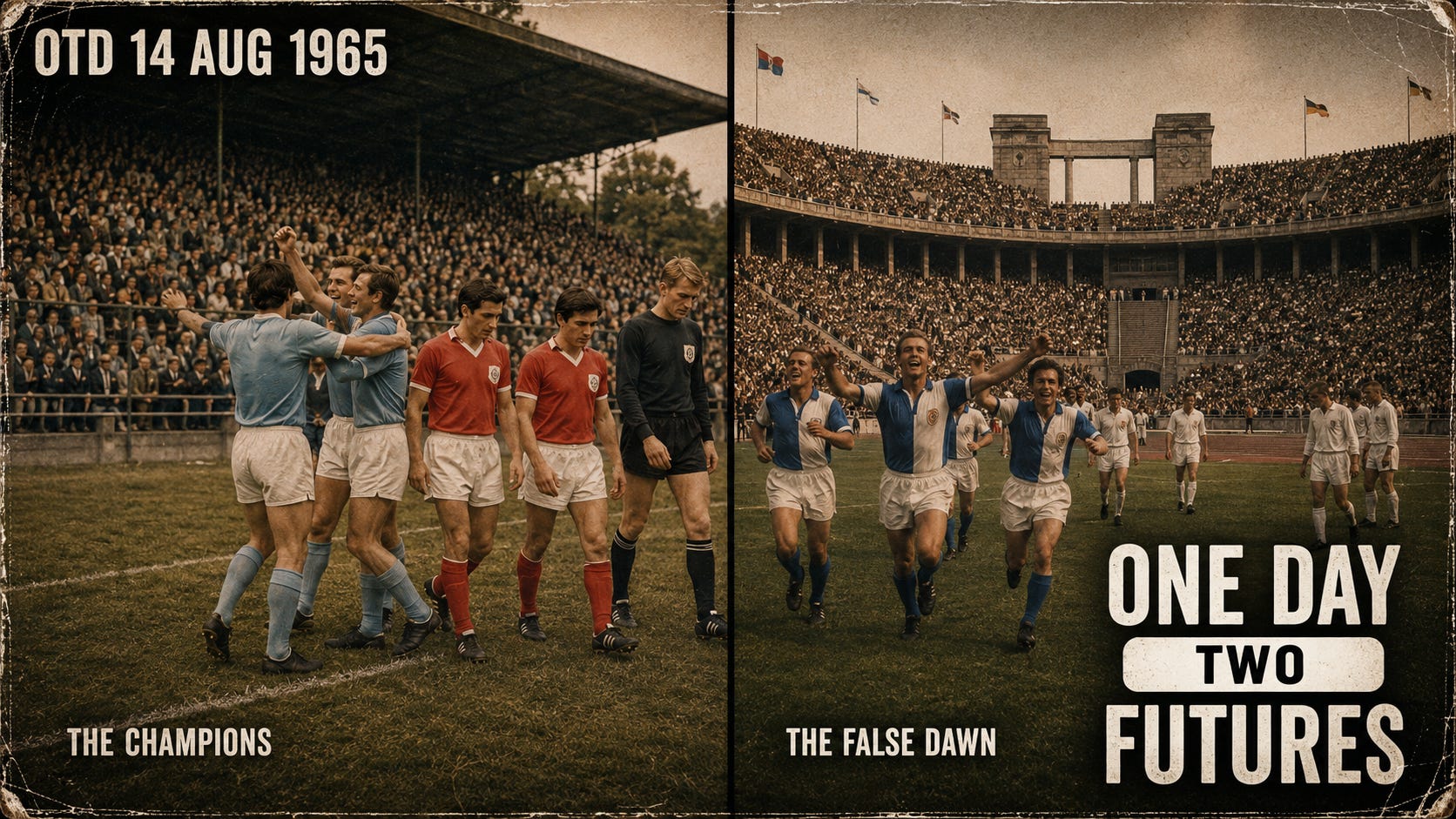
It is August 14, 1965. The Bundesliga’s third season kicks off, and this one is different. The league has expanded from sixteen clubs to eighteen. Bayern Munich are finally in. Borussia Monchengladbach are finally in. And Berlin has a representative nobody expected: Tasmania Berlin. Two matches give the day its meaning. In Munich, 1860 Munich beat Bayern 1-0. In Berlin, Tasmania beat Karlsruher SC 2-0. One is the beginning of 1860’s greatest season. The other is the strangest false dawn in Bundesliga history.
Start with the league itself. The Bundesliga was voted into existence in 1962: one national professional table, one champion, one top division. But the first Bundesliga was not simply the best sixteen clubs by one clean formula. There were regional quotas, financial criteria, sporting criteria, stadiums, and politics. One rule mattered enormously in Munich: only one club from a given city. So in 1963, 1860 Munich were chosen and Bayern were not. That sounds insane now, but in 1963 it made sense. 1860 were the stronger immediate case. They had momentum, won the DFB-Pokal in 1964, and reached the European Cup Winners’ Cup final in 1965, losing at Wembley to West Ham. A real team, ready now.
Bayern, meanwhile, were still becoming Bayern. They had won the German championship in 1932 and had history, but they had also been damaged in the Nazi era, when their Jewish president Kurt Landauer was forced out and persecuted. After the war, Bayern were not yet the national machine. They were a club with a future still waiting for permission. And that future was already forming: Sepp Maier, Franz Beckenbauer, Gerd Muller. Beckenbauer is one of football’s great sliding-door stories. As a boy he was expected to join 1860. Then, in a youth match, a 1860 player slapped him. The famous Watschn. Beckenbauer went to Bayern instead.
Now Berlin, where the young league became political. Hertha Berlin had been picked for the first Bundesliga partly because West Berlin mattered in Cold War terms. But in 1965 Hertha’s license was revoked over illegal payments, and the DFB still wanted a Berlin club in the league, for symbolism as much as sport, in a city isolated inside East Germany with the Wall already up. Tennis Borussia missed out in the play-offs. Spandauer SV were approached and declined. Then came Tasmania Berlin, third in the Berlin Regionalliga. Not ready. Part-time. Players pulled back from holidays, a squad asked to jump from regional football into the Bundesliga almost overnight. The league expanded to eighteen, which also saved Karlsruhe and Schalke from going down. So when Tasmania hosted Karlsruhe, the absurdity was doubled: a patched league had created a patched fixture.
Now the matches. Munich first, at Grunwalder Strasse, forty-four thousand, sold out. Bayern’s Bundesliga debut, with Maier, Beckenbauer, and Muller all starting. And 1860 win 1-0, Timo Konietzka scoring. This is not little brother beating big brother. Not yet. This is the established Bundesliga side beating the new neighbor. Then Berlin, the Olympiastadion, more than eighty-one thousand people. Tasmania against Karlsruhe. For a while it is goalless. Then Wulf-Ingo Usbeck scores. Then he scores again. Tasmania 2, Karlsruhe 0. The amateur outsiders have won their debut, and for one day they look like a fairy tale.
Two futures were planted that day. First, 1860’s win was a true harbinger. They won the Bundesliga that season, the only league title in their history, finishing ahead of Dortmund and Bayern. Bayern were excellent but not yet supreme. They took the cup that season, then the Cup Winners’ Cup in 1967, the Bundesliga in 1969, and then the 1970s empire. The opening derby loss did not stop Bayern. It simply reminds us that empires are not born already wearing crowns. Tasmania were the opposite. That 2-0 was almost the whole miracle. They did not win again for thirty-one matches. They finished last, with two wins, four draws, twenty-eight defeats, fifteen goals scored, and one hundred and eight conceded. The crowds collapsed from eighty-one thousand to 827 for a January match against Gladbach. Tasmania became the Bundesliga’s permanent measuring stick for disaster. Whenever a team starts terribly, people still ask: are they worse than Tasmania?
🎙️ THE PODCAST GOES DEEPER. The full episode has the 1963 selection rules, Beckenbauer’s sliding-door slap, Hertha’s license scandal, and Tasmania’s record collapse. That’s the 10-minute version.
---
🎧 Listen on Spotify, Apple Podcasts, Amazon Music, Overcast, iHeart, and YouTube.
📩 Got an episode idea? otd@17lawsguy.com
Yesterday: 13 August 1948, Sweden win Olympic gold.
Tomorrow: 15 August 1948, Dimayor kicks off and Colombia turns professional.