

There are cup upsets, and then there are cup runs that seem to have been designed by a writer who knew when to stop.
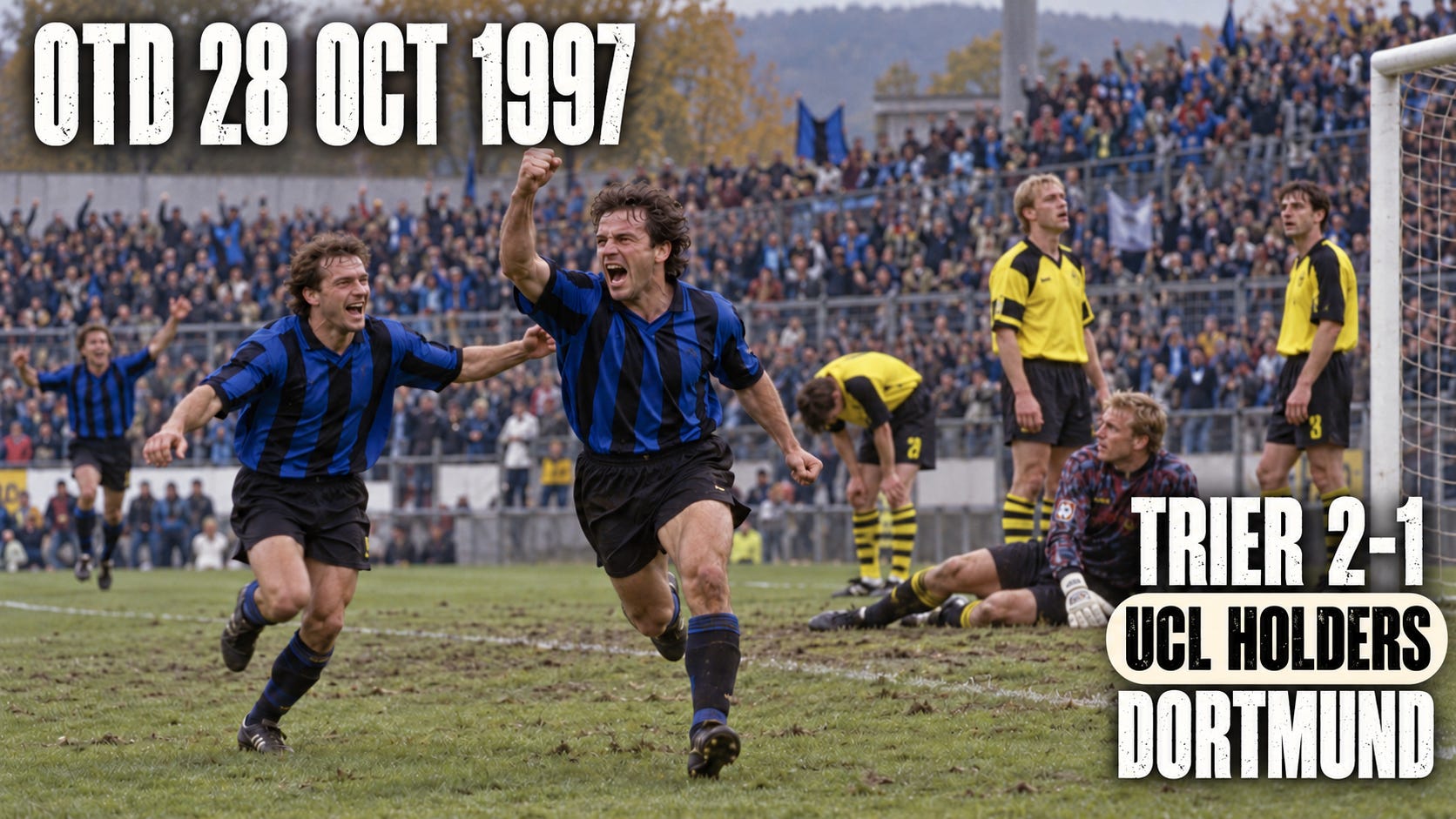
On October 28, 1997, third-tier Eintracht Trier beat Borussia Dortmund 2-1 in the Moselstadion. Dortmund were not simply a famous Bundesliga club who had drawn badly on a wet autumn afternoon. Five months earlier they had beaten Juventus 3-1 in Munich to win the Champions League, the greatest result in their history. Their team in Trier still contained Stefan Klos, Jürgen Kohler, Paul Lambert, Andreas Möller, Paulo Sousa and Heiko Herrlich. The coach was Nevio Scala. The setting was not a European stadium, nor even a Bundesliga one. It was Trier.
And it was not even the first European champion Trier had sent away that autumn. Five weeks earlier, Rudi Thömmes had scored the only goal against Schalke 04, the newly crowned UEFA Cup winners. Now Thömmes scored again. Marek Czakon converted a penalty. Kohler pulled one back for Dortmund. Trier held out.
That sequence is why this story deserves to stand in its own right, not merely as Germany’s version of yesterday’s Alcorconazo. Alcorcón made a word out of one four-goal humiliation. Trier made a season out of defeating the two German holders of Europe’s major trophies. The DFB-Pokal did not merely invite an upset. It allowed one small club to knock at Europe’s front door twice, and be let in both times.
How Did We Get Here?
Germany’s national cup has always carried two histories at once. It is the competition of serial winners and one-off liberations. Bayern Munich, with 21 titles, stand first in the winners’ list; Werder Bremen have six; Schalke, Dortmund, Eintracht Frankfurt and others have made the final in eras when the cup was as important as a league challenge. For the biggest German clubs, it is a trophy that belongs on the annual agenda. The dream of Berlin in May is not sentimental. It is expected.
But the cup was not built only for the powerful. The first nationwide German club cup began in 1935 as the Tschammer-Pokal. It was interrupted by the war and returned in West Germany in 1952-53 as the DFB-Pokal. Its modern logic preserves a route from the regional game to the national stage: Bundesliga and 2. Bundesliga clubs join the teams who have qualified through state association cups, and the lower-ranked side receives the home tie in the early rounds. It is a rule that turns the draw into an occasion before a ball is kicked. A small club does not have to travel to a famous ground and hope to survive. It can fill its own ground and make the famous club adapt.
That is the cup’s democratic gesture. It is not equality. Bayern have deeper squads, better facilities and more margin for error than the clubs emerging from the Verbandspokale. Dortmund in 1997 had internationals in every part of the pitch. But single elimination makes the burden uneven. The underdog can pour a season’s preparation into one afternoon or one night; the favourite arrives carrying league form, Europe, injuries, expectation and the certainty that anything less than victory becomes a national story.
The German cup had supplied such warnings long before Trier. In 1974, amateur VfB Eppingen beat Hamburg, the side who would go on to become European champions six years later. In 1990, Oberliga club Weinheim beat Bayern Munich 1-0. In 1994, Vestenbergsgreuth eliminated Bayern, and in later years the Pokal would keep returning to the same question: what happens when a famous badge has to play on someone else’s terms? These were not evidence that the hierarchy had disappeared. They were reminders that knockout football is the one domestic institution still permitted to embarrass it in public.
Trier had earned the right to be in that room. The club from the Moselle city were playing in the Regionalliga West/Südwest, then the third level of German football. Karl-Heinz Emig’s team were not a novelty act, but a serious regional side with players whose names meant something locally: goalkeeper Daniel Ischdonat; defenders Sven Teichmann and Antal Weiszenbacher; midfielders Peter Seufert and Thomas Richter; forwards Rudi Thömmes and Marek Czakon. Their cup campaign began with a 2-1 victory over second-tier Unterhaching. Then came Schalke.
Schalke had won the UEFA Cup only in May. Their triumph over Internazionale had made Huub Stevens’s team the “Eurofighters,” and it carried the emotional authority of the first European trophy in the club’s history. Trier beat them 1-0 at the Moselstadion on September 23. Thömmes scored in the 76th minute. The result would have secured a permanent place in the club’s history by itself. The most mischievous detail was that Thömmes was a Schalke supporter.
The next draw was more absurd still. Borussia Dortmund were the reigning Champions League winners. Ottmar Hitzfeld’s victorious 1996-97 side had defeated Juventus with Karl-Heinz Riedle’s two first-half goals and Lars Ricken’s famous late chip. By October, Hitzfeld had moved upstairs and Scala was coach, but the identity of the team had not evaporated. Klos, Kohler, Lambert, Möller, Sousa, Jörg Heinrich and Heiko Herrlich were all in Trier’s path. Dortmund had also opened that cup campaign by beating Warnemünde 8-0, then won 4-2 at Greuther Fürth. The visitors were not strangers to a hard cup tie; they were meant to be one of Germany’s answers to it.
The Moselstadion answered differently. Temporary stands raised the crowd to 17,900. That number matters because it tells the story of a city turning its ground into a national stage. Trier’s normal league life was regional; on October 28, the place held the Champions League holders, the German press and supporters who knew they were watching an opportunity that might never return.
Dortmund had the early status, the names and the ball. Trier had a shape, a crowd and the impatience to make the grander side uncomfortable. In the 37th minute, Seufert supplied Thömmes for the opening goal. It was the second time in five weeks that he had scored against a European trophy-holder. After halftime, René Schneider fouled Thömmes, and Czakon made the penalty 2-0 in the 50th minute.
The two goals had different kinds of force. The first gave the home crowd permission to believe; the second told Dortmund that belief had become a scoreline. Suddenly every touch carried the pressure of an explanation.
That was the moment the result stopped looking like a scare and started looking like a charge against the natural order. Dortmund responded quickly. Möller created the goal that Kohler scored in the 53rd minute. Scala made changes: Jovan Kirovski came on for Sousa at halftime, Wladimir But replaced Steffen Freund, then Bashiru Gambo entered. The names explain why Trier’s last half-hour carried such tension. This was not a rotated youth side whose defeat could be explained away as an experiment. It was a highly decorated European squad trying, in real time, to rescue itself from a third-tier stadium.
It could not. Trier won 2-1. Thömmes left to a substitute’s reception in the 73rd minute. The Moselstadion had eliminated the UEFA Cup winners and the Champions League winners in successive rounds. Germany had its own wonderfully unwieldy formulation: Trier were the *Champions-League-und-Uefa-Cup-Sieger-Besieger*.
So What?
Is this the greatest upset in DFB-Pokal history? As with yesterday’s Alcorconazo, “greatest” is an argument, not a calculation. Cup competitions have too many variables for an objective league table of amazement. A fifth-tier side beating a Bundesliga club can involve a greater division gap. A final can carry greater immediate stakes. A 1-0 can be more heroic than a 4-0. The question is not which shock has the largest numerical distance. It is which one best captures what the tournament permits.
Trier’s case is unusually strong because Dortmund were the reigning Champions League holders, not merely a rich club with a glamorous past. The win came in the round of 16, not on the first weekend when elite teams most often rotate. Dortmund fielded a recognisable, decorated side. Trier then added the context that no single match could supply: Schalke, the UEFA Cup winners, had already been eliminated in the previous round. The same scorer had hurt both of them. And Trier did not disappear after the headline. They beat Waldhof Mannheim in the quarter-final and reached the semi-final, where MSV Duisburg finally edged them 10-9 on penalties after a 1-1 draw.
That final detail is important. Trier’s autumn was not a flash produced by a loose ball and a stunned opponent. It was a cup campaign with an internal logic: a compact, committed third-tier team discovered that it could compete, the crowd discovered that it could carry them, and each win made the next one imaginable. They came one kick from a final against Bayern. The club’s modern identity still bends toward those months whenever it speaks about the Pokal.
Other shocks retain their own claims. Weinheim’s win over Bayern in 1990 was extraordinary precisely because Bayern arrived with World Cup winners and still lost to an Oberliga side. Vestenbergsgreuth’s 1994 victory over Bayern has become shorthand for rural Pokal romance. In 2012, fourth-tier Berliner AK beat Hoffenheim 4-0. More recently, Saarbrücken’s cup runs have renewed the conviction that German football’s lower tiers can still interrupt the elite. Each result has its own mixture of division gap, manner, timing and memory.
But Trier is hard to dislodge because the Dortmund result is only half its proof. It joins two European champions in a single campaign and then pushes on to the semi-final. That is not merely the story of a smaller club taking one clean swing. It is the story of a smaller club walking through the German cup’s heaviest door twice.
Yesterday’s Alcorconazo showed what happens when a single result becomes a word. Trier offers a different cup lesson: a run can become a local constitution. In Spain, the word outlived the players. In Trier, it is the chain of events that endured: Schalke out, Dortmund out, the floodlights needed for a televised semi-final, the last penalty wide. The story belongs to the city as much as to the players.
This is also where the comparison with the other great cups needs care. The FA Cup has Hereford and Newcastle, Wrexham and Arsenal, Sutton United and a long catalogue of afternoons in which a smaller ground became the point of the story. France had Calais, a fourth-tier club, reach the 2000 Coupe de France final. The Copa del Rey has its Alcorconazo. Italy, the Netherlands and Belgium have their own giant-killings, though entry rules and seeding can shape who gets exposed and when. The romance is real, but it is not a single European tradition playing out under identical rules.
Modern football has narrowed some of the openings. Elite clubs have larger squads and more information. They rotate with specialists rather than guesses. Money has made the distance between the first division and below more measurable in sports science, recruitment and depth. Some cups also give their leading clubs later entry or protective seeding. The DFB-Pokal, however, still understands something essential: the route into the tournament passes through regional cups, and early rounds give the lower-ranked team home advantage. That is not nostalgia. It is a structural decision to retain jeopardy.
The contradiction is that the very clubs most capable of commercialising the cup depend on these fixtures for its moral authority. A Bayern or Dortmund tie at a small ground gathers national attention because the result is not pre-written. The giant is selling an event, but it is also accepting the risk that the event will become someone else’s greatest day. If the cup were simply another seeding ladder leading efficiently to the same four clubs, it would lose the reason the early rounds matter.
Trier’s 1997 run therefore remains useful well beyond its own nostalgia. It tells the big clubs what the competition costs them: they cannot bring only their shirt, their medals or their expectation. It tells the smaller club what a home draw can become: not an honourable defeat, but an occasion to test every assumption on which the honourable defeat rests.
The strongest cupsets do not deny hierarchy forever. Dortmund remained Dortmund. Bayern won the 1998 final. European football did not reorder itself around the Moselstadion. But for one autumn, hierarchy had to travel to Trier, pay for a ticket and explain itself to 17,900 people. That is enough. It is more than enough.
Three Things to Take Away
1. Third-tier Eintracht Trier beat Borussia Dortmund 2-1 on October 28, 1997, despite Dortmund arriving as the reigning Champions League holders with a side containing Klos, Kohler, Lambert, Möller, Sousa and Herrlich.
2. Trier’s achievement was bigger than one upset: five weeks earlier, Rudi Thömmes had scored the winner against UEFA Cup holders Schalke. He also opened the scoring against Dortmund, before Czakon’s penalty made it 2-0.
3. Calling Trier’s run the greatest DFB-Pokal upset is a defensible judgment, not a provable fact. Its special force comes from the two European champions, the strength of Dortmund’s team and Trier’s run all the way to the semi-final.
On This Day
On October 28, 1997, Eintracht Trier beat Borussia Dortmund 2-1 in the DFB-Pokal. Dortmund were the reigning Champions League winners. Trier had already beaten UEFA Cup holders Schalke. For one autumn, the Moselstadion became Europe’s least comfortable cup destination.
Have a football memory, a correction or a story that belongs here? Write to otd@17lawsguy.com.
Yesterday: *Alcorconazo. When a Cupset Became a Word* — Alcorcón 4-0 Real Madrid, 27 October 2009.