

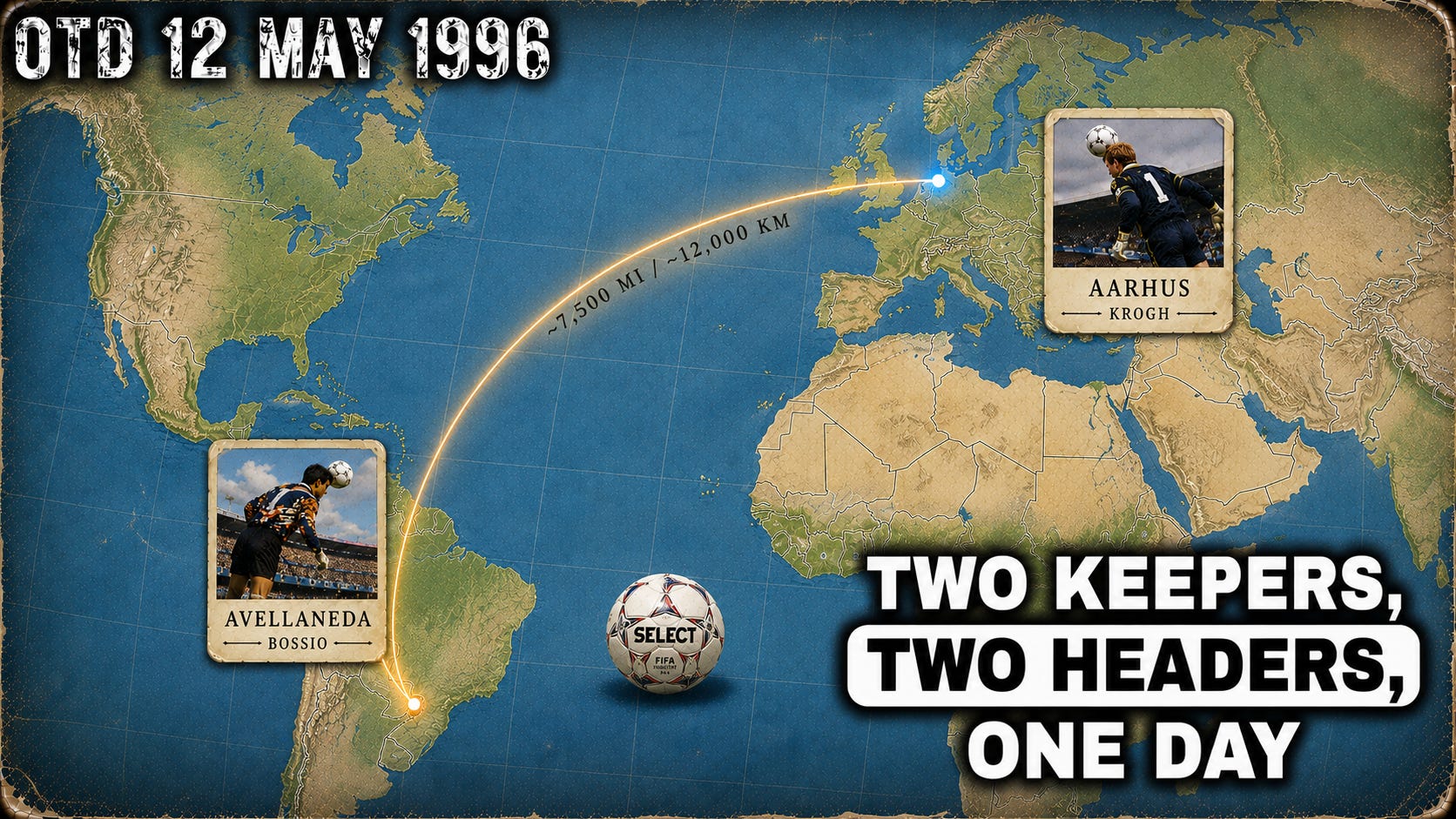
It is 12 May 1996.
Two football matches. Two continents. Almost seven-and-a-half thousand miles / twelve thousand kilometers apart.
In Aarhus, Denmark, Mogens Krogh leaves the Brøndby goal and heads in a late equalizer against AGF.
In Avellaneda, Argentina, Carlos Bossio leaves the Estudiantes goal and heads in a late equalizer against Racing Club.
Same day. Same position. Same emergency. Same solution: send the goalkeeper forward and hope the game does something irrational.
And here is the wild extra layer.
A year earlier, these two men had already stood opposite each other on the pitch — in an international final. Denmark against Argentina in the 1995 King Fahd Cup, with Mogens Krogh in goal for Denmark and Carlos Bossio in goal for Argentina.
This is the story of two goalkeepers who, on one strange Sunday in 1996 and literally on either side of the world, turned themselves into centre-forwards.
Start in Denmark.
AGF against Brøndby at Aarhus Stadion. This is not just another league match. This is the Danish title race. AGF are second. Brøndby are first. One point separates them. The stadium is packed. Even Crown Prince (today His Majesty the King) Frederik is there.
Brøndby lead 1-0 through Peter Møller just before half-time. Then AGF turn the game around. Thomas Thorninger scores twice. Henrik Mortensen makes it 3-1. AGF are heading for first place. Then Ebbe Sand pulls one back. 3-2.
And in the 87th minute, Brøndby win a corner. Mogens Krogh goes forward.
Krogh is not just any goalkeeper. He is the man Brøndby brought in after selling Peter Schmeichel to Manchester United in 1991. That is not an easy inheritance. Schmeichel is already a Danish icon, a European champion, one of the most aggressive goalkeepers football has seen.
Krogh is different. Less famous internationally. But solid, experienced, trusted. He has been around Brøndby long enough to understand the stakes.
The first corner does not quite produce the clean Hollywood moment. Krogh gets up for it, but the ball is going out. Ruben Bagger keeps it alive near the line. Per Nielsen recycles the play. The ball comes back into the area. Krogh is still there. Second chance. Header. Into the roof of the net.
AGF 3, Brøndby 3.
That alone would have been enough for the day. But in Argentina, a few hours and almost 7,500 miles / 12,000 kilometers away, the same football gods were apparently still at work.
Carlos Gustavo Bossio is known as Chiquito — “little” — which is football humour at its best because he is enormous. 6 foot 4, nearly two meters tall, broad, commanding, and already part of Argentina’s national-team picture in the mid-1990s. He had come through Belgrano, moved to Estudiantes, helped them return from the second division, and in 1995 had been part of Argentina’s Pan American Games gold-medal squad. A few months after this goal, he would go to the Atlanta Olympics and win silver with Argentina.
But on 12 May 1996, he is simply Estudiantes’ goalkeeper in a Clausura match away to Racing.
The setting is the Cilindro in Avellaneda. Racing lead 1-0 through Fleita. Estudiantes are running out of time. In the 88th minute, a corner is awarded. Bossio goes up.
And unlike so many goalkeeper goals, this is not chaos after chaos. This is a clean act.
The corner comes in. Bossio attacks it. Header. Goal.
Racing 1, Estudiantes 1.
The first goalkeeper in Argentine professional football to score from open play with his head.
For Estudiantes, Bossio’s goal became history more than destiny. They had arrived at that stage of the Clausura with ambition, but the draw did not launch them to the title. Vélez Sarsfield won the tournament. Estudiantes finished ninth.
Bossio’s career moved on too. In 1999, he went to Benfica. Later he returned to Argentina, became a major figure at Lanús, and in 2007 captained the club to the Apertura title — Lanús’ first top-flight championship.
For Brøndby, Krogh’s goal mattered immediately. The 3-3 draw meant AGF did not overtake them. Brøndby stayed top. Two weeks later, Brøndby won the 1995-96 Danish title by one point. One point. That is the entire meaning of the goal. Without Krogh’s header, AGF go above them. With Krogh’s header, Brøndby remain in front. And then Brøndby kept going: champions in 1996, 1997 and 1998.
The equalizer in Aarhus became not just a freak goal, but the ignition point of a championship sequence.
And the King Fahd Cup coincidence gives this story its final strange symmetry. On 13 January 1995 in Riyadh, Denmark beat Argentina 2-0 in the final of the King Fahd Cup, the competition that would become the Confederations Cup. Krogh in goal for Denmark. Bossio in goal for Argentina. They had met across an international final. Sixteen months later, on the same day, both of them scored late headed equalizers for their clubs.
Football does not usually write in rhymes.
This time, it did.
🎙️ The full episode (linked above) has more — including the wider pantheon of goalkeeper goals: Charles Williams in 1900, Pat Jennings’ 1967 Charity Shield, Schmeichel’s volley for Aston Villa, Jimmy Glass saving Carlisle from relegation in 1999, Alisson’s headed Premier League goal for Liverpool, and Provedel for Lazio in the Champions League. That entire taxonomy is in the audio.
---
🎧 Also available on Apple Podcasts, Amazon Music, Overcast, iHeart, and YouTube.
📩 Got an episode idea? otd@17lawsguy.com
Yesterday: 11 May 1976 — Welcome to Watford, Elton John.
Tomorrow: 13 May 1902 — the first Clásico, on a horse-racing ground in Madrid.
I remember sitting in a taxi, bound for Copenhagen airport, and the taxi driver & I were both listening to the radio transmission from Aarhus Stadion - so I experienced Mogens Krogh's incredible equalizer via live radio.