

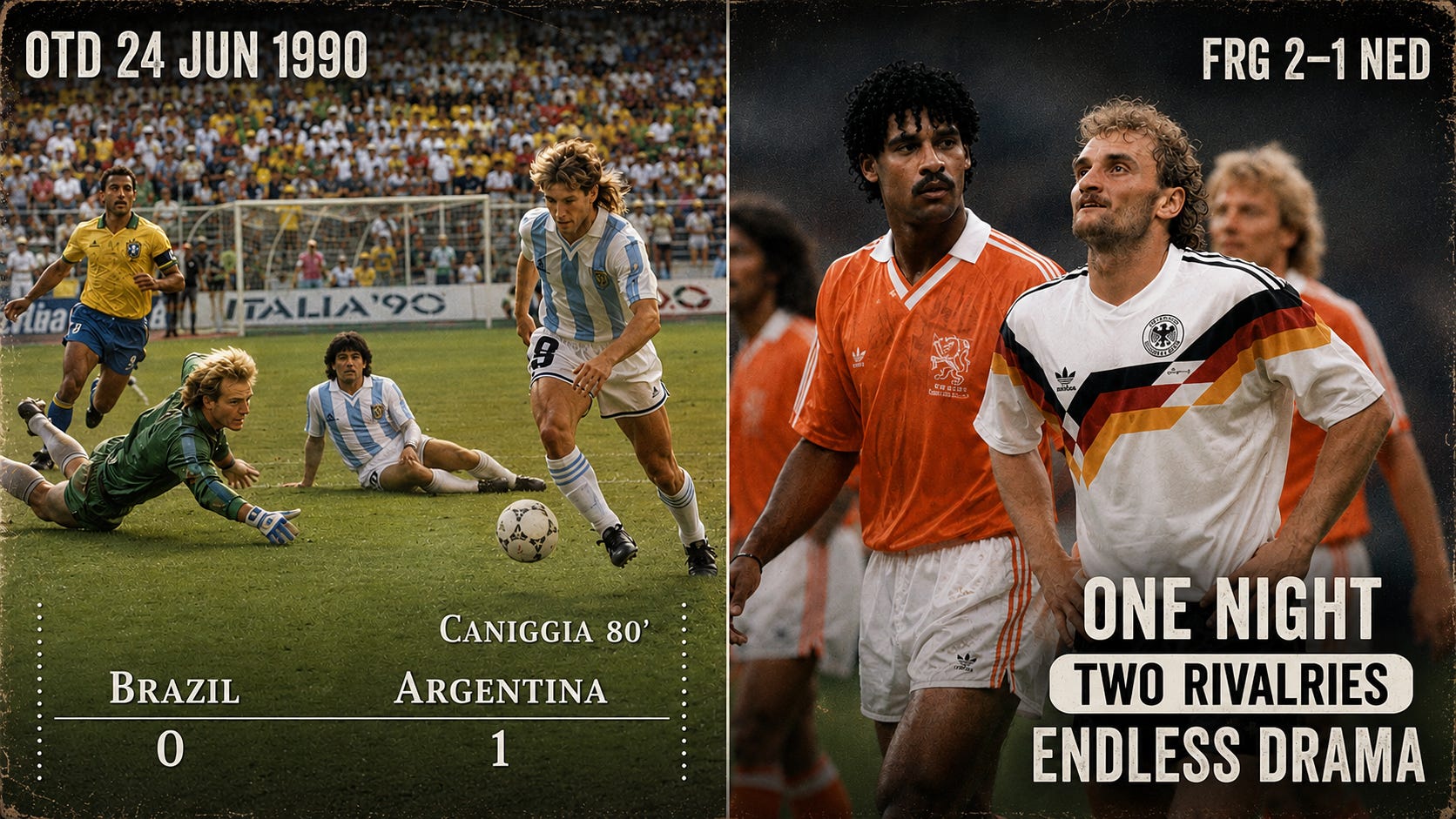
It is 24 June 1990, and the World Cup gives us six hours of pure grudge. At five o’clock in Turin, Brazil against Argentina, South America’s two great football civilisations. At nine in Milan, West Germany against the Netherlands, Europe’s most poisonous neighbourly feud. Four giants. Two rivalries. By the time the lights go down, two of them are out, and the two teams that will meet in the final have emerged.
Turin first, and a lesson football never stops teaching. Brazil were comfortably the better side, by a distance: they struck the woodwork twice, pinned Argentina back, and laid siege. Argentina survived on blocks, desperation, and a goalkeeper having the night of his life. Maradona was a wreck by now, ankle swollen, body four years past its 1986 peak. None of it mattered. With nine minutes left he collected the ball in a crowd of converging Brazilians and, somehow, the ball still obeyed him. One impossible pass, and Caniggia was through and gone. One chance, one goal. Brazil, who had dominated everything except the scoreboard, were out.
Being better is not the same as winning. It rarely has been.
There is a darker subplot to that match too, a bottle of water passed to a Brazilian defender and a scandal that South America still argues about. It belongs to the rivalry’s folklore now, the suspicion that Brazil lost to something other than a counterattack.
—-
Then to Milan, and an uglier kind of theatre. West Germany and the Dutch carried sixteen years of wounds into the San Siro: the 1974 final, the 1988 revenge. Within half an hour it curdled into one of the most notorious images in World Cup history, two great players sent off together amid a spitting incident that still makes people wince. Ten against ten, it was the more disciplined, less flamboyant German side that kept its head and won. The Netherlands, carrying a generation of genius, went home remembered as much for the disgrace as for the football.
And there is the asymmetry that has defined these two nations ever since. Germany take their pain and turn it into trophies. The Netherlands take theirs and turn it into mythology, the most beautiful team never to win the World Cup, over and over again. Same talent, across decades. Utterly different return on it.
The day was a hinge. Both winners, Argentina battered and unconvincing, West Germany cold and efficient, walked all the way to Rome, where Germany settled it 1-0 and Maradona wept. It was not the prettiest World Cup ever played. Italia 90 was a tournament of tension, cynicism, narrow margins and penalty shootouts. But this single Sunday held everything that made it unforgettable: a superior team eliminated by one touch of genius, a brilliant generation undone by its own loss of control, and the quiet emergence of the two sides destined to meet at the end.
Four giants walked in. By midnight, two were ghosts, and the final was already written.
🎙️ THE PODCAST GOES DEEPER. The full episode has what this post holds back: the Caniggia goal and the build-up to it, the holy-water scandal in detail, the Germany-Netherlands history from 1974 to 1988, the Rijkaard-Völler clash, both winners’ runs to the Rome final, and how both rivalries ran on through 2014 and 2022. That is the 10-minute version.
---
🎧 Listen on Spotify, Apple Podcasts, Amazon Music, Overcast, iHeart, and YouTube.
📩 Got an episode idea? otd@17lawsguy.com
Yesterday: 23 June 1998, Norway’s Late Shock Against Brazil.
Tomorrow: 25 June 2006, Portugal against the Netherlands, the Battle of Nuremberg.