

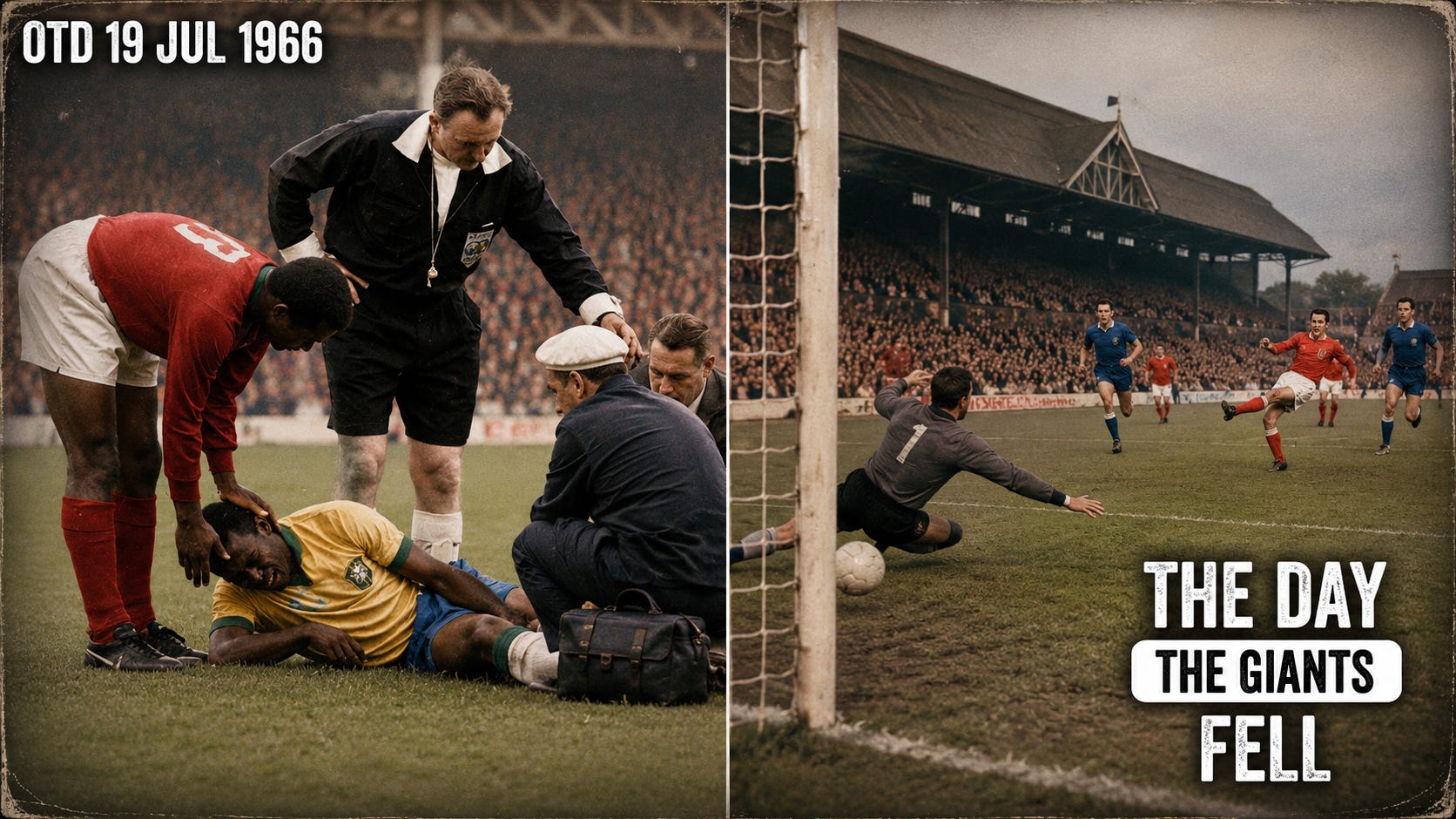
It is July 19, 1966, and history is about to change in two stadiums at once.
At Goodison Park, Portugal are playing Brazil, the back-to-back world champions of 1958 and 1962, the yellow shirt, the rhythm, the mythology. But 1966 Brazil are not quite that Brazil: the squad selection is messy, the preparation confused, too many old heroes and new possibilities mixed together. Pelé was fouled hard against Bulgaria and missed the loss to Hungary, so Brazil need a result against Portugal.
And Portugal are not a newcomer having fun. They are built on Benfica’s European rise, the club that ended Real Madrid’s first European Cup age in 1961 and beat them again in the 1962 final, the night Eusébio announced himself. By 1966, Eusébio is one of the great players in the world: power, balance, acceleration, shooting. Born in Mozambique, made in Lisbon. The Black Panther. Around him: Coluna, José Augusto, Simões, Torres.
Simões scores in the sixteenth minute. Eusébio makes it 2-0 in the twenty-eighth. And Pelé is in worse trouble: João Morais hacks him down brutally and stays on the pitch. There are no red or yellow cards yet, and no substitutes in World Cup play, so the greatest player in the world limps through the rest of the match as a passenger. Rildo pulls one back, Eusébio restores the distance, and it ends 3-1. The defending champions are out in the group stage. The great Brazil of 1958 and 1962 is over.
The same afternoon, at Ayresome Park in Middlesbrough, Italy are playing North Korea. Italy: two-time world champions, the country of Serie A and catenaccio, of Milan and Inter’s European Cups, of Rivera, Mazzola, Facchetti. North Korea: a team almost nobody in the West had seen, whose road to England ran through an Africa-Asia-Oceania qualification collapsed by boycott and withdrawal until it became two matches against Australia in neutral Phnom Penh, won 6-1 and 3-1. Chollima football, named after the mythical winged horse.
Italy need only avoid defeat. Then Bulgarelli is injured in the first half, and with no substitutes Italy are effectively reduced. In the 42nd minute, Pak Doo-ik finds the space and shoots low. North Korea 1, Italy 0. For the second half, Italy have the ball and the problem; North Korea have the lead and, remarkably, the crowd, because Middlesbrough has fallen for them. Final whistle. Italy are out. North Korea are in the quarter-finals, the first Asian team to reach a World Cup’s last eight.
The rewards for the two shocks meet each other four days later, back at Goodison: Portugal against North Korea, and after twenty-five minutes the score is impossible. North Korea 3, Portugal 0. Then Eusébio takes the match back: a goal, a penalty before half-time, a penalty to level, a fourth to lead. José Augusto makes it 5-3. One of the great World Cup comebacks. North Korea’s fairy tale ends, but not in shame; they bow to the crowd and leave as legends, adopted permanently by Middlesbrough, where surviving players returned decades later to an extraordinary welcome. Portugal lose the semi-final 2-1 to England after the match is moved to Wembley, beat the Soviet Union for third place, and Eusébio finishes top scorer with nine. It remains Portugal’s deepest World Cup finish.
And the two humiliated giants? Brazil turn the trauma into architecture: Mexico 1970, Pelé returned, Tostão, Jairzinho, Rivelino, Gérson, Carlos Alberto, the team that does not simply restore Brazil but defines it forever. Italy win Euro 1968 at home, then reach the 1970 final through the Game of the Century. So the two losers of July 19, 1966 meet in Mexico City for the right to keep the Jules Rimet Trophy. Brazil win 4-1.
Football’s long memory, closing a circle that opened in two English stadiums on one afternoon.
🎙️ THE PODCAST GOES DEEPER. The full episode has North Korea’s strange road through Phnom Penh, Eusébio’s 5-3 comeback, and the 1970 final payoff. That’s the 10-minute version.
---
🎧 Listen on Spotify, Apple Podcasts, Amazon Music, Overcast, iHeart, and YouTube.
📩 Got an episode idea? otd@17lawsguy.com
Yesterday: 18 July 1930, the Estadio Centenario opens, still drying.
Tomorrow: 20 July 1885, the day the FA finally permitted professionalism.
The Middlesbrough love affair had a beautiful sequel: the 2002 documentary The Game of Their Lives brought surviving North Korea players back to Teesside, and the welcome was extraordinary. Ayresome Park is housing now, and there is reportedly a bronze boot print in a garden marking roughly where Pak Doo-ik struck it. Football memory at its strangest and best.
It is obvious: Argentina got robbed in the final of 2026 as in the finals of 1990 and 2014. FIFA favoured Spain with a better calendar (one more day of rest) and also Spain had BIG help from the referee
https://ezequieldoiny.substack.com/p/it-is-obvious-argentina-got-robbed?utm_source=share&utm_medium=android&r=8t2s5