

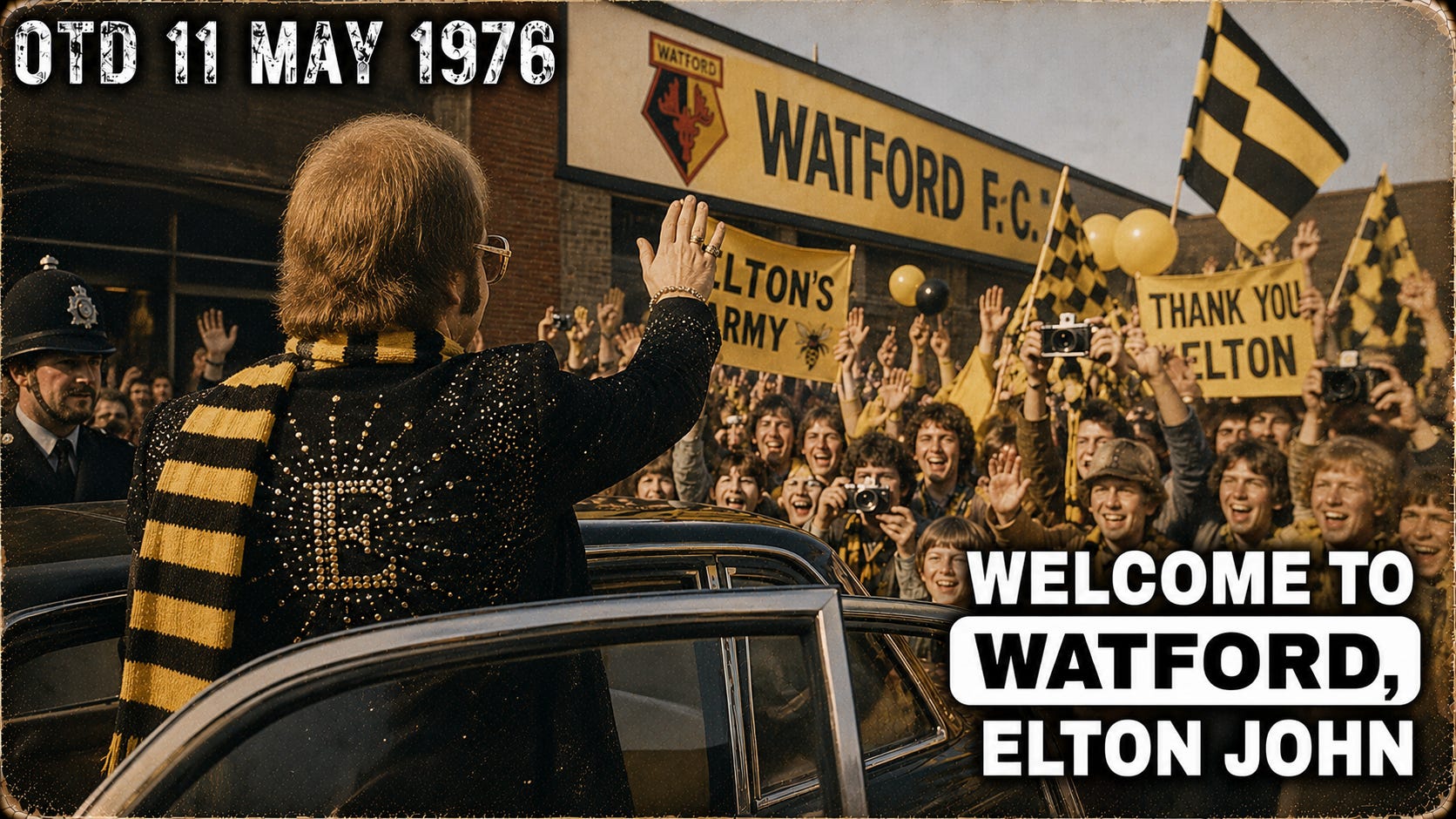
It is 11 May 1976. Watford Football Club have a new chairman.
His name is Reginald Kenneth Dwight. But the world knows him as Elton John.
He is twenty-nine years old, one of the biggest pop stars on earth, and now he owns a small Fourth Division football club from Hertfordshire.
It sounds ridiculous. Then it becomes one of English football’s great transformation stories.
Because Elton John does not buy Watford as a vanity object. He buys the club he supported as a boy. He brings money, attention, ambition — and then the most important decision of all: Graham Taylor.
Within six years, Watford go from the Fourth Division to the First Division. Within seven, they finish second in England.
This is the story of what happens when a global rock star treats a local football club not as an accessory, but as a mission.
Watford was not a glamour club. Founded in the nineteenth century, moved to Vicarage Road in 1922, spent most of its life outside English football’s elite. By the mid-1970s, Watford were a small club in the Fourth Division. In 1974-75, they had been relegated from the Third Division. In 1975-76, they finished eighth in the Fourth.
Then comes Elton.
He had grown up nearby, in Pinner, Middlesex, and Watford was his childhood club. Not a convenient brand. Not an investor’s opportunity. His club.
By 1976, Elton John is a global phenomenon. Your Song. Rocket Man. Crocodile Rock. Goodbye Yellow Brick Road. Bennie and the Jets. He is one of the defining performers of the decade. He is flamboyant, theatrical, wealthy, famous — and, in football terms, completely unusual. Football chairmen in England usually came from local business: industry, construction, brewing, retail. They were civic businessmen, not rhinestone superstars.
Elton first gets formally involved with Watford as vice-president in 1973. Then, on 11 May 1976, Jim Bonser resigns and Elton takes over as chairman.
There is suspicion. Of course there is. To some, it looks like a stunt. A pop star playing football executive. Elton understands that people in the game are waiting for him to fall over. But his answer is not celebrity distance. His answer is passion. He famously says he is passionate about the club with a capital P.
And he makes the claim that sounds almost absurd at the time. He wants Watford in the First Division.
The laughter is understandable. This is a Fourth Division club. The First Division is Liverpool, Manchester United, Arsenal, Everton, Tottenham, Aston Villa. It is another universe.
But Elton’s great strength is that he does not try to be the manager. He does what a good chairman should do: he finds the right football man.
In 1977, he appoints Graham Taylor from Lincoln City. That is the hinge.
Taylor is young, disciplined, direct, demanding, and absolutely clear about the club he wants to build. He brings structure. He brings standards. He brings a style often mocked from outside — direct, intense, high-tempo — but devastatingly effective when executed properly.
And the partnership works because Elton and Taylor trust each other. Elton provides ambition and backing. Taylor provides football judgement.
The rise is immediate. Fourth Division champions in 1977-78. Promoted again from the Third Division in 1978-79. Two years of consolidation in the Second Division. Then up again in 1981-82.
Fourth Division to First Division in five seasons.
Then comes the season that turns the whole thing into legend. 1982-83. Watford’s first season in the top flight. Most promoted clubs hope to stay up. Watford finish second.
Second in England. Only Liverpool ahead of them. Luther Blissett is the league’s top scorer. John Barnes is emerging as one of the most exciting young players in the country. Vicarage Road is no longer a curiosity.
Watford qualify for Europe. In 1984, they reach the FA Cup final, losing 2-0 to Everton at Wembley. Elton is there, living every kick.
Before Elton, Watford were a lower-league club with loyal supporters and modest expectations. Under Elton and Graham Taylor, they became a national story — not because the club was bought into dominance in the modern super-club sense, but because the right money, the right manager, the right local culture and the right ambition aligned.
Elton sold to Jack Petchey in 1987 but remained tied to the club. He later returned as chairman, stepped down again in 2002, and continued as honorary life-president. He played concerts at Vicarage Road to help the club. In 2014, a stand at the stadium was named for him.
And he became, very quietly, an early model for something now familiar: celebrity capital entering football with narrative, publicity and emotional branding attached. Delia Smith at Norwich. Ryan Reynolds and Rob McElhenney at Wrexham. Some are more commercial. Some are more global-brand strategy than local romance.
But Elton showed, very early, that celebrity ownership could be serious if the celebrity genuinely belonged to the club’s story.
The pop star and the schoolteacher-like manager.
The dreamer and the builder.
Elton John brought the outrageous dream. Graham Taylor made it operational.
---
🎧 Also available on Apple Podcasts, Amazon Music, Overcast, iHeart, and YouTube.
📩 Got an episode idea? otd@17lawsguy.com
Yesterday: 10 May 1987 — Naples Crowned by Diego.
Tomorrow: 12 May 1996 — two goalkeepers, two leagues, two last-minute headers.