

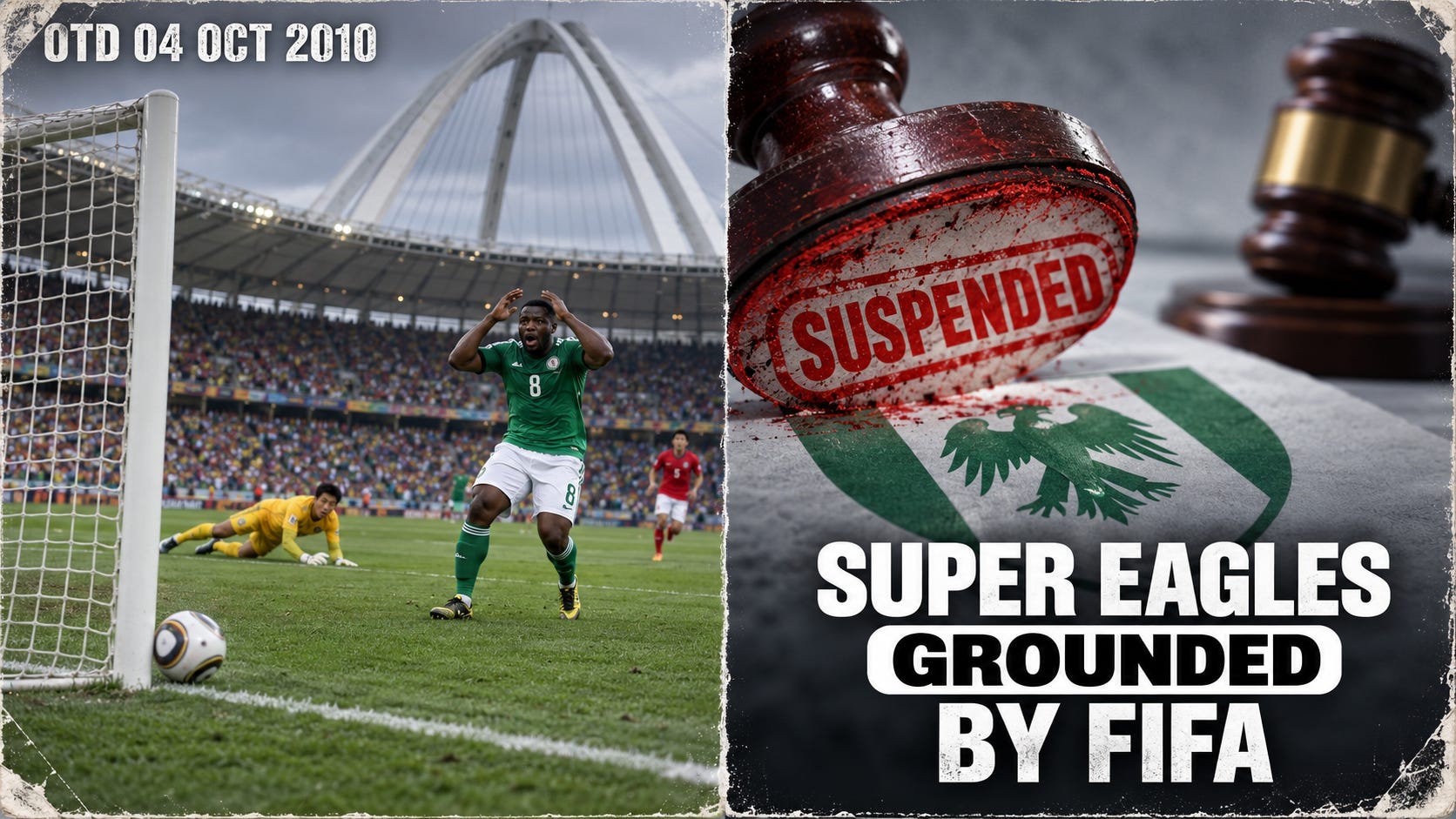
On October 4, 2010, FIFA suspended Nigeria from world football. Not merely the senior men’s team, the Super Eagles, but every Nigerian national side, every club, every friendly, and every official hoping to attend a FIFA or CAF course, grant or development program. A country that had given the world Jay-Jay Okocha, Nwankwo Kanu, Rashidi Yekini and an Olympic gold medal was suddenly outside the international game, six days before a must-win Cup of Nations qualifier. The trigger was not Nigeria’s disastrous World Cup that summer. It was a more fundamental question football administrators and governments have fought over for decades: who actually governs a football association, when a federation, a court and a head of state all claim the authority to decide?
How did we get here?
Organized African football grew up inside colonial administrative structures, built on British, French, Belgian and Portuguese models, and African associations stayed marginal within FIFA even as independence movements transformed the continent around them. That began changing in 1957, when Egypt, Sudan, Ethiopia and South Africa formed the Confederation of African Football. CAF’s inaugural championship had only three participants, since South Africa was excluded after refusing to field a racially integrated team, but the institution mattered more than its first tournament: African football now governed its own affairs on its own continent.
Nigeria’s Football Association had formed in 1945, and a representative side toured Britain in 1949. Independence in 1960 brought Nigeria into FIFA and CAF, and the country entered the Africa Cup of Nations for the first time in 1963. Progress was uneven; civil war devastated the country between 1967 and 1970, and the instability that followed touched every national institution, football included. Nigeria took bronze at the 1976 and 1978 Africa Cup of Nations, then won the tournament outright on home soil in 1980, beating Algeria 3-0 before a reported 85,000 people at Lagos’s National Stadium, Segun Odegbami scoring twice. The youth ranks reinforced the signal, Nigeria winning the inaugural FIFA Under-16 World Championship in 1985 and another global youth title in 1993.
Then came the generation that reset Nigeria’s place in the world game. In 1994, the Super Eagles won the Africa Cup of Nations in Tunisia and qualified for their first World Cup. Built around Stephen Keshi, Sunday Oliseh, Finidi George, Emmanuel Amunike, Daniel Amokachi and Rashidi Yekini, Nigeria won its group at the finals and came agonizingly close to eliminating Italy in the round of sixteen. Amunike put Nigeria ahead in the twenty-fifth minute, and the lead held until Roberto Baggio equalized with two minutes of normal time left, then won it from the penalty spot in extra time to send Italy through 2-1. FIFA’s world ranking briefly placed Nigeria fifth, the highest any African side had yet reached.
Two years later Nigeria reached an even greater summit, though politics nearly erased it first. The country was then ruled by General Sani Abacha, and after the execution of activist Ken Saro-Wiwa and eight fellow Ogoni campaigners, relations with Nelson Mandela’s South Africa collapsed. Abacha withdrew the defending champions from the 1996 tournament hosted there, and CAF excluded Nigeria from 1998 too. Politics had taken an exceptional generation out of its own continental championship, but it could not take them out of the Atlanta Olympics. Nigeria came back from three-one down to beat a Brazil side built around Ronaldo, Rivaldo, Bebeto and Roberto Carlos, Kanu scoring a golden-goal winner, then twice came from behind against Argentina in the final before Amunike settled it in the last minute. Nigeria became the first African country to win Olympic football gold, and that summer felt like the opening of something enormous: Okocha became one of the era’s great entertainers, Kanu won the Champions League with Ajax before a celebrated career at Arsenal, and Finidi and Amunike also won European titles. Nigeria reached the World Cup’s last sixteen again in 1998, beating Spain 3-2 along the way.
Underneath those achievements, the administration never matched the talent. Players repeatedly complained about unpaid bonuses, poor travel arrangements and officials meddling in team selection, coaches cycled through in quick succession, and federation elections turned into political contests, because administrative positions carried access to government money, FIFA funding, travel and patronage. The team kept succeeding in spite of the system surrounding it, not because of it. Nigeria lost the 2000 Africa Cup of Nations final to Cameroon on penalties, then finished third in 2002, 2004, 2006 and 2010, while failing even to qualify for 2006. By 2010, the first World Cup held in Africa, Nigeria had become an underachieving giant, scraping through qualification only on the final day, when Obafemi Martins scored twice away to Kenya and Mozambique obligingly denied Tunisia the result Nigeria needed. The federation then dismissed coach Shaibu Amodu despite that qualification and replaced him with Sweden’s Lars Lagerbäck only months before the tournament. In South Africa, Nigeria lost 1-0 to Argentina, then 2-1 to Greece after Sani Kaita was sent off, leaving a final group match against South Korea that Nigeria still needed to win. They led, fell behind, and equalized through Yakubu, who then missed one of the tournament’s most extraordinary chances, turning the ball wide from four yards out with an open goal in front of him. The match finished 2-2, and Nigeria went home with a single point.
Who governs the game?
President Goodluck Jonathan decided the humiliation demanded presidential action. On June 30, he announced Nigeria would withdraw from international football for two years while the sport was reorganized. It could be framed as decisive leadership, since the federation had plainly malfunctioned and Nigeria’s anti-corruption agency was already investigating senior officials over the alleged misuse of World Cup funds. But a head of state cannot suspend his own national federation without triggering FIFA’s most jealously guarded principle, that a member association must run its affairs free of undue influence from government or any other outside party. FIFA gave Nigeria until July 5 to reverse the decision or face suspension of the entire association, and Jonathan backed down hours before the deadline. The federation engineered a face-saving retreat, dismissing president Sani Lulu and vice-president Amanze Uchegbulam, apologizing for the World Cup performance and promising to rebuild.
That defused the crisis without resolving it. Nigeria still needed to elect a new football administration, and the process was challenged by the National Association of Nigerian Footballers, which argued the planned election violated both domestic football regulations and the federation’s own statutes. On August 20, a Federal High Court in Lagos ordered all parties to preserve the status quo while the case was heard, an order restated four days later. The election went ahead on August 26 regardless, and Aminu Maigari was elected NFF president. On September 6, Justice Okon Abang declared that election null and void for proceeding in open defiance of the court’s order. It was a genuine conflict of authority, not a simple case of right against wrong: the court was enforcing Nigerian law, while FIFA saw outside legal intervention stopping an elected executive from doing its job. Meanwhile the government-controlled National Sports Commission ordered acting NFF general secretary Musa Amadu to step aside, and the sports minister intervened directly in the domestic league, instructing that the new season begin without relegation from the one before.
By early October, FIFA faced an accumulation of provocations: the president’s attempted withdrawal, court orders paralyzing the new executive committee, government pressure forcing out the acting general secretary, and ministerial interference in the league itself. On this day, FIFA’s Emergency Committee acted, suspending the NFF immediately. The phrase that stuck in headlines was “FIFA bans Nigeria,” but the precision mattered: it was the federation that was suspended, not only the senior men’s side. No Nigerian team, at any level, could enter a regional, continental or international competition. No club could play internationally, and the country could not even arrange friendlies. The NFF and its officials lost access to FIFA and CAF development support, courses and training, and the suspension would stand until the court actions ended and the elected executive could operate without interference.
The move was severe but not unprecedented; FIFA had suspended federations before when governments removed leadership or rewrote football structures by decree, with Greece and Iran both suspended in 2006 over this kind of intrusion. The weapon works because FIFA never has to convince a government its reading of law is wrong; it can simply cut the country off from the sport’s network. That power carries its own contradiction. Government interference genuinely can destroy a federation’s independence, and no minister should be picking a national team or installing loyal officials. But governments also build the stadiums, fund the programs and run the courts and anti-corruption agencies that actually catch wrongdoing, and insisting that football alone must police itself can sound like a demand for immunity from scrutiny, particularly when FIFA’s own house was no model of transparent governance that year. Barely two weeks after suspending Nigeria’s federation, FIFA’s ethics committee opened an investigation into Nigeria’s own representative on its executive committee, Amos Adamu, after a newspaper sting reported he had offered to sell his vote in the next World Cup hosting bid; FIFA banned him for three years that November. The same organization demanding Nigerian football insulate itself from outside interference was, that same month, disciplining the Nigerian inside its own governing body.
So what?
The immediate danger was Nigeria’s Africa Cup of Nations qualifier away to Guinea on October 10. Nigeria had already beaten Madagascar 2-0 in its opener, and if the suspension held, the Guinea fixture would have to be forfeited, postponed or struck from the schedule. Youth teams, clubs and administrators were shut out too, landing on everyone who had no part in creating the dispute, and that pressure produced quick movement: NANF signaled it would drop its legal challenge, Musa Amadu was allowed back into his post, and the government withdrew its intervention in the league. On October 8, four days after imposing the ban, FIFA provisionally lifted it, and Nigeria traveled to Conakry after all. The reprieve carried its own deadline, a court hearing set for October 25, and the court later discharged the contempt case and the Maigari administration survived. Nigeria’s suspension had been dramatic but brief, and the Super Eagles suffered no automatic forfeiture, though they did lose 1-0 to Guinea two days after the ban was lifted. A year later, needing only a win at home to the same opponent to complete qualification, Nigeria let Guinea equalize late in a 2-2 draw and missed out on the 2012 Africa Cup of Nations. That failure cannot honestly be pinned on a four-day suspension a year earlier; the deeper problem was administrative disorder running through the whole cycle. The suspension was a symptom, not the cause, and it did not touch Nigeria’s ability to produce players: the country won the 2013 Africa Cup of Nations under Stephen Keshi, added Under-17 World Cup titles in 2013 and 2015, and reached the World Cup’s round of sixteen again in 2014.
The governance problem never went away, though. After Nigeria’s elimination from that 2014 World Cup, another court order removed the NFF leadership and installed a government-appointed administrator, and FIFA suspended Nigeria again, a ban that ended quickly once Maigari’s committee was restored. That repetition is the real legacy of October 4, 2010, more than the four days themselves. Nigeria kept proving it could produce world-class players under almost any conditions; what it struggled to produce was a stable institution capable of governing them without court battles, disputed elections and recurring FIFA ultimatums. The pattern is not uniquely Nigerian. Kenya and Zimbabwe were both suspended in 2022 after their governments dissolved the national football bodies, and Pakistan has endured repeated suspensions over who legitimately controls its association. The names change; FIFA’s demand stays the same: restore the recognized executive, withdraw outside control, prove the federation can run itself. A suspension can settle who sits in the federation’s offices. It cannot make that federation competent, eliminate corruption, or guarantee honest elections and a sustainable domestic league.
Three things to take away
FIFA did not suspend Nigeria for losing at the World Cup. It suspended the federation because courts, ministers and government agencies had left its elected leadership unable to function independently, a distinction the phrase “FIFA bans Nigeria” tended to erase.
A FIFA suspension reaches an entire football ecosystem. Not just the senior team, but youth and women’s sides, clubs, friendlies, officials and development funding, all cut off at once.
The ban lasted four days, but what caused it did not disappear with it. Nigeria won the 2013 Africa Cup of Nations, proving the talent had survived; Nigeria was suspended again in 2014, proving the governance problem had too.
On October 4, 2010, FIFA grounded the Super Eagles for four days. The ban lifted in time for Guinea. The question it raised, of who truly governed Nigerian football, never did.
---
📩 Got an idea to an OTD story? otd@17lawsguy.com
Yesterday: 03 October 1973, Bayern Munich came within eleven minutes of being eliminated from the European Cup by Åtvidaberg, a Swedish club backed by a typewriter factory. Conny Torstensson scored twice for the Swedes that night; weeks later he had signed for Bayern.