

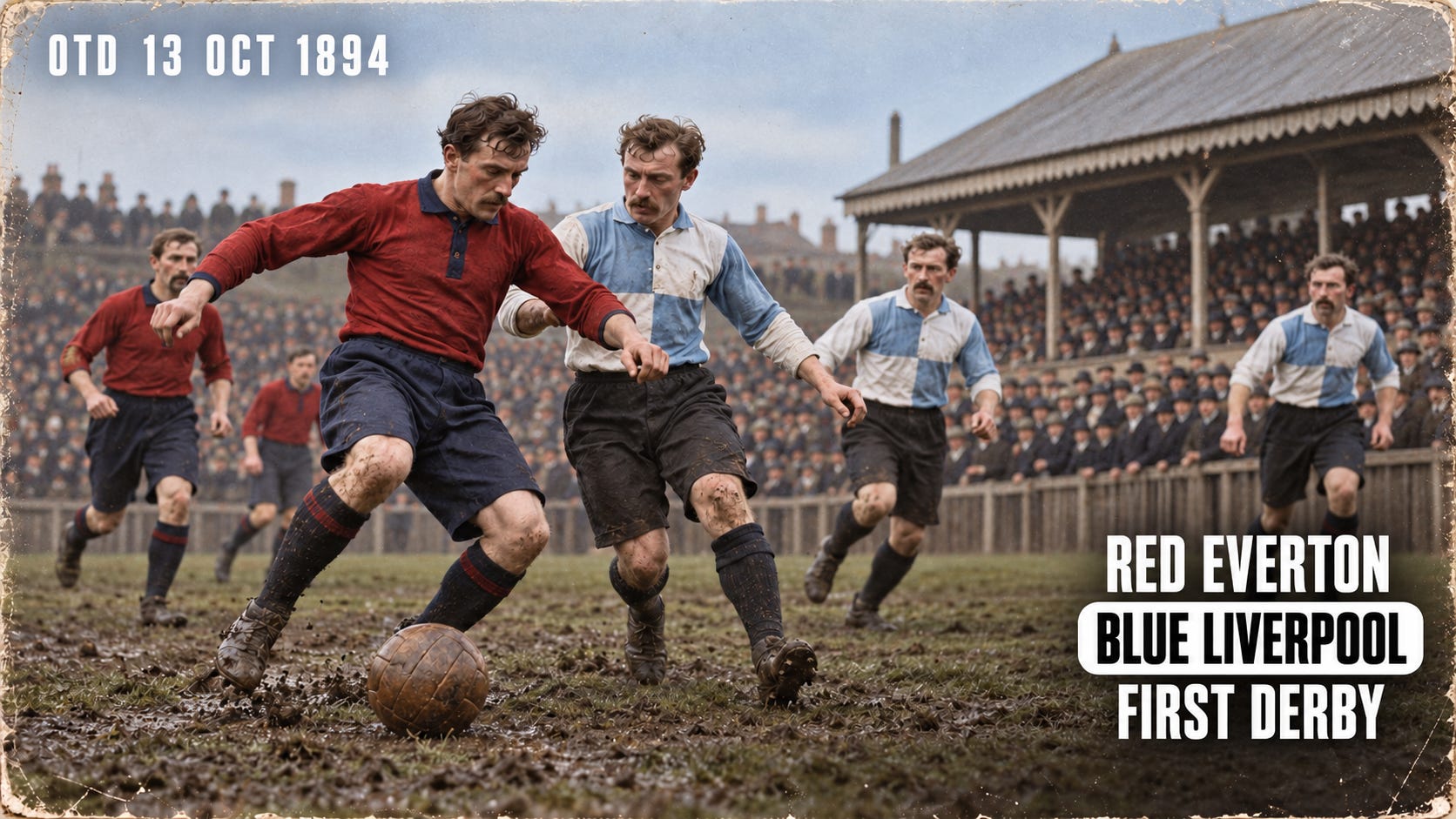
It is 13 October 1894, and 44,000 people are trying to fit into Goodison Park for a football match unlike any the young Football League has staged before.
Everton enter in ruby shirts with dark blue trim and navy knickers. Liverpool wear pale blue and white. To modern eyes, the city has dressed the wrong teams in the wrong colors.
The clubs are separated by Stanley Park, two years of history and a boardroom rupture that has left one of them playing in the other’s former home. Everton are established champions and top of the First Division. Liverpool are newly promoted, winless and already discovering that their unbeaten Second Division season has not prepared them for the highest level.
Ten minutes after kickoff, Tom McInnes gives Everton the lead. Alex Latta adds a second after an hour. Jack Bell completes a 3-0 victory two minutes from time.
The first Football League Merseyside derby has been played, although nobody calls it that. Merseyside will not exist as a metropolitan county for another eighty years. The colors will change. The stadiums will grow. The two clubs will become global institutions.
The family argument will remain.
How did we get here?
The rivalry begins with one club, not two.
Everton emerged in 1878 from St. Domingo’s, a Methodist church in the Everton district. The football team soon outgrew its congregation and adopted the name of the wider area. It played first in Stanley Park, then at Priory Road, before moving in 1884 to a field off Anfield Road.
John Houlding, a local brewer, Conservative politician and influential Everton figure, helped arrange the move. He later bought the Anfield land and became the club’s landlord. Everton developed the ground, attracted increasingly large crowds and joined the Football League as a founder member in 1888. In 1890/91, Everton won the championship at Anfield.
Success sharpened the questions around ownership. The familiar summary is that Everton left because Houlding raised the rent, and rent was central. Yet the dispute also concerned control, the possible purchase of Anfield and adjoining land, Houlding’s commercial interests and competing ideas about how a rapidly expanding football club should be governed. He wanted Everton tied more securely to property and businesses he controlled. An opposing group, led by George Mahon, wanted a different structure and a different home.
On 15 March 1892, the split became final. Everton’s members voted to leave Anfield. Mahon’s group secured Mere Green Field on the other side of Stanley Park and built Goodison Park in only a few months. It was among England’s first purpose-built major football grounds, with stands on three sides, changing rooms, offices and even a separate room for the referee.
Houlding possessed a football ground but no football team. He first tried to preserve an Everton identity for his new company, but the established club kept its name. Liverpool Football Club and Athletic Grounds Limited was formally recognized on 3 June 1892.
The clubs were therefore not unrelated neighbors who gradually became rivals. Liverpool were born directly from Everton’s departure. Anfield had already staged Everton’s first league championship before Liverpool played a match there. Goodison existed because Everton needed to escape Anfield. Each ground was evidence in the other club’s origin story.
The shirts made the relationship even stranger. Everton had changed colors several times and were wearing ruby with dark blue in 1894. Liverpool began in blue and white, apparently using a combination associated with Everton and shirts left behind at Anfield. Liverpool did not adopt red shirts and white knickers until September 1896. Everton’s royal blue became established in the early twentieth century. Liverpool’s famous all-red strip arrived only under Bill Shankly in 1964.
On the afternoon that began the league rivalry, then, Everton supplied the red and Liverpool the blue.
Houlding’s new club advanced with remarkable speed. Liverpool recruited heavily from Scotland, prompting the nickname “the team of Macs.” They won the Lancashire League in their first season, 1892/93, and were elected to the Football League’s Second Division. In 1893/94, Liverpool won all fourteen home league games and completed the twenty-eight-match campaign unbeaten. Promotion still required a test match against a First Division club. Liverpool beat Newton Heath, the future Manchester United, 2-0.
Everton and Liverpool had already met by then. This is where the usual claim that October 1894 brought the first-ever derby requires qualification.
On 22 April 1893, the clubs contested the Liverpool Senior Cup final at Bootle’s Hawthorne Road ground. Ten thousand people watched Tom Wyllie score the only goal for Liverpool. The match was fierce, Everton demanded a late penalty and then protested what they considered the referee’s general incompetence. Liverpool were not immediately presented with the trophy while the local association considered the complaint. The appeal failed.
They met again in the same competition in April 1894, when Everton won 3-0 with reserve-heavy teams. These local cup encounters mattered, but the Football League meeting gave the rivalry national standing and a permanent place in the season.
The contrast on 13 October could hardly have been greater. Everton had won their first eight league matches, scoring thirty goals and conceding seven. Liverpool had played nine, drawn four, lost five and won none. Everton were first. Liverpool were fourteenth in a sixteen-club division.
The anticipation overwhelmed normal measures. Goodison’s 44,000 crowd was extraordinary in an era before mass motor transport, radio commentary or floodlights. Reported gate receipts reached £1,026. This was not curiosity about two distant powers. It was an industrial city arriving on foot, by tram and by rail to see what its own sporting division had created.
Everton’s selection included Scottish international Johnny Holt at center-half, England forward Edgar Chadwick, prolific center-forward Jack Southworth and the dangerous wide men Latta and Bell. Liverpool captain Andrew Hannah had himself played for Everton and won the 1891 championship at Anfield. Around him stood many of the Scots who had driven Liverpool’s rise, including Duncan McLean, Joe McQue, Jim McBride, Jimmy Ross, Harry Bradshaw and Hugh McQueen.
Everton struck after ten minutes. McInnes, playing inside-right, scored the first goal in league derby history. Liverpool remained within one goal through halftime, but Latta made it 2-0 in the 60th minute. Bell scored in the 88th.
Everton had won 3-0, precisely the score by which they had beaten Liverpool’s reserves in the local cup final months earlier. The result reflected the immediate hierarchy: the established former champions against a club only two years old and experiencing its first top-flight season.
Five weeks later, Anfield staged its first league derby. Liverpool twice came from behind, Jimmy Ross converting a last-minute penalty for 2-2. The season ended as the opening Goodison meeting had suggested. Everton finished second to Sunderland after a powerful title challenge. Liverpool finished bottom and were relegated through the test-match system.
The separation was real. Permanence was not yet guaranteed.
So what?
What followed was one of football’s great exercises in proximity.
Liverpool returned to the First Division in 1896 and soon became champions. Everton remained one of the country’s major clubs. With interruptions when one occupied the Second Division, their league rivalry continued, then became annual from Liverpool’s promotion in 1962. Goodison remained one of its two homes until Everton moved in 2025. Anfield and Goodison stood less than a mile apart, with Stanley Park between them and generations of divided households surrounding both.
The fixture became the most-played derby in English league football. After the first meeting at Everton’s new Hill Dickinson Stadium in April 2026, the conventional senior derby count, which begins with the 1894 league fixture and excludes the early local cup meetings, stands at 248. Liverpool lead with 102 wins to Everton’s 68, with 78 draws.
Those totals contain almost every kind of football memory.
Liverpool’s Ian Rush is the derby’s record scorer with twenty-five goals. Everton’s Dixie Dean, whose life and legend belong to the opposite side of Stanley Park, scored nineteen. Everton goalkeeper Neville Southall made a record forty-one appearances. The highest-scoring derby produced eleven goals when Liverpool won 7-4 at Anfield in 1933. Liverpool’s largest home league win was 6-0 in 1935. Both clubs have won 5-0 away: Everton at Anfield in 1914 and Liverpool at Goodison in 1982.
That 1982 match gave Rush four goals and Everton one of their bleakest afternoons. Emergency loanee Glenn Keeley was sent off on his debut after bringing down Kenny Dalglish. Keeley had not realized that a newly emphasized professional-foul interpretation could mean dismissal. He never played for Everton again. Liverpool won 5-0, still their largest victory at Goodison.
The largest Goodison attendance also belongs to the derby. On 18 September 1948, 78,299 watched Everton draw 1-1 with Liverpool. Two decades later, the city found a way to fit an even larger audience into two stadiums. Demand for the 1967 FA Cup tie at Goodison was so immense that eight giant screens were erected on the Anfield pitch. Alan Ball scored Everton’s winner before 64,851 at Goodison while another 40,149 watched the closed-circuit relay across Stanley Park. More than 100,000 people occupied the two grounds for the same match.
The phrase “friendly derby” arose from this intimacy. Support did not divide neatly by neighborhood, class, politics or religion. Red and blue existed inside the same streets and often the same families. From 1902 to 1932, the clubs even shared a matchday program. Unlike Glasgow’s Old Firm, attempts to assign one club a fixed Catholic identity and the other a Protestant one never adequately described their support.
Friendly did not mean gentle. The contest has generated more Premier League red cards than any other fixture, twenty-three by the commonly used count. Tackles, touchline confrontations and the pressure of sharing a workplace, school or family dinner with the opposition have repeatedly sharpened it. The description works best when it means familiar, not harmless.
The 1980s displayed both meanings. In the 1984 League Cup final, blue and red supporters traveled together to Wembley and sang “Merseyside” in an era scarred by hooliganism elsewhere. The match ended 0-0; Liverpool won the replay 1-0 at Maine Road. Two years later, the clubs returned for the first all-Merseyside FA Cup final. Everton led through Gary Lineker, but Rush scored twice around a Craig Johnston goal as Liverpool won 3-1 and completed the Double, having already finished two points above Everton in the league.
The friendship was strained by competitive imbalance and by Heysel. Everton’s brilliant 1984/85 champions were denied a European Cup campaign when English clubs were banned following the disaster at the 1985 final involving Liverpool. Resentment entered a rivalry that had once presented mixed terraces as proof of civic distinction.
Then Hillsborough demonstrated the deeper bond. Eighteen days after the disaster, Liverpool returned to competition at Goodison on 3 May 1989. Ninety-five red and blue scarves, reflecting the death toll known at the time, were linked around the pitch. A banner in the Liverpool end thanked Everton: “We never walked alone.” The match finished 0-0, but the score was incidental. Weeks later the clubs met in another FA Cup final, Liverpool winning 3-2 after extra time.
Goodison produced the derby’s wildest modern draw in February 1991. Liverpool led four times in an FA Cup replay. Everton equalized four times, Tony Cottee supplying the fourth in extra time. The 4-4 did not settle the tie, and its emotional cost extended beyond the night. Kenny Dalglish resigned as Liverpool manager two days later, exhausted by pressures that included carrying the club and bereaved families through Hillsborough’s aftermath. Everton won the second replay 1-0.
Other matches acquired their own folklore. Gary McAllister’s audacious free kick from roughly forty yards won a violent, card-filled Goodison derby 3-2 for ten-man Liverpool in stoppage time in 2001. Dan Gosling’s extra-time FA Cup winner for Everton in 2009 was missed by television viewers when ITV accidentally cut to advertisements. Divock Origi’s 96th-minute goal in 2018 came after Jordan Pickford mishandled a shot that struck the crossbar. The derby specializes in endings that seem to wait until everyone believes the danger has passed.
Liverpool’s modern dominance created a record twenty-three-match unbeaten sequence from 2011 until Everton won 2-0 at an empty Anfield, due to Covid-19 restrictions, in 2021. Everton’s 2-0 Goodison victory in April 2024 was their first home derby win for fourteen years and inflicted severe damage on Liverpool’s title challenge.
Goodison then received an ending worthy of its history. The final derby there, delayed by Storm Darragh until 12 February 2025, appeared to belong to Liverpool until James Tarkowski drove a spectacular equalizer into the top corner in the 98th minute. The 2-2 draw left the complete Goodison record perfectly balanced: 120 competitive derbies, 41 wins for Everton, 41 for Liverpool and 38 draws.
The next home derby opened a new age. At Hill Dickinson Stadium in April 2026, Mohamed Salah scored in his final derby, Beto equalized and Virgil van Dijk headed Liverpool’s winner at 99:53. The first derby at Everton’s new home had ended with the latest cruelty of all.
Three days earlier, Everton had unveiled a permanent Hillsborough memorial outside the new stadium. Two young mascots, one in blue with a nine and one in red with a seven, hold hands. The image says more about the rivalry than “friendly” ever could. The clubs compete for history and status, sometimes bitterly, but neither can fully tell its own story without the other.
That is why the colors of 1894 matter. They show how identities that now appear eternal were still being assembled. Liverpool could wear blue. Everton could wear red. Anfield could be Everton’s old championship ground. The rivalry was not inherited from ancient tribes; it was made from property, ambition, migration, shared streets and repeated football matches.
The colors eventually settled. The relationship never did.
Three things to take away
October 1894 began the league rivalry, not the clubs’ entire relationship. Liverpool had beaten Everton in the 1893 Liverpool Senior Cup final, but the 3-0 at Goodison established the fixture inside the national league.
The modern colors conceal the common origin. Everton wore ruby and dark blue, while Liverpool played in pale blue and white. Liverpool themselves existed because Everton had left Anfield two years earlier.
The derby’s greatness lies in intimacy as much as hostility. Record crowds, mixed families, Wembley finals, red cards, Hillsborough solidarity and 120 perfectly balanced Goodison meetings turned a boardroom split into a civic institution.
On This Day...
On 13 October 1894, 44,000 people entered Goodison Park to watch Everton meet Liverpool in the Football League for the first time. McInnes, Latta and Bell gave the established club a 3-0 victory over their winless new neighbors. Everton wore red. Liverpool wore blue. Nobody yet spoke of Merseyside, the Friendly Derby, Wembley finals or global fan bases. But the city’s defining football argument had found its permanent stage.
---
Questions, corrections or story ideas: otd@17lawsguy.com
Yesterday: 12 October 2003, The World Cup’s Only Golden Ending.
💥👏👏