

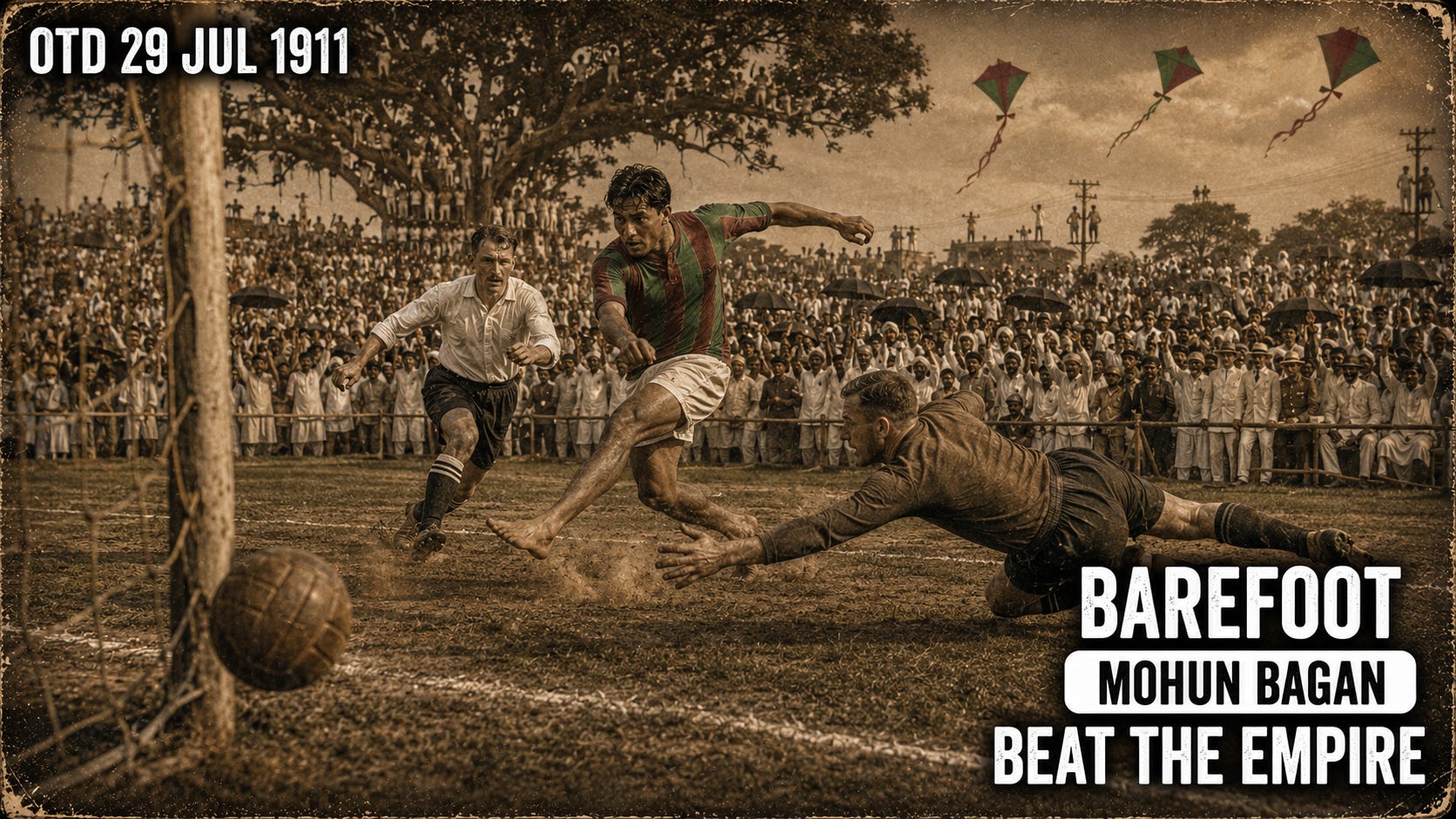
It is July 29, 1911. Calcutta. The IFA Shield final. Mohun Bagan against East Yorkshire Regiment. An all-Indian team against a British military team. Bare feet against boots. Colonial subjects against the empire’s own game.
East Yorkshire score first. Then Shibdas Bhaduri equalizes. Then, near the end, Abhilash Ghosh scores. Mohun Bagan 2, East Yorkshire Regiment 1. For the first time, an Indian team wins the IFA Shield, and football in India has its origin myth.
Football arrived in India through British soldiers, schools, and clubs, not as Indian culture but as imperial recreation. It moved through cantonments and colleges and above all Calcutta, the capital of British India until 1911 and the great early center of the game. The British brought it. Indians made it theirs, and that is the real story. One name stands at the beginning: Nagendra Prasad Sarbadhikari, the Father of Indian football, who in the late 1870s saw British soldiers playing, brought the game into the schoolyard, and did the patient work of pioneers against colonial condescension.
The tournaments came. The Durand Cup in 1888, now Asia’s oldest. The Indian Football Association, founded in Calcutta in 1893, and the IFA Shield the same year. But in colonial Calcutta, Indian did not mean Indian-run. For years Indian clubs were trying to enter a structure controlled by British authority and prestige. So football became a place of unequal contact, and it asked a sharp question. Indian players could play the British game. But could they beat British teams? Could they win British trophies? Could they make the imperial sport answer back?
Mohun Bagan, founded in 1889, green and maroon, a club from north Calcutta, were not yet the modern giant of memory. But by 1911 the timing was explosive. This was Bengal after the 1905 partition and the Swadeshi movement, a colonial city where Indians were constantly being told where they stood. So a football match was never only a football match. Not when one side wore boots and the other mostly played barefoot. Not when one side was a British regiment.
The Shield run was serious. St. Xavier’s beaten 3-0. Rangers 3-1. Rifle Brigade 1-0. Middlesex Regiment held 1-1, then beaten 3-0 in the replay. This was not one lucky afternoon; they had beaten their way through British and institutional opposition to reach the final.
On July 29 the crowd was enormous, too large for everyone to see, the city following through rumor and movement and, by legend, kites carrying the score to people outside the ground. East Yorkshire were strong, organized, physical, booted, military. Mohun Bagan were led by Shibdas Bhaduri, and most of them were barefoot. That fact can turn romantic too easily, so be precise: barefoot football was a limitation as much as a legend, speaking to access, poverty, and the state of the game’s development. But on this day the limitation became part of the story.
East Yorkshire scored first, a Sergeant Jackson free kick. The old script was ready: the brave Indian team has gone far, the regiment will still win. Then Shibdas Bhaduri equalized, and the ground changed. The empire’s game was suddenly alive in Indian hands. Late on, Shibdas created again, and Abhilash Ghosh finished. Mohun Bagan 2, East Yorkshire Regiment 1. The Shield was theirs, and Calcutta erupted.
This is why July 29 became Mohun Bagan Day. Not because a club won a cup, but because a colonized people saw one of their teams beat the rulers at the game the rulers had brought. The Empire did not fall because of a football match. But national feeling is built from moments, scenes people can repeat, and this one was perfect: barefoot footballers, a booted regiment, the Calcutta crowd, the late winner, the Shield lifted.
There is a warning inside the pride. Barefoot romance is beautiful, but romance is not infrastructure. India produced extraordinary peaks, Olympic respect in 1948, Asian Games gold in 1951 and 1962, but never turned them into lasting dominance, while cricket rose and other nations built clearer pathways. So 1911 is both glory and question: the country that produced that culture so early never became the Asian giant its passion might suggest.
🎙️ THE PODCAST GOES DEEPER. The full episode has Sarbadhikari as the Father of Indian football, the Immortal XI, and the line from 1911 to Asian Games gold. That’s the 10-minute version.
---
🎧 Listen on Spotify, Apple Podcasts, Amazon Music, Overcast, iHeart, and YouTube.
📩 Got an episode idea? otd@17lawsguy.com
Yesterday: 28 July 1962, the birth of the Bundesliga.
Tomorrow: 30 July 1930, the first World Cup final, Uruguay 4 Argentina 2, to round off our World Cup month.