

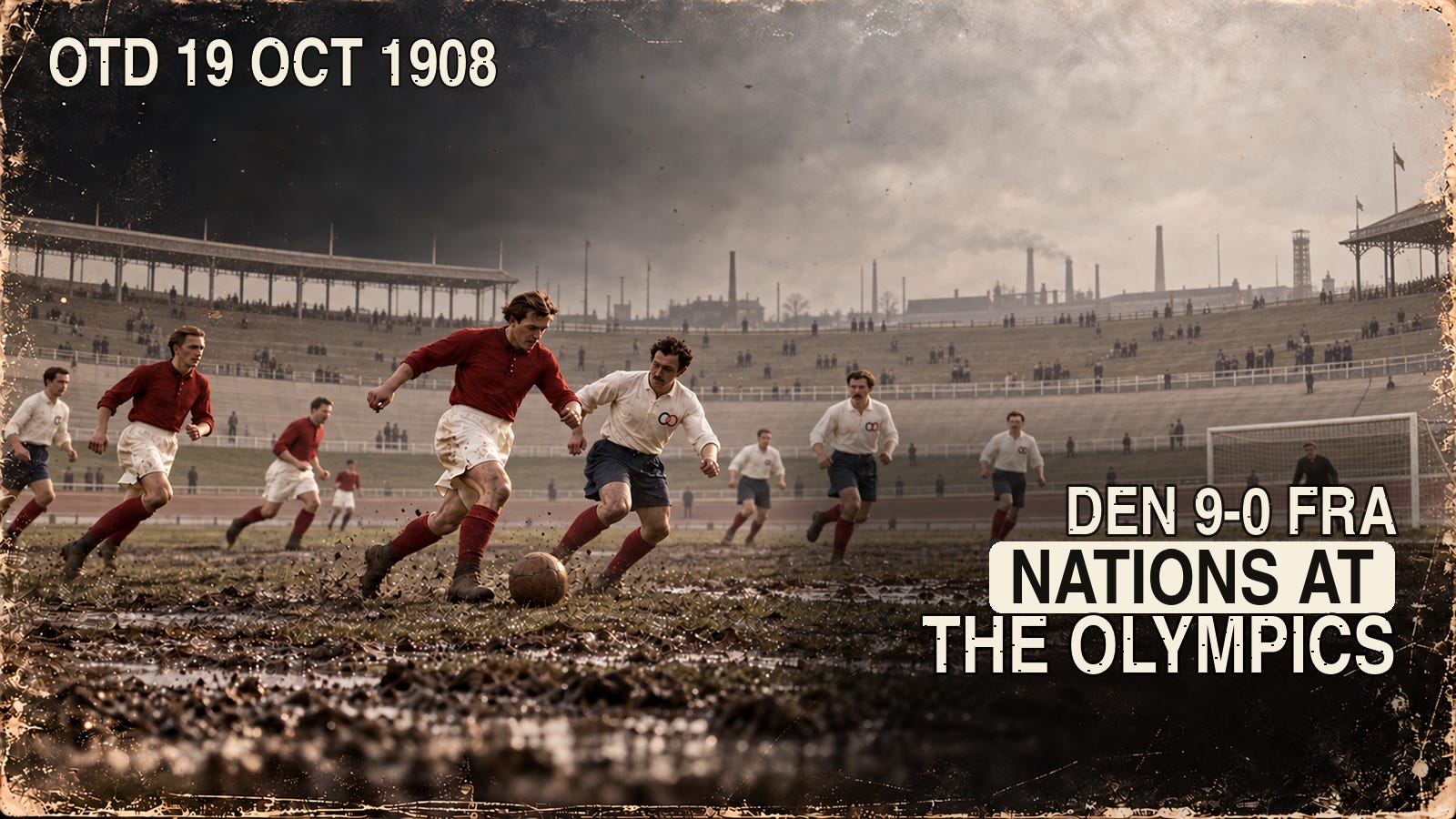
On the afternoon of October 19, 1908, 22 men walked onto the grass inside London’s White City Stadium and gave Olympic football something it had never quite possessed before: an official match between national representative teams.
That claim needs care. Football had already appeared at the Olympics, or at events later folded into Olympic history. Paris had staged matches in 1900. St. Louis had done so in 1904. Athens had hosted another tournament at the Intercalated Games of 1906. Yet those competitions had been populated by clubs, local selections and improvised representative sides. Their Olympic status was often clarified only afterward. London 1908 was different. Here was a planned knockout competition for nations, organized by England’s Football Association under Olympic auspices.
Its first match was not close.
Denmark beat France B 9-0. Four days later, the Danes would defeat France A 17-1. The numbers make 1908 look like a primitive carnival of mismatches. It was also the moment when international football found a stage large enough to expose both its promise and its disorder. Denmark arrived as one of the best amateur football cultures in Europe. France arrived with two teams and a divided game. Great Britain supplied the rules, the venue and, eventually, the champions.
Modern Olympic football still carries the consequences of what began at White City: a competition forever negotiating whether it is the summit of the sport, a development tournament, a political symbol or something caught between all three.
How did we get here?
The Olympics did not discover football in 1908. They spent eight years trying to decide what it was.
At Paris in 1900, Upton Park represented Britain, Club Francais represented the host country and a student selection from the Universite de Bruxelles represented Belgium. Nobody had entered a national side in the modern sense. The matches sat awkwardly inside the sprawling Exposition Universelle, and medals were assigned retrospectively. Upton Park’s 4-0 victory over Club Francais is now listed as part of Olympic history, even though the participants did not experience it as the opening game of a formal Olympic national-team tournament. That strange beginning is a story in its own right.
St. Louis in 1904 was smaller still. Galt FC traveled from Ontario and faced two local American teams, Christian Brothers College and St. Rose Parish. Galt won 7-0 and 4-0, results now credited as Canada’s Olympic gold. Again, however, these were clubs, not national elevens. Travel costs, amateur restrictions and the immense distances involved had reduced an international ideal to three teams at one venue.
The 1906 Intercalated Games in Athens seemed to move matters forward, but not cleanly. A Copenhagen Football Association selection represented Denmark against sides from Athens, Thessaloniki and Smyrna. The Danes beat Smyrna 5-1, then led Athens 9-0 at halftime in the final. Athens did not return for the second half. Denmark received the title, but neither the IOC nor FIFA treats 1906 as the first official Olympic tournament for national teams. It was another bridge between festival football and international competition.
London finally supplied a firmer structure. Eight entries appeared in the draw: Great Britain, Denmark, the Netherlands, Sweden, Hungary, Bohemia and two French teams. Hungary and Bohemia withdrew before playing, leaving six active sides and two quarterfinal walkovers. France B drew Denmark. France A advanced without facing Bohemia. The Netherlands advanced without facing Hungary. Great Britain opened against Sweden.
One detail matters: FIFA did not organize the tournament. The federation had been founded in Paris in 1904, with Denmark and France among its original members, but Olympic football in London was run by the Football Association. FIFA’s direct stewardship of the Olympic competition came later. The 1908 tournament was international, official and national in a way its predecessors had not been, but it was still an English administrative project.
That suited Denmark. Association football had taken root early in Copenhagen. Kjøbenhavns Boldklub had embraced the game in the 1870s, and the Danish Football Association was founded in 1889 – the first FA outside the British isles. Danish players learned within a compact club culture that prized passing, movement and disciplined amateurism. By 1906, a Copenhagen selection had overwhelmed its Olympic-adjacent opposition in Athens. By 1908, Denmark could select a national side from (Copenhagen) clubs already accustomed to organized competition for two decades.
France’s development was more fractured. British residents and French enthusiasts had established clubs in Paris and the north, and France played its first official international in 1904, drawing 3-3 with Belgium. But rival governing bodies disputed authority at home. The Union des Societes Francaises de Sports Athletiques, the Comite Francais Interfederal and other interests represented competing visions of French sport. Sending two Olympic teams advertised depth, but it also reflected an era in which selection and control were far from settled.
The practical imbalance was severe. Contemporary research indicates that the French parties crossed the Channel on the morning of their matches and returned the same day, an economy forced by limited money. Denmark had the stronger system, the more coherent team and players who already understood one another.
The Danish lineup at White City was Ludvig Drescher in goal; Charles Buchwald and Harald Hansen as the two fullbacks; Kristian Middelboe, Harald Bohr and Nils Middelboe across the halfback line; and August Lindgren, Oscar Nørland, Peter Marius Andersen, Sophus “Krølben” Nielsen and Vilhelm Wolfhagen in the five-man attack. Kristian Middelboe captained the team. The familiar 2-3-5 formation can look reckless through modern eyes, but Denmark’s halfbacks gave it structure, and its forwards moved with a fluency France could not match.
France B lined up with Andre Desrousseaux in goal; Jean Verlet and Georges Bilot behind Pierre Dastarac, Emile Gressier and Louis Vialaret; then Raoul Six, Jules Jenicot, Andre Holgard, Marius Mathaux and Louis Filez in attack. Verlet captained a team that was not merely facing better footballers. It was confronting a more mature football environment.
Denmark needed ten minutes to score its first official international goal. Nils Middelboe supplied it. Wolfhagen added two more within minutes. At 3-0, France had barely had time to understand the speed of the contest.
Then Harald Bohr scored.
Bohr was 21 years old, an Akademisk Boldklub player and already far more than a sporting curiosity. He would become an important mathematician, especially known for his work on almost periodic functions. His elder brother Niels also played football, as a goalkeeper for AB, before reshaping modern physics and winning the Nobel Prize. Decades later, Niels would attend the 1927 physics congress in Como that forms part of the story of Giuseppe Meazza’s extraordinary debut. In London, however, it was Harald who wore Denmark’s shirt.
He scored again immediately after halftime. Nils Middelboe made it 6-0, Wolfhagen completed his four-goal afternoon with two more, and Sophus Nielsen finished the scoring in the 78th minute. Denmark had scored four in the first half and five in the second. France B had not scored at all.
Crowd estimates vary, as they often do for this period. The official figure usually cited is 2,000, while later research has found contemporary estimates that were lower. Either way, the cavernous White City Stadium was nowhere near full. The first proper Olympic international did not feel like a coronation. It felt like an experiment being conducted in a building too large for its audience.
Yet the match established several facts at once. Denmark was formidable. France B was overmatched. Olympic football could now produce an official international record, not merely a retrospective medal table. And a tournament designed to gather nations could magnify the gaps between them.
So what?
If 9-0 looked shocking, Denmark’s next match made it seem restrained.
France A had received a quarterfinal walkover after Bohemia withdrew. On October 22, the supposedly stronger French selection met Denmark in the semifinal. Sophus “Krølben” scored 10 times. You read that right. Wolfhagen added four. Denmark won 17-1, still the largest victory in men’s Olympic football. France’s only goal came through Emile Sartorius, with Denmark already far ahead.
Btw, “Krølben’s” record stood until Australia demolished American Samoa 31-0 in a World Cup qualifier in 2001, and Archie Thompson scored 13 goals.
The result exposed the misleading labels attached to the French teams. France A was not remotely close to Denmark’s standard. It also showed how quickly a young international game could become lopsided when one country possessed an established club network and another assembled a traveling selection amid administrative conflict.
The other half of the bracket was less extreme, though hardly balanced. Great Britain beat Sweden 12-1 in the quarterfinal, then defeated the Netherlands 4-0. Britain’s team was selected by the Football Association and consisted entirely of English amateurs. It competed under the British name, but it was not a composite side drawn equally from the United Kingdom’s four football traditions. Scotland, Wales and Ireland had their own associations and their own complicated relationship with FIFA and Olympic representation.
The final on October 24 brought together the tournament’s two coherent powers. Great Britain beat Denmark 2-0. Frederick Chapman scored early; Vivian Woodward, Tottenham Hotspur’s celebrated amateur center forward, added the second after halftime. Denmark took silver. The Netherlands eventually received bronze after defeating Sweden 2-0 in a consolation match reshaped by the French withdrawal.
Was the tournament a success? Administratively, yes. It created a recognizable international knockout competition, recorded official national-team matches and delivered a credible final between elite amateur sides. It also demonstrated that football could fit within the Olympic program without being reduced to a club exhibition.
As spectacle, the verdict was mixed. Attendance at the opening matches was small, and even the final occupied only a fraction of White City’s capacity. Contemporary reporting treated the British victory with satisfaction, but football was not yet the Olympic Games’ unquestioned commercial engine. The scores suggested a competition without competitive depth: 12-1, 9-0 and 17-1 in a tournament that produced only six played matches, including the bronze playoff.
Still, the imbalance was evidence of expansion, not simply failure. Countries were learning to turn scattered clubs into national systems. Denmark had moved early and looked advanced. France’s humiliation did not prevent French football from becoming a central force in the international game’s politics. Jules Rimet, then building influence through the Comite Francais Interfederal, would eventually lead FIFA and attach his name to the World Cup trophy. Weakness on the field and ambition off it could exist at the same time.
Denmark’s silver was no accident. The Danes returned at Stockholm in 1912 and again reached the final. Along the way they beat Norway 7-0 and the Netherlands 4-1, but Great Britain defeated them 4-2 for another gold medal. The tournament had grown to 11 teams and attracted far more attention. It also produced another extraordinary score: Germany beat Russia 16-0, with Gottfried Fuchs scoring ten.
Olympic football was becoming larger, but not necessarily more equal.
The next scheduled Games were Berlin 1916. World War I erased them. When the Olympics resumed at Antwerp in 1920, football returned with an even more dramatic argument over authority and justice. Belgium led Czechoslovakia 2-0 in the final when the Czechoslovak team walked off in protest at the refereeing. Officials disqualified them and awarded Belgium the gold medal. A separate sequence of placement matches eventually left Spain with silver and the Netherlands with bronze. The first postwar Olympic tournament ended not in reconciliation, but in accusation.
Then football began to outgrow the institution that had given it a global platform.
Uruguay’s brilliance in 1924 and 1928 transformed Olympic football into something close to a world championship. European audiences saw a South American team win with technique, speed and tactical imagination. Yet the old amateur rule was becoming impossible to reconcile with a sport whose best players required time, travel and compensation. FIFA wanted control over eligibility and competition. The IOC guarded its definition of amateurism.
In May 1928, FIFA voted to create an independent world championship. Uruguay hosted and won the first World Cup in 1930. Football disappeared from the 1932 Los Angeles Olympics, then returned in Berlin in 1936, but the hierarchy had changed permanently. The day FIFA chose its own tournament was the day Olympic football ceased to be the game’s uncontested summit.
What followed was a long search for purpose. During the Cold War, officially amateur players from Eastern European state systems often faced Western teams unable to select their leading professionals. Olympic results reflected political definitions as much as sporting strength. Eligibility rules shifted again in 1984. From 1992, the men’s event became an under-23 competition, and since 1996 teams have generally been allowed three overage players. The women’s tournament, introduced in 1996, developed on a different basis as a full senior international competition.
The modern Olympics therefore contains two football ideas at once. The women’s event can bring the strongest national teams and stars. The men’s event offers young players a global tournament, with senior reinforcements, but sits below the World Cup and continental championships. Clubs are not always obliged to release eligible men, another reminder that the Olympic movement no longer controls football’s calendar.
At Paris 2024, Spain won the men’s gold medal and the United States won the women’s tournament. The settings, broadcasts and athletes belonged to a different universe from White City in 1908. Yet the old questions remained recognizable. Who represents a nation? Which players can be selected? How does an Olympic title fit within football’s larger order? Can a tournament preserve a distinct identity when the sport around it has become richer and more powerful than the Games themselves?
Denmark 9-0 France B did not answer those questions. It introduced them.
The result was a mismatch, but the occasion was a threshold. Before October 19, Olympic football was a collection of events later organized into a history. After it, there was a national-team tournament with a bracket, an official record and an international future. The crowd was small. The score was huge. The structure was imperfect.
But nations had reached the Olympics, and football would never again fit comfortably inside them.
Three things to take away
1. London 1908 was the first proper Olympic football tournament for national representative teams. Paris 1900, St. Louis 1904 and Athens 1906 belong to the prehistory, but their entrants were clubs, local selections or unofficial combinations.
2. The Football Association, not FIFA, organized the tournament. FIFA already existed, and Denmark and France were founding members, but direct FIFA control of Olympic football came later.
3. The 9-0 score was only the beginning. Denmark beat France A 17-1, lost the final 2-0 to Great Britain and helped establish a competition that would eventually propel football toward an independent World Cup.
Ideas, corrections, or your own football-history leads: otd@17lawsguy.com