

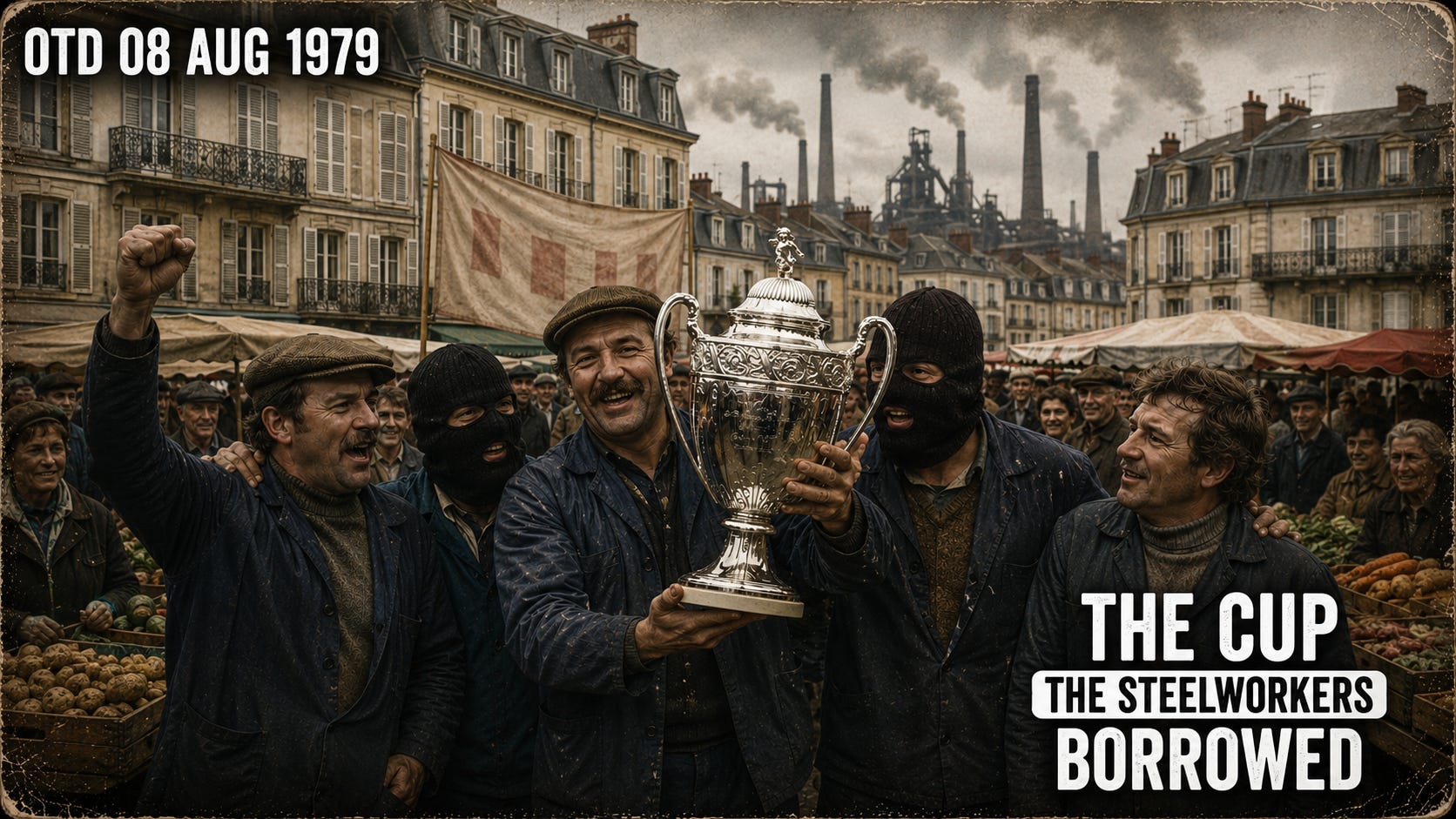
It is August 8, 1979. Nantes. La Jonelière, the training center of FC Nantes. Inside sits the Coupe de France trophy. Nantes have just won it for the first time. Except, overnight, it disappears. Stolen? Borrowed? A few days later it turns up in Lorraine, hundreds of kilometers away, in the hands of steelworkers. Not rival fans. Not thieves. Trade unionists. And they have a message.
Start with the Coupe de France. Created in 1917 and named for a founder who died in the war, it carries something deeply democratic: clubs big and small, professional and amateur, Paris and province, a cup that belongs to French football as a whole. Over time the final became part of the Republic’s ritual, the President handing over the trophy. By 1979 it was one of the great institutions of French sport.
Now Nantes. Founded in 1943, they became one of France’s most important clubs under José Arribas, the roots of le jeu à la nantaise, winning the league four times between 1965 and 1977. But the Coupe de France kept escaping them: finalists in 1966, 1970, and 1973, and three times no cup. Then 1979. The final, on June 16 at the Parc des Princes, was against a Division 2 Auxerre coached by a young Guy Roux, and it went to extra time, where Éric Pécout completed a hat-trick: Nantes 4, Auxerre 1. After all those failed finals, the Canaris finally had the cup, handed over by President Valéry Giscard d’Estaing.
Or so they thought. Because less than two months later, the trophy was gone. On August 8, at the training center, a window had reportedly been left open, and the cup disappeared from its showcase. At first people thought it was a joke, a prank; the club’s sporting director later said they expected someone to return it quickly. Then the truth emerged. The thieves were CFDT militants from northern Lorraine, steelworkers from around Longwy, and they had not taken the cup because they cared about Nantes. They had taken it because they cared about blast furnaces. Jobs. Factories. A whole way of life disappearing.
The late 1970s were brutal for the steel regions of Europe. Longwy carried industrial weight, and its factories were threatened, its professions vanishing. So the steelworkers decided they needed attention, and they understood something modern: if normal protest is ignored, take the object everybody photographs. They called it borrowing, not theft. One activist, Robert Giovanardi, later said they wanted something spectacular enough to influence public opinion, adding that you did not have to be Arsène Lupin to pull it off. This was not Ocean’s Eleven. It was a football trophy, a training-center window, and desperate people with a media strategy.
The cup went to Longwy, was displayed, and the activists posed with it, sometimes in balaclavas, holding the Coupe de France like a political hostage to say, look at us, we are still here. And then, just as quickly, the story turned gentle. On August 12 the trophy was returned, with Longwy enamel plates offered as an apology gift. Giovanardi later insisted they took good care of the cup and did not even drink from it. That may be the best detail of the whole episode. Even the revolutionary trophy borrowers had standards.
We should let this story be funny, because it is. But it lasts because it is also sad. The action got attention and made people talk, but it did not save the industrial world those workers were fighting for. The plant closures continued. Longwy’s pain did not disappear because a trophy had briefly become a protest banner. And of all trophies to borrow, this one makes symbolic sense, because the Coupe de France is the people’s cup, the open cup of villages and factory clubs and giant-killings. So when steelworkers took it, they dragged the most democratic football object in France into the most democratic argument in France: work, dignity, and who gets remembered when an economy changes. Football objects carry power not because of metal, but because people agree to care. Instead of another leaflet, they borrowed the Coupe de France, and for a few days France had to look.
🎙️ THE PODCAST GOES DEEPER. The full episode has Nantes ending their final curse, the Longwy steel crisis behind the theft, and the apology plates. That’s the 10-minute version.
---
🎧 Listen on Spotify, Apple Podcasts, Amazon Music, Overcast, iHeart, and YouTube.
📩 Got an episode idea? otd@17lawsguy.com
Yesterday: 7 August 1953, the day Barcelona had Di Stéfano.
Tomorrow: 9 August 1942, the Death Match in Nazi-occupied Kyiv, a story that has to be told.